Meta Muse Comes to Mac: AI Starts Taking Over Your Computer

Meta's Muse upgrades from chat tool to agentic AI on Mac, accessing files and executing tasks directly.
Meta has expanded its AI assistant Muse to macOS, giving it the ability to access local files, launch applications, and execute tasks on behalf of users — marking a formal transition from a conversational assistant to an Agentic AI. This upgrade bridges the gap between understanding intent and taking action, reducing the friction of switching between AI suggestions and manual work. However, opening up local permissions also raises new privacy and security challenges around data handling, cloud uploads, and permission transparency — dimensions users should carefully evaluate. Meta's move aligns with the broader race among OpenAI, Anthropic, and Google toward desktop AI agents, reflecting the industry's shared bet on the next phase of human-computer interaction.
Meta Brings AI Assistant Muse to Mac
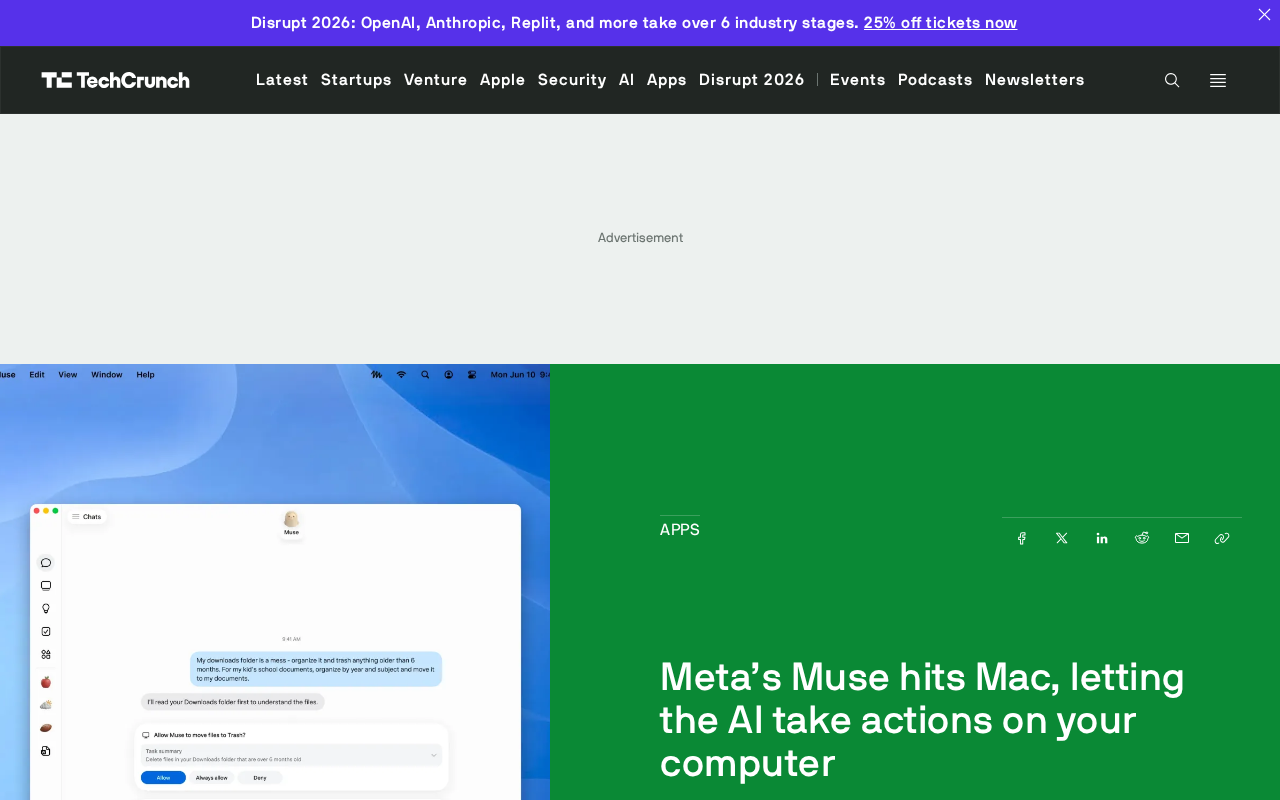
Meta's AI assistant Muse has received a significant update — it's now officially available on macOS. Unlike previous AI assistants that stayed purely at the conversational level, Muse on Mac has been given the ability to directly operate your computer: it can access your files, launch applications, and execute tasks on your behalf.
This means Muse is no longer just a chat tool for answering questions and generating text. It's moving in the direction of an "Agentic AI" — one that can read and organize documents, or coordinate workflows across multiple applications. AI has shifted from saying to doing.
From Conversational Assistant to an AI That Can Actually Act
Over the past year or two, the industry conversation around AI agents has intensified. The core distinction of an agent is whether it can take actions in a real environment, rather than simply outputting suggestions. Muse's arrival on Mac is a concrete expression of this trend.
The benefits of giving AI direct access to local files and applications are clear: it bridges the gap between "understanding intent" and "executing actions," reducing the friction of constantly switching between AI suggestions and manual work. For example, instead of asking an AI how to organize a batch of files and then doing it yourself, you could theoretically just let Muse handle it directly.
This kind of capability is also what the major tech companies are racing toward. Deeply embedding AI at the operating system level — and granting it access to local resources — is widely seen as the defining form of the next phase of human-computer interaction.
The concept of an AI Agent originates from multi-agent systems research, and its core characteristic is a closed-loop "perception–decision–action" capability. Unlike traditional language models that only generate text output, agent-based systems can invoke external tools (such as file systems, browsers, and API interfaces), translate generated instructions into real-world operational steps, and adjust subsequent behavior based on execution results. Current mainstream agent implementations typically rely on Function Calling or Tool Use mechanisms, enabling large language models to trigger predefined operation interfaces in a structured format. OpenAI's Operator, Anthropic's Computer Use, and Google's Project Mariner are all representative explorations along this same path. Muse's landing on Mac is essentially connecting this mechanism to macOS's local permissions system, extending AI's "action radius" into a user's personal computing environment.
Privacy and Security Considerations Behind the Convenience
When AI gains permission to access files and execute operations, privacy and security concerns naturally come to the fore. An AI assistant that can read your local files and invoke your various applications is touching a considerably sensitive range of personal data.
For users, the questions worth paying attention to include: how data is handled when Muse performs operations, what information gets uploaded to the cloud, whether the granting and revoking of permissions is clear and controllable, and whether there are explicit confirmation and boundary mechanisms when the AI acts on your behalf. These are the core questions that agentic AI must answer as it moves toward mainstream adoption.
For any AI tool with local operation capabilities, users are advised to carefully review its permission scope and data policies before enabling it — especially when handling work documents or sensitive personal information.
From a technical perspective, the permission model for agentic AI faces challenges far more complex than those of traditional applications. Traditional app permissions are statically declared (e.g., "requires camera access"), whereas an AI agent's operational intent is dynamically generated — making it difficult for the system to predict at the authorization stage which specific files it will read or how it will invoke applications. This "opacity of intent" creates structural difficulties in enforcing the principle of least privilege. Mitigation approaches currently proposed by the industry include: sandbox isolation (restricting AI to only access designated directories), operation preview and user confirmation steps, local inference priority (reducing data uploads), and complete retention of operation logs. When evaluating such tools, users should focus on whether the service provider offers clear data retention explanations, whether model inference is completed locally, and whether fine-grained permission revocation is supported.
What This Means for the Mac Ecosystem and the AI Competition
Meta's choice to launch this capability on the Mac platform also reflects the accelerating push by major players into desktop AI. Desktop operating systems host a vast range of productivity scenarios, and whoever can first deliver a capable, trustworthy agentic AI assistant stands a strong chance of gaining an early foothold in the next wave of human-computer interaction.
That said, there's still a significant gap between "capable of operating" and "operating well enough to be trusted." The accuracy with which an AI agent executes tasks, its ability to understand complex instructions, and the traceability of its actions when something goes wrong will all directly affect the real-world user experience. How Muse actually performs on Mac remains to be seen through broader testing in real-world scenarios.
Overall, Muse's arrival on Mac is a signal of AI's evolution from "assistant" to "agent." It extends AI's reach beyond the chat window on your screen into your actual files and applications — representing both an exciting vision for productivity and a new test of privacy, security, and trust.
Related articles

Chain of Thought Isn't Just for AI: How Humans Can Use CoT to Improve Thinking Quality
Chain of Thought isn't just a prompt trick for large models. Starting from a Hacker News discussion, this article analyzes why CoT works for human thinking too, breaks down actionable ways to transfer it, and highlights the key differences between human CoT and machine CoT.
Cloudflare Teams Up with OpenAI: Closi…
Cloudflare Teams Up with OpenAI: Closing the Loop from Vulnerability Discovery to Defense with AI
Cloudflare uses OpenAI Daybreak to investigate security vulnerabilities and generate reviewable remediation plans, while developers use Codex to boost coding efficiency and quality.

Orca Multi-Agent Orchestration in Practice: A Guide to Parallel Collaboration with Claude and Codex
Orca is Stable AI's free open-source agent workbench supporting 34 agents like Claude Code and Codex in parallel. Learn its Git worktree isolation, multi-model orchestration, and mobile management.