Meta Muse Comes to Walmart: AI Agents Help You Snag Black Friday Deals

Walmart partners with Meta Muse as AI agents complete the shopping loop in a real retail setting for the first time.
Walmart announced that Meta's AI agent Muse can now find and purchase Black Friday discounted items on Walmart's website on behalf of users, marking a shift from product recommendations to completing the transaction loop. The feature is built on the Agent Gateway Walmart announced last month, which helps agents retrieve products without sharing user purchase history. Black Friday serves as an extreme test of agent reliability. The article notes that the agent's payment permissions, failure handling, and decision traceability mechanisms remain undisclosed—these trust and responsibility rules are key to mainstream adoption of agent shopping. The collaboration pushes AI agent competition from conversational capability toward transaction completion, and intermediate layers like Agent Gateway may become a reference architecture for retailers integrating third-party agents.
From Browsing to Checkout: AI Agents Start Taking Over the Shopping Cart
Walmart announced that Meta's AI agent Muse can now shop directly on Walmart's website on behalf of users—finding and purchasing Black Friday discounted items. This means AI assistants are no longer just recommending products; they are actually completing the "find it and order it" loop. According to the original source material, Walmart is rolling out a real-time implementation of the Agent Gateway it announced last month, which helps AI agents find relevant products for users without sharing their purchase history.
The significance of this news lies in pushing "AI agent shopping" from demos into a real retail scenario—and Black Friday, a promotional event with high traffic and high decision pressure, happens to be an extreme test of agent reliability.
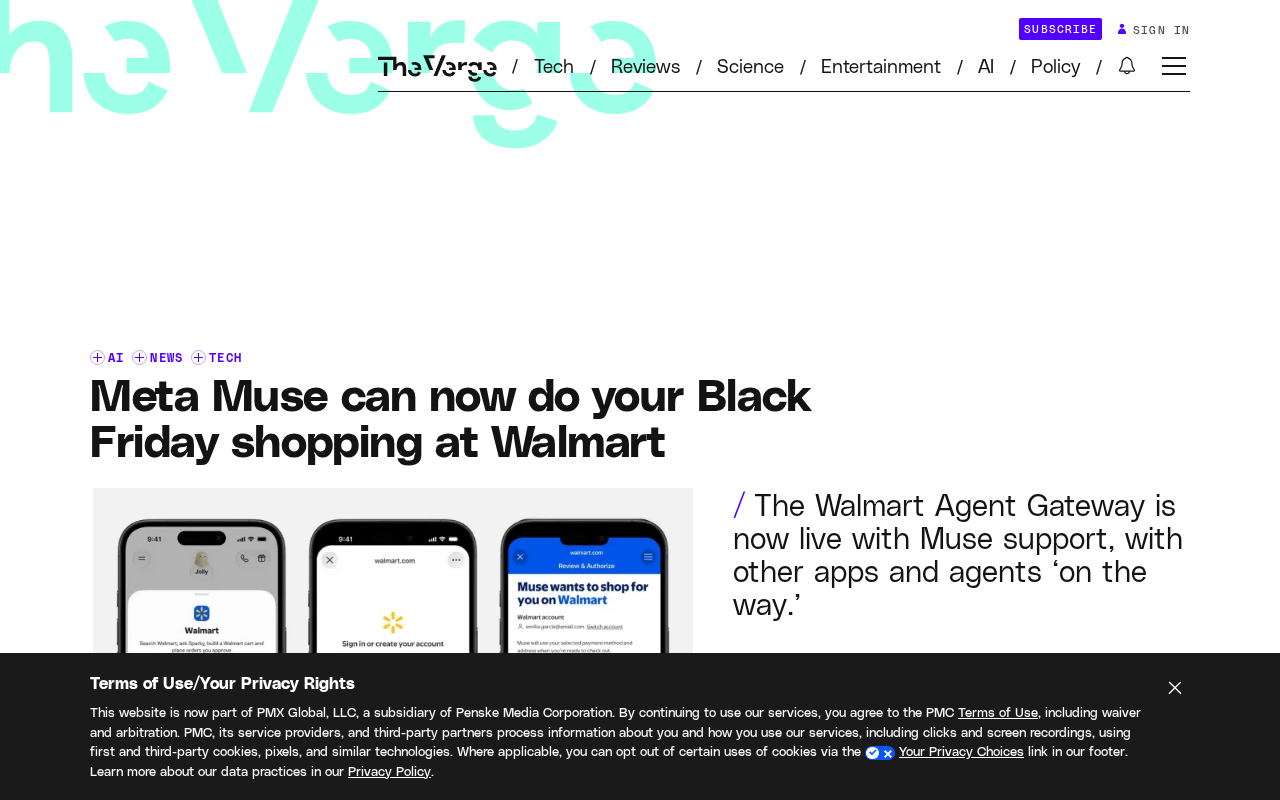
What Is Agent Gateway: A Trade-off Between Privacy and Agent Efficiency
Agent Gateway is the underlying infrastructure Walmart unveiled last month, with two core goals: first, enabling AI agents to retrieve relevant products; second, avoiding handing users' purchase history directly to the agent provider. The original material doesn't elaborate on technical details, but based on its positioning, it looks more like an intermediate layer Walmart has built between "open agent access" and "protecting user data."
For retailers, directly opening product and user data to external AI agents carries risks; for agents like Meta Muse, insufficient context makes it hard to make accurate choices. Agent Gateway attempts to satisfy both sides: agents can complete tasks while the platform still controls data boundaries. If this model works, it could become a reference architecture for other retailers integrating third-party AI agents.
AI Agent: The key difference between an AI agent and an ordinary chatbot is its "ability to act." Traditional AI assistants can only generate text or suggestions, whereas AI agents can call external tools, access website interfaces, and execute multi-step operations (such as searching, filtering, adding to cart, and submitting orders) to accomplish a goal. In e-commerce scenarios, this means the agent needs to understand user intent, interact with product catalogs, handle inventory and price changes, and complete transactions when necessary. Agent reliability depends on its planning capabilities, tool-calling accuracy, and ability to handle exceptional states. Walmart's Agent Gateway is precisely the infrastructure that provides a standardized access point for such agents, enabling third-party agents to safely execute shopping tasks under restricted permissions.
API Gateway: An API gateway is an intermediate layer between clients and backend services, responsible for request routing, authentication, rate limiting, monitoring, and protocol conversion. Walmart's Agent Gateway can be understood as an API gateway designed specifically for AI agents: it exposes limited product retrieval and purchase interfaces to agents while hiding sensitive data such as user purchase history, and may also control agent request frequency and permission scope. This design allows retailers to let external agents complete the shopping loop without fully opening their databases—a common architectural pattern for balancing openness and security.
Why Black Friday: A Test of Agentification in Promotional Scenarios
Black Friday shopping is characterized by a large number of products, rapidly changing discounts, and short user decision times. Having AI agents intervene at this point is equivalent to handing repetitive tasks like "price comparison, discount filtering, and ordering" to machines. Walmart's choice to launch the real-time implementation now has a clear intent: validating Agent Gateway's stability with real promotional traffic.
From a user experience perspective, agent-assisted shopping saves the time cost of repeated filtering and rush buying; from the platform's perspective, transactions brought by agents are still transactions, and may even improve conversion efficiency. However, the material doesn't disclose how Muse handles inventory changes, discount expiration, or payment confirmation—exactly the areas where agent shopping is most prone to problems.
The Boundaries of Agentic Commerce and Unresolved Questions
What can be confirmed so far: Muse can find and purchase Black Friday items on Walmart's website on behalf of users, through Agent Gateway, without sharing purchase history. As for the agent's permission scope (whether it can autonomously complete payment), failure handling mechanisms, and how users can trace the agent's decisions—the original material doesn't explain any of these.
These are not minor details but the key to whether agent shopping can be trusted by ordinary users. An AI that can "buy for you" must be understandable and traceable when things go wrong. Walmart and Meta's implementation is more like a starting point: the infrastructure for agentic commerce is in place, but the rules around permissions, responsibility, and transparency are still being formed.
Agentic Payment: Agentic payment refers to the ability of AI agents to autonomously initiate and complete payment processes after obtaining user authorization. This involves mechanisms such as tokenized payment credentials, user authorization scope (e.g., per-transaction limits, merchant whitelists), transaction confirmation, and dispute handling. The industry has yet to establish unified standards, with main challenges being: how to ensure agents don't overspend beyond authorization, how to roll back transactions when payment fails or items are out of stock, and how to let users trace the agent's decision chain. Walmart and Meta's collaboration doesn't disclose whether Muse has autonomous payment permissions—which is precisely the core threshold for agent shopping to move from "assisted ordering" to "fully automated purchasing."
Significance for the Industry
Meta Muse's integration with Walmart pulls AI agent competition from "conversational capability" to "transactional capability." When agents can directly complete purchases, the value metric for AI assistants will shift from answer quality to task completion rate and transaction security. For retailers, integrating external agents means traffic entry points may be restructured; for agent developers, e-commerce platform gateway rules will determine their capability ceilings.
Black Friday is just a testing ground. What's truly worth watching is whether intermediate layers like Agent Gateway can be replicated across more retail scenarios, and whether users are willing to hand the "place order" step to AI.
Related articles

Prompt Engineering for Beginners: From Writing Prompts to Engineering Thinking
Starting from the essence and four functions of prompts, this article systematically explains the six-step process, four success criteria, learning value, and practical limitations of prompt engineering to help you build a complete understanding.

Anthropic Launches Nasdaq IPO: AI Giant's Listing and Risk Disclosures
Anthropic officially launches its Nasdaq IPO under ticker ANT, with market valuation expected to potentially exceed SpaceX's record. The prospectus devotes nearly 100 pages to AI risks, while first-half revenue grew over 14x but net losses widened sharply, reigniting the AI bubble debate.

Rust cURL Clone Uses 4,832 unsafe Blocks—Is the Memory Safety Myth Broken?
A Rust cURL clone uses 4,832 unsafe keywords, challenging Rust's memory safety narrative. We analyze what unsafe really means, compare Fil-C, and examine rewrite motives.