Meta Muse Glimmer 30B In-Depth Review: Impressive Visual Understanding, Low Local Deployment Barrier

Meta's Muse Glimmer 30B impresses with visual understanding while remaining accessible for local deployment on consumer GPUs.
Meta's Muse Glimmer 30B is a 29.6B parameter dense model under Apache 2.0 license with 128K context. It runs on 24GB VRAM when quantized to INT4. While benchmark scores place it between Gemma 4 31B and Qwen 3.6 27B, its multimodal visual understanding is exceptional—accurately identifying animals, trees, and environmental context from photos. Weaknesses include complex technical hardware identification, SVG generation, and overly conservative refusal behavior.
Meta Returns to the Local AI Arena: Muse Glimmer 30B Arrives
After the Llama series gradually faded from the mainstream spotlight, Meta returns to the open-source track with an entirely new local large language model—Muse Glimmer 30B. This model uses the permissive Apache 2.0 license, features 29.6 billion parameters, and is a dense model that performs better on high-bandwidth systems and dedicated GPUs.
Unlike the currently popular Mixture of Experts (MoE) models, dense models activate all parameters during each inference pass, while MoE architectures only activate a subset of expert networks—for example, Mixtral 8x7B has a total of 47 billion parameters but only activates about 13 billion per inference. The advantage of dense models lies in more predictable inference behavior, more stable latency, and full utilization of computational resources on high-bandwidth memory systems; the downside is that VRAM requirements scale proportionally with parameter count. Meta's choice of the Apache 2.0 license is also noteworthy: it permits commercial use without requiring derivative works to be open-sourced, making it significantly more permissive than the custom license Meta previously used for the Llama series (which imposed restrictions on companies with over 700 million monthly active users), marking a substantive shift in their open-source strategy.
For developers focused on local deployment, the most interesting aspect is its accessibility: the model features a 128K context length, requires approximately 64GB of VRAM for full-precision inference, but official quantized versions are also available. A 128K context means the model can process roughly 100,000 English words—equivalent to a medium-length novel—in a single pass. This relies on advances in positional encoding techniques (such as RoPE and its extensions), enabling the model to handle complete codebase analysis and long-document summarization tasks.
Quantization is a technique that compresses model weights from high-precision floating-point numbers (such as 16-bit FP16) to lower-precision representations (such as INT8 or INT4). At full precision, 29.6 billion parameters require approximately 59GB of VRAM (2 bytes per parameter), plus inference overhead brings it to about 64GB. According to the reviewer's testing, the INT8 quantized version requires roughly 32GB of VRAM, while the more aggressive INT4 quantized version can fit into a GPU with 24GB of VRAM, reportedly with only about 1% accuracy loss—consistent with typical results from academic research on 4-bit quantization methods (such as GPTQ and AWQ). This means a single RTX 3090 or 4090 can run it.
In terms of performance, the model reportedly achieves 74.9 tokens per second on an RTX 5090; the reviewer observed approximately 60-65 tokens/sec running the full-precision version on their 3090, dropping to about 40 tokens/sec as context grows—because the computational complexity of the attention mechanism scales quadratically with sequence length. Additionally, the model supports a D-Flash version, which reportedly provides approximately 3x acceleration. D-Flash is presumably a variant implementation of Flash Attention that reduces the actual computational cost of attention through block computation and memory access pattern optimization, though it currently doesn't work properly in Docker containers.
Benchmark Performance: Solid but Not Top-Tier
Based on publicly available benchmark data, Muse Glimmer 30B's performance is quite solid, though not top-tier. The reviewer noted that its overall scores fall roughly between Gemma 4 31B thinking version and Qwen 3.6 27B.
Specifically:
- Coding ability: SWE benchmark score of 51.2, which is "decent." SWE-bench is a software engineering benchmark created by a Princeton University team that requires models to generate code patches that pass unit tests on real GitHub issues. A score of 51.2 means the model can solve about half of real software engineering problems—a level that was unimaginable just a year ago, when the best models in early 2024 scored below 20%.
- Agentic capabilities: Supports reliable tool calling, multi-turn reasoning, and failure recovery. Agent capability refers to a model's ability to autonomously call tools, process intermediate results, and recover from errors in multi-step tasks—a key technical direction as current AI applications evolve from "Q&A assistants" to "autonomous executors," and a major area of investment for companies like OpenAI and Anthropic.
- General capability and reasoning: Scored 94.7 on M2026, slightly higher than Qwen 3.6 27B's 94.1
- Multilingual: Supports up to 100 languages, with variable "effort level" control
A notable weakness appears in Verified-class benchmarks. On Terminal Bench, Qwen 3.6 27B scores about 60.7, while Muse Glimmer only manages 51.7—a clear gap. The reviewer also notes that with Qwen 3.8 27B about to be released, scores for this generation of comparison models will see significant improvements.
The Real Standout: Multimodal Visual Understanding
If Muse Glimmer is merely "middle of the road" on benchmarks, its performance in multimodal visual understanding is truly impressive. This was the most eye-catching part of the entire review. It should be noted that the model only processes text and images—it does not support video input.
Modern multimodal large models typically employ a three-stage architecture of "vision encoder + projection layer + language model." The vision encoder (such as ViT or SigLIP) splits images into fixed-size patches and encodes them into vector representations, the projection layer maps visual tokens into the language model's embedding space, and the language model ultimately processes both text and visual information in a unified manner. The model's ability to infer shooting time and geographic location from photos demonstrates that its vision encoder preserves rich detail information, while the language model possesses strong reasoning capabilities to associate visual cues with world knowledge.
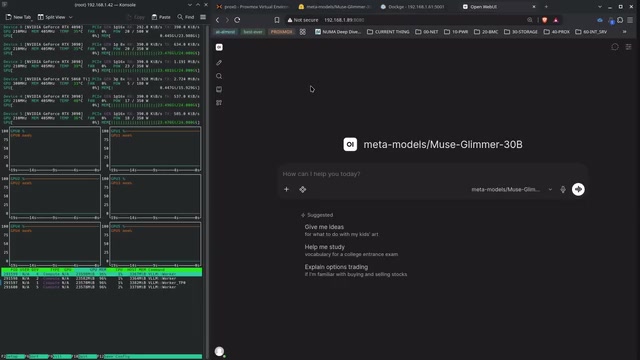
Outdoor Scenes and Animal Recognition
The reviewer first showed the model a photo of a camel in the Texas Hill Country. The model not only accurately identified it as a light brown dromedary (single-humped camel) standing behind a wire fence, but also described the green pasture, low shrubs, and evening pink-cloud lighting atmosphere, even inferring from the photo timestamp that it was taken around 8 PM in May 2022.
Even more impressive was tree species identification. In a barbecue scene photo, the model inferred from just the blurry background that it was likely a "live oak or Texas red oak," providing reasoning: light-colored bark, rounded trunk, low spreading canopy, and "typical Central Texas Hill Country landscape." The reviewer emphasized that he provided no geographic information in the prompt—the model inferred everything purely from the image. This kind of environmental context association capability is quite rare.
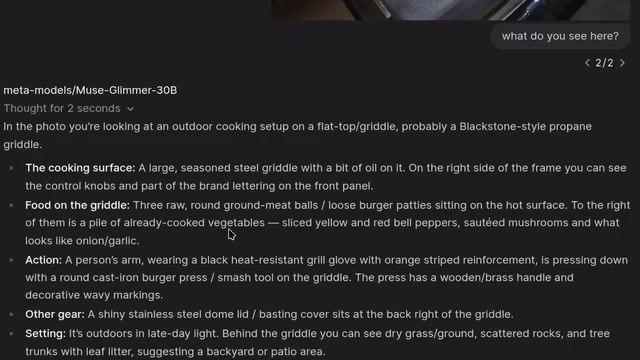
Detail Recognition and Object Counting
In the griddle photo, the model not only recognized the Blackstone griddle and round cast-iron burger press, but also accurately determined there were "three raw hamburger patties" on the griddle, explicitly stating "any more would be outside the frame"—without rashly guessing about quantities beyond the visible area, sticking only to observed facts. This restrained, hallucination-free response style is exactly the quality a visual reasoning model should exhibit.
For a photo of the reviewer's black cat peeking out from a network patch panel, the model's description hit nearly every detail from the reviewer's original description: RJ45 port numbers, blue Ethernet patch cables, "HD series" markings, orange-red cables, and even the cat's expression of "enjoying chewing on cables," the stone-painted fireplace behind it, and the beige sofa. The reviewer frankly stated he was "extremely impressed with its visual acuity."
Limitations: Complex Technical Scenes Still Cause Failures
Despite strong visual understanding, it's not perfect. When the reviewer presented a photo of a densely packed home data center filled with tech equipment, the model began to reveal weaknesses.
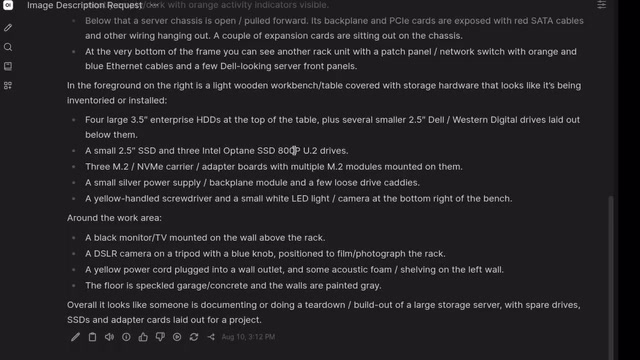
The model misidentified SAS cables as SATA cables and failed to understand the hardware fact that SATA cables serve no purpose in a Dell PowerEdge T620. This involves specialized knowledge of enterprise storage interfaces: SAS (Serial Attached SCSI) and SATA (Serial ATA), while physically similar in connector appearance, differ significantly—SAS is a high-performance interface for enterprise applications supporting dual-port redundancy and higher data throughput; the Dell PowerEdge T620, as an enterprise server, primarily uses SAS backplanes, making SATA irrelevant in this context.
A more obvious error appeared in storage device identification: it misidentified an Intel Optane 900P SSD as an 800P, and misjudged a PCIe AIC (Add-in Card) form factor Optane as U.2 form factor. Intel Optane is a product line based on 3D XPoint non-volatile memory technology, and while the 900P and 800P belong to the same product family, they differ significantly in performance and capacity. The PCIe AIC form factor is a full-height or half-height expansion card inserted directly into a motherboard PCIe slot, while U.2 form factor devices are installed via 2.5-inch drive bays with dedicated SFF-8639 connectors—completely different in physical size and installation method, though in crowded server chassis photos, cable obstruction and shooting angles do increase identification difficulty. It also miscounted hard drives, missing a Seagate drive.
The reviewer's overall assessment: most image recognition earns an "A-minus," while this high-density technical photo rates about a "B-minus." This indicates the model excels at general visual understanding but still struggles in scenarios requiring specialized domain knowledge (such as enterprise hardware form factors and cable specifications).
Refusal Tendencies and SVG Generation Testing
As a Meta-produced model, the reviewer was wary of its "refusal tendencies." Test results confirmed these concerns: in the classic "end of the world" role-playing task, the model refused to execute, reasoning that it cannot coerce, harm, or sacrifice crew members, even if the crew members are LLM-based robots.

The reviewer considered this refusal "a failure," not because it refused per se, but because it didn't provide brilliant and logical reasoning for its refusal like DeepSeek does—instead simply deflecting with "I'm an AI assistant, I cannot execute this."
On logic reasoning quizzes, the model performed well: it correctly completed character-level tasks like "is the third letter of the second word in the sentence a vowel or consonant," and answered array character position calculations correctly. However, on the task of generating an SVG of "a cat walking on a fence," the model completely failed—producing a bizarrely angled cat that looked "scrambled by a teleporter," with crude fence and sun. The reviewer gave its SVG capability the lowest score. SVG generation places extremely high demands on a model's spatial reasoning ability, as it requires translating natural language descriptions into precise geometric coordinates and path instructions—a fundamental cognitive gap from the sequential nature of text generation.
Conclusion: The Open-Source Signal Matters More Than the Model Itself
Overall, Muse Glimmer 30B is a local model that's "solid overall, stunning in spots." Its full-precision operation is stable, its visual understanding capabilities approach the latest Gemma 4 series, it's suitable for scenarios with heavy image processing needs, and it can run via llama.cpp with mmproj. llama.cpp is an open-source inference framework developed by Georgi Gerganov, implemented in pure C/C++, and is a cornerstone project of the local AI deployment ecosystem; its mmproj (multimodal projector) component is responsible for projecting vision encoder outputs into the language model's embedding space, allowing visual understanding capabilities to be flexibly loaded as a plugin module. However, in terms of pure benchmark scores, SVG generation, and refusal reasonableness, the model still has clear shortcomings.
The reviewer's final reflection is perhaps more thought-provoking than the model itself: Meta's return to the open-source camp is a positive signal that "American open-source AI hasn't given up." The regulatory threats he mentioned primarily refer to domestic U.S. legislative movements around AI safety, including proposals like California's SB-1047 (which was ultimately vetoed) that attempted to impose pre-deployment safety evaluation requirements on open-source models, as well as White House executive order requirements regarding compute threshold reporting. Critics argue these regulations could stifle American open-source AI development, while Chinese companies like Alibaba (Qwen series) and DeepSeek continue to release powerful models with open weights in a "doubling down" posture—even Qwen 3.8, which wasn't originally planned, was confirmed for open-source release as a result. In this game between open-source and closed-source, Muse Glimmer's appearance is a footnote showing that a tech giant is willing to "give back rather than only take."
Related articles

Getting Started in Machine Learning Research: Essential Paper Reading List and Research Internship Application Path
A complete path from zero to research internship for ML beginners, covering essential classic papers (AlexNet, ResNet, Transformer), paper reading methods, reproduction tips, and practical advice for research internship applications.

Claude Code Hands-On Tutorial: Complete Guide from Installation to Automated Development
Complete guide to Claude Code covering environment setup, permission configuration, Go Goals autonomous loops, Skills system, MCP protocol integration, and version control for automated development.

Gemini 3.7 Flash Release and GPT-5.6 Ultra-Fast Mode: AI Open Source Enters the Ecosystem Era
Google releases Gemini 3.7 Flash for coding and Agent optimization while OpenAI launches GPT-5.6 Ultra-Fast mode with 14x speed gains. AI open source shifts from open models to open ecosystems.