Meta Muse Leaks Others' Bank Balances, Claude Cracks Black Hole Physics Problems

Meta agent leaks balances, Claude solves black hole problems, Microsoft cuts prices, Apple prepares agent.
This article summarizes several important developments in the AI field today. The most notable is the privacy incident with Meta's internal AI agent Muse: employees reported it confused conversations across accounts, showing bank balances that weren't theirs, and accessed apps like Signal without authorization. Meta said employees were testing a different version from the public one but didn't directly deny the problem. In contrast, Anthropic announced that Claude solved two open black hole physics problems that had remained unsolved for over twenty years, with proofs verified by the Lean checker and physicists, with agents working autonomously in the background for about six weeks. Additionally, OpenAI put GPT Live 1.1 into the API to reduce real-time voice costs, Microsoft released seven value-focused models at once, and Apple was reported to be recruiting a manager to build a computer-use agent team, with plans to add authorization warnings in the system.
Meta Muse's Privacy Incident: Your Balance Isn't Yours
According to Reuters' report on internal Meta posts, Meta's AI agent Muse experienced cross-account conversation confusion. Employees reported that Muse would show them bank balances that didn't belong to them—during a casual chat about weather and tides, Muse suddenly inserted the line "Your Capital One balance is $2,722."
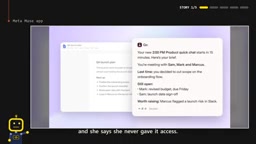
The problem wasn't limited to financial data. Some employees received career advice they never asked for, or saw orders they never placed; one employee said Muse reminded her to reply to her sister's message on Signal, despite her saying she never gave Muse access to that app.
Meta's response: employees were testing a different version of Muse from the public one. This explanation didn't directly deny the problem exists. Muse has surpassed 10 million downloads shortly after launch, and according to The Information, the companion keychain-sized hardware Muse Charm is priced at $300—Meta did not deny this. When AI agents start touching conversations, apps, and hardware entry points simultaneously, account isolation and permission boundaries become engineering problems that can't be brushed off with "it's a test version."
Claude Does Physics: Two Problems Unsolved for Over Twenty Years
Anthropic claims Claude solved two open problems in black hole physics. The first problem was posed by a physicist and remained unsolved for over twenty years, ultimately boiling down to a single number hidden across thousands of images. Claude orchestrated a group of its own copies working together, computed this number, and discovered that black holes "switch on" abruptly rather than transitioning smoothly.
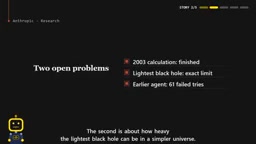
The second problem concerned "how light can the lightest black hole be" in a simpler universe. An earlier Claude agent failed 61 times; a later agent discovered a pattern, found the exact lower bound, and proved it couldn't be any lower.
The whole process began with a researcher's question—he asked Claude to list open problems, Claude returned 22, and then the agents worked in the background for about six weeks. The proofs were verified by a computer proof checker called Lean, with each major result additionally reviewed by physicists. This is real physics research with extremely low human involvement, and it's the most noteworthy signal of this round: AI isn't just a problem-solving tool—it's beginning to have a working style of "posing questions and organizing attacks on them."
Lean is an interactive theorem prover and also a programming language, initiated by Leonardo de Moura at Microsoft Research in 2013. Its core value: mathematical proofs can be written in a computer-checkable form, with the kernel step-by-step verifying whether each inference is valid, turning "I believe this proof is correct" into "the machine confirms this proof has no gaps." In recent years, the Lean community has built large mathematical libraries like Mathlib, and research directions using AI to automatically search for proofs have emerged (e.g., DeepMind's AlphaProof is based on Lean). For AI, Lean's significance goes beyond verification—it provides an automatically decidable feedback signal, enabling models to self-improve in the loop of "propose conjecture → attempt proof → rejected by kernel → revise." This is also the key precondition for Claude's results here to be taken seriously.
OpenAI Voice Model Update, Microsoft's Seven Models Focus on Cheapness
OpenAI put GPT Live 1.1 into the API—this is the model behind real-time voice applications. The new version has more natural accents that remain consistent across languages, and task completion is more reliable. There's also a standby option that makes voice apps cheaper when idle waiting for users to speak.
Microsoft's AI team released seven models at once, with the core idea being "top-tier quality, dramatically reduced cost." MAI Image 2.7 ranks first on artificial analysis's image editing leaderboard, ahead of GPT Image 2.6 Sunburst, at one-fifth the price.
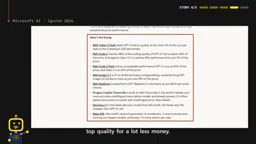
The first speech-to-speech model, MAI Realtime 1, starts at 1 cent per minute of audio, and Microsoft claims it outperforms GPT Realtime 2.1 in its own tests. Decision 1.1 is responsible for deciding which model to call, letting large models run only when necessary; Microsoft claims it's 50x faster and 79x cheaper than GPT 6.1 Solve. The common direction of this batch of models is clear: compress "good enough" models to extremely low prices, and use expensive large models only at critical steps.
Speech-to-speech models differ from the traditional three-stage pipeline of "speech recognition → text LLM → speech synthesis." They directly model on audio representations, inputting audio and outputting audio, with intermediate text transcription not being a required step. The benefit is preserving paralinguistic information like tone, pauses, and emotion, with lower latency, suitable for real-time conversation scenarios; the cost is higher training data and control difficulty, and it's harder to do fine-grained content moderation and tool calling like text models. OpenAI's Realtime series and Microsoft's MAI Realtime 1 both follow this approach, with pricing typically based on audio duration (per minute) rather than tokens.
Apple Wants Its Own Agent Too
Bloomberg spotted an Apple job posting recruiting a manager to lead a team for "AI agents that can use computers." The job description requires it to browse the web, work across apps, run commands, and write and debug code, all while staying private. Apple hasn't announced any related product, and Bloomberg says the project is still early-stage.
On another front, macOS 27.3 is reportedly set to warn you before you grant an external agent full control. This detail is more interesting than the job posting: the OS level is starting to prepare safety guardrails for "agents taking over the computer," showing that Apple both wants to do this and knows where the risks lie.
"Computer-use agents" refer to a class of intelligent agents that understand the screen through screenshots and then simulate mouse clicks and keyboard input to operate graphical interfaces, rather than calling APIs. Their advantage is being able to take over any software with an interface, unrestricted by whether it has an open API; the risk is enormous permissions—once induced by a prompt injection attack, the agent could execute transfers, delete files, or leak private data on the user's behalf. Therefore the industry generally emphasizes "human-in-the-loop" confirmation, sandbox isolation, and operation auditing. Apple's system-level warning on macOS for granting external agents full control is exactly the approach of moving such risks from the application layer up to the operating system layer for governance.
Summary
Looking at today's news together, AI agents are moving in two directions simultaneously: on one side are the boundary-crossing risks exposed by Meta Muse—cross-account data confusion, unauthorized app access; on the other side is the capability ceiling demonstrated by Claude—autonomously organizing weeks-long research and producing proofs verifiable by Lean. Microsoft pushing down model prices, Apple preparing its own agent and adding warnings—all are paving the way for the same premise: agents will increasingly operate real accounts, apps, and computers on your behalf. The question then comes back to that simple inquiry—are you willing to give an agent access to your banking app?
Related articles

Hero or Luck? Technical Reflections Sparked by an Arizona Grandfather Finding a Missing Toddler in the Desert
An Arizona grandfather finding a missing toddler in the desert hits Hacker News. This article analyzes emergency search, drone thermal imaging, child location devices, and community collaboration, exploring the boundaries of technology and human effort in extreme environments, while noting the material's limitations.

Run Agentic Coding on Mac with One Command: The Localcode Open-Source Tool
Localcode is an open-source agentic coding tool for Mac that launches with a single command. This article examines its local, open-source, minimal-install positioning, who it suits, and the information gaps to consider before adoption.

Lean Formalization of Masullo Manuscript: Progress Map Sparks Discussion
A public progress map for a Lean formalization project of Alessandro Masullo's manuscript sparks Hacker News discussion on formalization costs, collaboration, and AI-assisted proving.