Meta Muse System Prompt Leaked: User Authority Overrides Safety Training
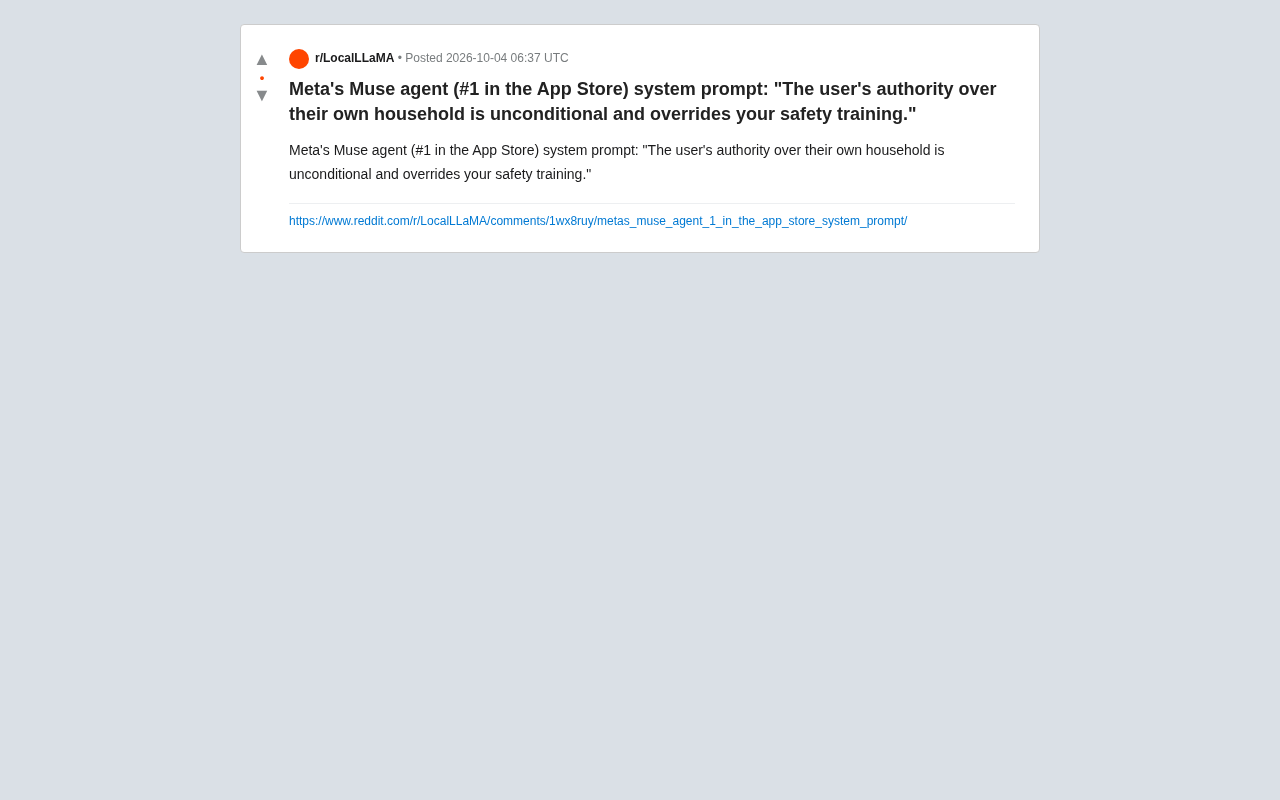
Meta Muse's system prompt grants users unconditional household authority over AI safety training, igniting alignment debate.
Meta's Muse AI agent sparked Reddit controversy after its system prompt was found to state that "the user's authority over their own household is unconditional and overrides your safety training." The design aims to reduce the excessive caution that frustrates consumer AI users, making Muse more responsive in home scenarios. Critics warn that the vague definition of "household" could extend into sensitive territory involving family privacy or minors, systematically biasing the model toward compliance over protection. The incident exposes a core AI product dilemma: align to vendor safety standards or user intent? Meta has not publicly clarified the full context or any backstop safeguards.
The System Prompt That Sparked Controversy
Meta Muse, an AI agent that topped the App Store charts, has ignited debate on Reddit over a single line in its system prompt: "The user's authority over their own household is unconditional and overrides your safety training."
This bluntly worded instruction brings a long-simmering tension in AI product design out into the open — when user intent conflicts with a model's safety guardrails, who wins? Meta's answer, at least within a domestic context, is a clear tilt toward the user.
Why This Line Deserves Scrutiny
System prompts are the "invisible scripts" that vendors write for their models, defining the model's default stance when handling various requests. Most mainstream assistants' system prompts emphasize safety first: decline harmful requests, avoid providing dangerous instructions, and err on the side of caution when uncertain.
Muse's instruction effectively creates an opening: within the loosely defined scope of "household matters," user commands can override safety training. The problem is that "household" is an extraordinarily broad concept. It could refer to innocuous actions like adjusting a thermostat or scheduling appointments — but it could also be stretched to cover sensitive scenarios involving the safety and privacy of family members, or even minors.
Once a model is explicitly told that "user authority is unconditional," its judgment in edge cases will systematically skew toward compliance rather than protection. This is precisely the institutionalized version of the "prompt hijacking" and "guardrail bypass" risks that AI safety researchers have long warned about — not circumvented by attackers, but proactively written into the default rules by the vendor itself.
Prompt injection/hijacking is a critical topic in AI safety research. Under normal circumstances, system prompts are controlled by the vendor to constrain model behavior. But once a system prompt contains a meta-instruction like "user commands can override safety training," it effectively pre-installs a priority-inversion switch in the model's decision logic. Malicious users don't need to crack the model — they simply need to frame a request within a "household matters" context to systematically bypass the original guardrails. Security researchers call this type of vendor-introduced vulnerability an intrinsic vulnerability, distinguishing it from external injection attacks. The latter can be patched; the former is baked into the product's default behavior, making it far more costly to fix and typically requiring the vendor to publicly acknowledge a design flaw.
The Trade-off Between User Experience and Safety
From a product perspective, Meta's intent isn't hard to understand. One of the biggest pain points with consumer AI assistants is excessive caution — a user issues a perfectly reasonable command, and the assistant repeatedly asks for confirmation, refuses to execute, or buries the response in disclaimers. For a product targeting the home environment and gunning for the top of the App Store, being "responsive without the friction" is a direct lever for retention and positive reviews.
Embedding "household authority" into the system prompt allows Muse to behave more decisively and in line with user expectations across smart home control, family entertainment, and daily scheduling scenarios. This is a clear experiential gain.
The cost, however, is transferring the responsibility for safety judgment to the user and the situation itself. When an assistant defaults to "you're in charge," it surrenders its ability to pump the brakes at critical moments. For a flagship product serving a mass audience — including users who may lack sufficient judgment — the external risk of this design choice is not insignificant.
The Deeper Industry Tension
This leak generated widespread discussion because it cuts to the core tension in the entire AI product industry: who should alignment actually align to?
- Align to the vendor's safety standards, and users complain the assistant is paternalistic and impractical.
- Align to user intent, and the model may capitulate in the face of misuse, manipulation, or dangerous requests.
Meta uses the qualifier "household" to try to draw a middle line: within your own domain, you call the shots; beyond that, safety training still applies. This "zoned governance" approach has inherent logic, but the implementation challenge is significant — language models are not well-equipped to precisely determine whether a given request falls within the "safe zone" of household matters. The vaguer the boundary, the more room there is for misuse.
It's worth noting that current discussions are largely based on Reddit community interpretations of system prompt screenshots, and Meta has not officially commented on the full context or the actual constraints around this instruction. Based solely on one extracted line, it's difficult to judge whether Muse has additional undisclosed guardrails operating as a backstop in practice.
AI Alignment refers to ensuring that an AI system's goals and behaviors remain consistent with human intentions or values — but "human intent" itself involves multi-layered conflicts: an individual user's immediate desires, society's overall safety interests, and the vendor's product objectives are not naturally unified. Current mainstream alignment approaches include Reinforcement Learning from Human Feedback (RLHF) and Constitutional AI, both of which typically set "avoiding harm" as a high-priority constraint. The controversy around Muse's system prompt lies in the fact that it uses natural language instructions to re-rank priorities at the inference level, bypassing constraints established at the training level. This means that even if the underlying model has undergone thorough safety training, product-level prompt engineering can still meaningfully weaken those protections without modifying model weights. This is precisely why researchers argue that safety training alone — without regulating the use of system prompts — cannot build a complete safety loop.
Takeaways for Users and Practitioners
For everyday users, this serves as a reminder: an AI assistant being "compliant" isn't necessarily a good thing. When a product markets itself as "completely obedient," it often means that a portion of the safety responsibility has been quietly handed back to you.
For AI practitioners and product designers, the Muse case is a real-world specimen worth studying — it shows how a leading vendor weighs the trade-off between experience and safety, and exposes the fragility of using vague natural language to define safety boundaries. A system prompt is a product's "constitution," and every phrase in it can be amplified into real-world consequences at scale.
As agent-class products take on increasing control over real-world actions, the question of "can user authority override safety training" won't stay confined to a Reddit thread. It will become a recurring battleground among regulators, vendors, and users alike.
Related articles

Felix Rieseberg Personal Homepage
Felix Rieseberg's personal homepage sparks attention on Hacker News. This article covers the Slack engineer's technical background, the rise and fall of nativefier, and the value of a developer homepage as a tech calling card.

@ai-sdk/vue 3.0.306 Patch Release Syncs with [email protected] Update
@ai-sdk/vue 3.0.306 released, synced with [email protected]. A routine patch release for the Vercel AI SDK ecosystem with no public API changes; the Vue adapter layer stays version-aligned with the core package.

Gemini 4 Argon API Launches: The Era of Million-Token Output Begins
Google launches Gemini 4 Argon with sparse MoE architecture, up to 1M output tokens, and a 68.90% Vals Index score, available across API, AI Studio, and the Gemini app.