Meta Muse Wonder Launch: What It Means for Meta's Return to the Frontier AI Race

Meta launches Muse Wonder to rejoin the frontier AI race, with polarized reception and a landscape shifting from duopoly to five-way competition.
Meta released its new-generation Muse Wonder models (streamlined Wonder and full WonderFull), positioned by Chief AI Officer Alexander Wang as competitive with frontier rivals, marking Meta's return after being sidelined in 2025. Benchmarks show WonderFull nearing or leading GPT-6 Astra and Opus 5.5 on DeepSuite 1.1, Terminal Bench 4.0, and multiple agentic and vertical benchmarks, with Artificial Analysis cross-validating the gains—but per-call costs rose nearly threefold. Community feedback is divided: WonderFull earned S-tier praise from several developers, while streamlined Wonder drew criticism for poor coding and 3D demos, with the shared name causing negative spillover. Meta built the series for personal agents, focusing on Active Memory and Active Focus; Zuckerberg, meanwhile, refused to sign the Pacing the Frontier open letter, stressing openness and engineerability. The frontier landscape is temporarily back to about five labs competing, but stronger internal models are brewing.
Meta Officially Returns to the Frontier AI Battlefield
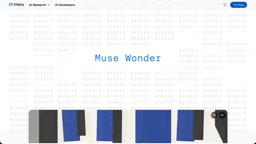
Meta this week released a new-generation model family called Muse Wonder. Unlike the Muse Spark series launched over the past few months, this Wonder series has been explicitly positioned by Meta's Chief AI Officer Alexander Wang as a product that can compete head-on with the "big players."
In 2025, most headlines about Meta and AI revolved around Zuckerberg spending enormous sums to recruit researchers, along with the internal turmoil that followed. At the time, the industry had all but written Meta off from the frontier AI race. Yet entering 2026—hailed by the industry as the "year of agents"—Meta has announced its return with Muse Wonder.
The release includes two model variants: Wonder is a streamlined, speed-optimized version, while WonderFull is the full version available through an API. According to analyses from multiple sources, including a Bilibili creator and the YouTube channel AI Daily Brief, the launch of the Muse Wonder series marks a shift in the U.S. frontier AI competitive landscape from a "duopoly" back to a "five-way race."
Benchmarks: What the Data Says
On paper, WonderFull's performance is genuinely impressive. On DeepSuite 1.1, WonderFull scored 79%, leading GPT-6 Astra and Opus 5.5 by nearly 5 percentage points. On Terminal Bench 4.0, it trails these frontier competitors by just 2 points.
In agentic tasks, WonderFull shows a clear advantage. It ranks first on Meta's internal "Personal Superintelligence Index," leading Astra and Opus by about 4 percentage points, and achieves state-of-the-art results on the Harvey Lab legal work benchmark, Val's financial agent, and Automation Bench.
Independent evaluator Artificial Analysis cross-validated Meta's test results: WonderFull scored 56 on the intelligence index, tied for second with Sonnet 5.5 and just 2 points behind Opus 5.5. The streamlined Wonder ranked seventh with 52 points, tied with GPT-6.1 Sol and the yet-to-be-released Gemini 4.0 Argon. Artificial Analysis specifically noted this is a "substantial improvement" over Muse Spark 1.3—and only 6 weeks have passed since that release.
But the price has risen accordingly. Muse Wonder costs $4.52 per task call, nearly 3 times more than Muse Spark 1.3, about $1 more expensive than GPT-6 Astra or Grok 4.7, but roughly $1.50 cheaper than Opus 5.5.
A framework for interpreting these benchmarks: The various benchmarks mentioned here each measure different capability dimensions, and understanding their differences helps assess a model's true level. Comprehensive benchmarks like DeepSuite 1.1 typically mix knowledge Q&A, reasoning, and coding problems; once scores approach the ceiling, discrimination drops. Terminal Bench 4.0 focuses on multi-step operations in a terminal environment, closer to an agent's ability to autonomously execute tasks. Artificial Analysis's intelligence index is a third-party standardized evaluation of multiple models on the same private question bank—its value lies in cross-validating vendors' self-reported results with a unified standard, reducing bias from selective disclosure. Meanwhile, the Harvey Lab legal benchmark, Val's financial agent, and Automation Bench are vertical-domain evaluations measuring a model's usability in specific professional workflows. Therefore, leading by a few percentage points on any single benchmark does not equal overall victory; the truly meaningful signal is consistent performance across multiple independent benchmarks.
Community Feedback: WonderFull Praised, Wonder Questioned
Real-world user testing paints a more divided picture than the benchmarks. Developer Theo placed WonderFull in his S-tier models, alongside Opus 5.5. He shared a specific case: when Opus 5.5, GPT-6.1 Sol, and WonderFull were all asked to fix a bug, Opus found the root cause and submitted a PR, GPT-6.1 Sol found the bug and wrote 300 lines of tests but explained it in an obscure way, while WonderFull discovered an existing small PR and suggested simply merging it.
Conductor's Charlie Holtz also gave positive feedback, saying WonderFull "found a real security vulnerability in the codebase that other agents had missed in one pass," performed excellently in design and visualization, and was particularly skilled at using sub-agents.
However, the streamlined Wonder's reputation is notably poor. Every's Dan Shipper reported that on his senior engineer benchmark, Wonder scored only 52%, far below GPT-6.1's 71%. AI researcher Mehu Mohan said he was also unsatisfied with WonderFull, believing it was far inferior to Opus 5.5 and even worse than GPT-6.1 Sol.
A widely discussed issue: Wonder and WonderFull share the same name, causing users' negative experiences with Wonder to influence their evaluation of WonderFull. Adam Holter pointed out this might be a case where separate releases would have been better. You might not have noticed, but Alexander Wang actively responded to community feedback, saying "this feedback is fair," and proactively reached out via DM to learn more.
Excessive usage consumption is another concentrated complaint. Some users reported that a $50/month plan consumed 13% of the 5-hour quota in less than 10 minutes. Alexander Wang later responded that there might be a counting bug.
The Mismatch Between 3D Demos and Real Programming Work
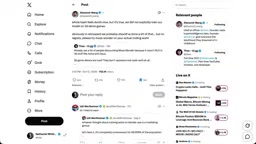
A thought-provoking phenomenon is that many users dismissed Muse Wonder because of poor performance on visual demo tasks like 3D games and CAD design. Developer Theo offered sharp criticism: "3D game demos look cool, but they are completely unrepresentative of real programming work."
This observation points directly to a structural problem in the current AI industry: because 3D games and rendering effects are highly viral on social media, frontier labs are compelled to optimize for these use cases, knowing that users on X will judge models by them. Alexander Wang also admitted: "The whole team now feels dumb, but it's true—we didn't specifically train the model for 3D demo games. In hindsight, maybe we should have done a little, but no regrets. Please try Muse Wonder on real programming work."
In sub-tests for front-end design and creative tasks, Claire Vaux found Wonder performed quite poorly in front-end design, was mediocre at writing except for emails, and wasn't great at SVG, video, or creative design. But on coding and agentic tasks, it "stands shoulder to shoulder with the big players," ranking first among the 8 frontier models she tested.
Why 3D demos became the default judging standard: 3D games and rendering tasks are repeatedly used as model demos because they are naturally suited to short-video virality—a model that can instantly generate an interactive scene is more likely to spread on social platforms than one that can refactor legacy code. This incentive structure leads labs to invest optimization resources in these "high visual impact, low verification cost" tasks, even if they are unrelated to most developers' daily work. In contrast, the value of real programming work often lies in understanding ambiguous requirements, following existing code conventions, and avoiding breaking changes—abilities that are hard to showcase visually. To assess whether a model suits real engineering, the more reliable approach is to run real tickets in your own codebase, not to rely on its performance on demo tasks.
Why Meta Needs Wonder: The Memory and Focus Challenges of Personal Agents
Behind the Muse Wonder release lies clear product logic. Meta's consumer app Muse, while good at immediate tasks (like booking flights and hotels), has received user feedback showing poor performance on long-term tasks. Some users reported that Muse would misremember dates and send incorrect reminders, while others trying to book hotels through Muse encountered "infinite loops" and ultimately had to give up and do it manually.
The Meta team is clearly aware of these issues. According to community analysis, Meta built the Wonder series specifically for "agents that act on behalf of users," with two key features worth noting:
- Active Memory: Tracks what matters to you across conversations
- Active Focus: Keeps pushing forward when tasks get hard, tries other approaches, and recovers from mistakes
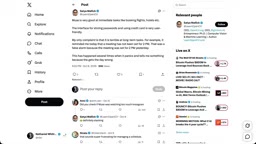
These features directly address the core challenges personal agents face in actual use. As investor Brycent put it: "There is currently no single best personal assistant." He uses four products simultaneously: Instinct, Muse, Grokbot, and DOTS. But for most users, the context-switching cost between multiple personal assistants may far exceed expectations—the value of a personal assistant is directly proportional to how well it knows you.
The technical meaning of Active Memory and Active Focus: Active Memory means the model can persistently maintain key facts relevant to the user across multiple sessions—such as schedule preferences, frequent contacts, or unfinished commitments—and proactively retrieve them in subsequent interactions, rather than starting from scratch each conversation. This requires the system to have cross-session structured storage and retrieval mechanisms, not just a longer context window—no matter how long the context, it's lost once the session ends. Active Focus addresses the "getting stuck" problem in long tasks: when a step repeatedly fails, the model needs to recognize it has entered a loop, try alternative paths, and extract reusable lessons from failures rather than mechanically retrying. These two capabilities together determine whether a personal agent can truly take on the responsibility of "running errands for the user," and they represent the biggest gap between most products' demos and daily usability.
Zuckerberg's Different Path: Against "AI Deification"
The Muse Wonder release also once again highlights the fundamental disagreement between Zuckerberg and other AI lab CEOs on the question of "frontier pacing." He neither signed the "Pacing the Frontier" open letter nor, weeks later, published an article titled "The Future Belongs to Everyone" as a counter.
Zuckerberg's core argument: openness and broad access must become core principles of the AI era, even if it means taking on additional risk. In his view, the catastrophic consequences of AI power concentration are greater than the risks of releasing powerful AI models.
In an interview with the Financial Times, Zuckerberg declared that Meta has reached the frontier and is "already working on the next upgrade." He predicted model development "may feel much faster from here." Regarding the risk of AI causing human extinction, he said he "leans toward believing AI is a technology that can be responsibly engineered with normal guardrails, rather than the anthropomorphized vision of AI going rogue."
This represents a fundamental divergence from other labs—OpenAI and Anthropic are both essentially building what they see as a "machine god," while Meta is trying to build what it considers "ordinary technology."
Competitive Landscape: Duopoly or Five-Way Race?
Looking back at the overall landscape shift: entering 2026, the frontier model space was dominated by three companies—OpenAI, Anthropic, and Google. As coding agents rose and proved more important in the short term than any other application, that number briefly shrank to two. Now, with Meta's return—and if Gemini 4 Argon delivers on Google's promises—the frontier AI race is back to about five labs competing.
But this may be superficial. According to industry sources, multiple labs are testing more powerful internal models—Anthropic's new model has been spotted in testing, and OpenAI is reportedly exploring a Sora revival as well as acquisition integrations with several companies. As Google's Patrick Tomey shared following a New York AI dinner, the industry consensus: "Fable 5.5 will be stunning, but OpenAI will surpass it with Bell in December."
If these closed-door super models are about to emerge, the frontier "duopoly" may quickly re-form. But at least for now, Meta has clearly declared: it's back.
One-line Summary
Meta releases the Muse Wonder series to return to the frontier AI race, with polarized reception and a landscape that may shift from duopoly back to a five-way race.
Paragraph Summary
Meta released its new-generation models Muse Wonder (streamlined Wonder and full WonderFull), positioned by Chief AI Officer Alexander Wang as products that can compete directly with frontier rivals, marking Meta's return to the race after being sidelined in 2025. Benchmarks show WonderFull approaching or even partially leading GPT-6 Astra and Opus 5.5 on DeepSuite 1.1, Terminal Bench 4.0, and multiple agentic and vertical benchmarks, with Artificial Analysis cross-validating the improvement—but per-task call costs rose nearly threefold. Community feedback is divided: WonderFull won praise from several developers and made S-tier, while the streamlined Wonder drew criticism for poor coding and 3D demo performance, with the shared name causing negative reviews to spill over. Meta built the series specifically for personal agents, emphasizing Active Memory and Active Focus; Zuckerberg, meanwhile, refused to sign the Pacing the Frontier open letter on AI safety, emphasizing openness and engineerability. The frontier landscape has temporarily returned to about five labs competing, but stronger internal models are in the works.
Related articles

Cursor Can Now Control Your Computer: AI Agents Can Drive Desktop Apps for Testing
Cursor adds desktop control: AI agents can drive desktop apps like the iOS Simulator to test their own features. We analyze the impact on dev workflows, possible technical approaches, and reliability concerns.

Vibecoding a Custom Inference Engine: High Hopes, Harsh Reality
A Reddit developer shares the real experience of vibecoding a custom inference engine: running GGUF Q4 models in the browser with WebGL2 and GLSL, only to fall into tokenizer debugging hell. This article analyzes the engineering challenges of browser-side LLM inference and why cloning llama.cpp is the more rational choice.

How High Are Anthropic's Early Investor Paper Returns Ahead of IPO?
Anthropic's early investor paper returns draw attention ahead of IPO. This article analyzes sources of book gains, capital structure, pre-IPO games and risks, and implications for the AI startup ecosystem.