Meta Open-Sources 30B Model Muse Glimmer: A Practical Breakdown of Running a Local Agent on a Single GPU

Meta open-sources Muse Glimmer, a 30B Agent model that runs on a single consumer GPU via three key optimizations.
Meta's Superintelligence Lab released Muse Glimmer under Apache 2.0, a 30B multimodal Agent model designed to run on consumer GPUs like the RTX 4090. It achieves this through 4-bit quantization (under 20GB VRAM), hybrid attention (local windows with periodic global layers), and D-Flash speculative decoding (3.1x speedup). While it leads on Agent benchmarks like MCP Atlas and DeepSearch QA, it trails Qwen 3.6 on pure coding tasks.
An Overlooked New Battleground: Local Agents
While the industry is still competing over who has more parameters and who spends more on cloud compute, Meta quietly did something different—they squeezed a 30B-scale multimodal Agent model into a single consumer-grade GPU.
This model, called Muse Glimmer, has a crystal-clear positioning: it's not yet another chatbot for casual conversation, but rather purpose-built for always-on local agents. Behind this lies a fundamental divergence in approach—on one side, OpenAI and Anthropic lead the cloud-based large model arms race; on the other, Meta is attempting to carve out a new lane for local Agents.
The choice of 30B is quite deliberate: it's significantly more capable than 7B small models, yet not so large that it requires a data center. It sits precisely in the sweet spot between "runnable on consumer hardware" and "capable enough to handle Agent tasks."
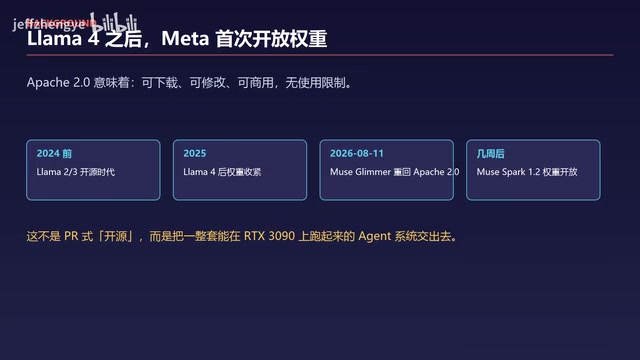
What's even more noteworthy is how it was released. After the LLaMA series had tightened weight access at one point, Muse Glimmer marks the first time Meta's Superintelligence Lab has open-sourced a model under the Apache 2.0 license. Apache 2.0 is one of the most permissive mainstream open-source licenses available—it allows anyone to freely use, modify, and distribute code and model weights, even for commercial purposes, with the only requirement being to retain the original copyright notice. By comparison, Meta's earlier releases of LLaMA 2 and LLaMA 3 used a custom Community License that imposed additional authorization requirements for companies with over 700 million monthly active users, sparking "fake open source" controversies in the open-source community. The switch to Apache 2.0 means small and medium enterprises and independent developers can embed it in commercial products without any legal concerns—a fundamental boost to ecosystem growth. Zuckerberg also previewed that the larger Muse Spark 1.2 weights will be released within weeks. This means the open-source community will gain access to a complete model chain from 30B to larger scales.
Three Key Techniques: How Muse Glimmer Fits 30B into a Single GPU
Muse Glimmer's ability to fit into a consumer-grade GPU relies not on brute force, but on a sophisticated combination of engineering techniques.
Modular Architecture: Not Simply Stacking Parameters
The first key to understanding Glimmer is its modular division of labor. Rather than simply stacking 30B parameters, it clearly assigns responsibilities: approximately 28B text parameters handle reasoning and planning, 2B are dedicated to tool calling, a 2B ViT handles visual understanding, and a separate D-Flash small model specializes in acceleration.
ViT (Vision Transformer) is a visual model architecture proposed by Google in 2020 that splits images into fixed-size patches (typically 16×16 pixels), linearly projects each patch into a vector sequence, and feeds it into a standard Transformer encoder. In multimodal large models, ViT typically serves as the visual encoder, converting image information into vector representations in the same space as text tokens, then fusing with the language model through projection layers or cross-attention mechanisms. Glimmer allocates 2B parameters to its ViT—a scale sufficient for understanding screenshots, UI elements, and document images common in Agent scenarios, while avoiding an oversized visual encoder that would consume the limited VRAM budget.
This division of labor lets each component do what it does best, and also lays the groundwork for subsequent memory optimizations.
Technique #1: 4-bit Quantization Compresses VRAM to Under 20GB
A 30B model at full-precision BF16 requires approximately 55GB of VRAM, far exceeding the capacity of any consumer-grade GPU. Glimmer uses 4-bit quantization to compress all weights below 20GB while keeping precision loss within 1%.
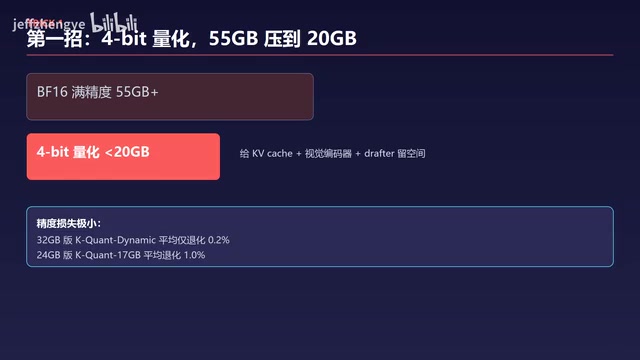
Quantization refers to the process of compressing model weights from high-precision floating-point numbers (like BF16's 16 bits) to low-precision integers (like 4 bits). At BF16 precision, each parameter occupies 2 bytes, meaning a 30B model needs about 60GB of storage and VRAM; after 4-bit quantization, each parameter occupies only 0.5 bytes, theoretically reducing VRAM requirements to approximately 15GB, staying under 20GB with runtime overhead included. Current mainstream 4-bit quantization methods include GPTQ, AWQ (Activation-aware Weight Quantization), and the GGUF format. Keeping precision loss within 1% is no trivial feat—it typically requires layer-by-layer or group-wise quantization using calibration datasets, along with Group Quantization strategies to preserve precision in critical weight channels.
This step is crucial—only by compressing the model itself can the GPU accommodate the model while still having room for KV Cache, visual encoder, and speculative decoder at runtime. The KV Cache (Key-Value Cache) mentioned here is the core acceleration mechanism for Transformer inference: during autoregressive generation, each new token requires computing attention relationships with all historical tokens. To avoid redundant computation, the inference engine caches the Key and Value vectors produced by each attention layer. However, KV Cache VRAM usage scales linearly with sequence length—for a 30B model processing 131K tokens of context, KV Cache at full precision could consume tens of additional gigabytes of VRAM. This is why Glimmer must control KV Cache bloat through the subsequent hybrid attention mechanism, beyond just model weight quantization.
Technique #2: Hybrid Attention Mechanism Saves Memory Overhead
If every layer performed full 131K long-context attention, VRAM would instantly explode. Standard Transformer full attention has O(n²) computational complexity, where n is the sequence length. When context reaches 131K tokens, this means each layer must handle approximately 17 billion attention computations, with KV Cache growing linearly alongside.
Glimmer's strategy is hybrid attention: most layers only attend to a local window of 2048 tokens, with full global attention performed only every four layers. This design is similar in spirit to Mistral's Sliding Window Attention, with the theoretical basis being that lower Transformer layers typically handle local syntax and short-range semantics with weak dependence on global context, while higher or interleaved layers handle global reasoning and long-range dependency modeling. Through this hierarchical division, the vast majority of layers only need to store KV pairs for 2048 tokens rather than the full 131K, resulting in substantial VRAM savings.
This way, the model can still capture long-range dependencies at the macro level while dramatically reducing memory overhead at the micro level—a key design that makes long-context processing viable on a single GPU.
Technique #3: D-Flash Speculative Decoding Achieves 3x Speedup
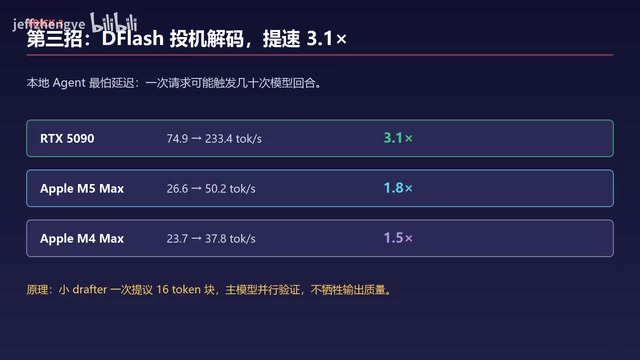
Agent scenarios differ from single-turn chat—they involve multiple rounds of tool calls and self-verification, where latency compounds at each step. To address this, Glimmer introduces D-Flash speculative decoding: a small draft model generates candidate blocks of 16 tokens at once, which the main model then verifies in parallel.
Speculative Decoding is one of the most important technical breakthroughs in large model inference acceleration in recent years, formally proposed by DeepMind and Google in 2023. Its core concept borrows from CPU branch prediction: a tiny "draft model" (typically 1/10 or even smaller than the main model in parameter count) quickly autoregressively generates a string of candidate tokens, which are then sent to the main model for verification in a single parallel forward pass. Since the main model can verify multiple tokens in parallel within a single GPU computation, verification costs far less than sequential generation. If the draft model achieves high prediction accuracy (typically 70%-90%), the system can achieve multi-fold speedup without any loss in output quality. Glimmer's D-Flash approach generates 16 candidate tokens at once—a fairly aggressive configuration that requires the draft model's distribution to be highly aligned with the main model.
This mechanism boosts generation speed on an RTX 5090 from 75 tokens/s to 233 tokens/s—a full 3.1x speedup. For Agent tasks requiring frequent tool interactions, this kind of acceleration directly determines whether the experience is usable.
Real-World Benchmarks: Leading on Agent Tasks, Weaker on Coding
Performance data is central to evaluating Glimmer's value, but it needs to be viewed objectively—it doesn't dominate across all categories.
Clear Lead on Agent Benchmarks
On Agent-class benchmarks, Glimmer shows significant advantages (data from Meta's official comparison table):
- MCP Atlas: 75.5, compared to Qwen 62.5 and Gemma 54.2
- DeepSearch QA: 74.6
- SWE-Bench Pro: 51.2
These benchmarks differ fundamentally from traditional static evaluations like MMLU and HumanEval—they measure not what the model "knows" but what it "can do." MCP Atlas focuses on an Agent's ability to use MCP (Model Context Protocol) tool chains, testing whether the model can correctly invoke external APIs, databases, and search engines to complete complex tasks. DeepSearch QA examines multi-step retrieval and reasoning capabilities, simulating an Agent's full workflow of proactively searching, aggregating, and answering questions under incomplete information. SWE-Bench, created by Princeton University, extracts Issues and corresponding Pull Requests from real GitHub repositories, requiring the model to understand problem descriptions and autonomously modify codebases to fix bugs or implement features; the Pro version is significantly harder.
These results validate its positioning as a "local Agent brain."
Weaknesses in Coding and Terminal Operations
However, to avoid overstating things, its weaknesses must be noted. On pure terminal coding and graphical interface operation tasks, Qwen 3.6 (27B) actually performs better:
- Terminal Bench: Glimmer 51.7 vs Qwen 60.7
- SWE-Bench Verified: 76.0 vs 77.2
- OS World: 65.9 vs 75.6
The conclusion is clear: Strong on Agent tasks, relatively weak on coding. Model selection should be based on actual use case rather than blindly chasing the newest release.
Deployment Hardware Requirements: For Enthusiasts, Not Everyone
It's important to clarify that Glimmer is not an "everyone" model—it targets hardware enthusiasts.
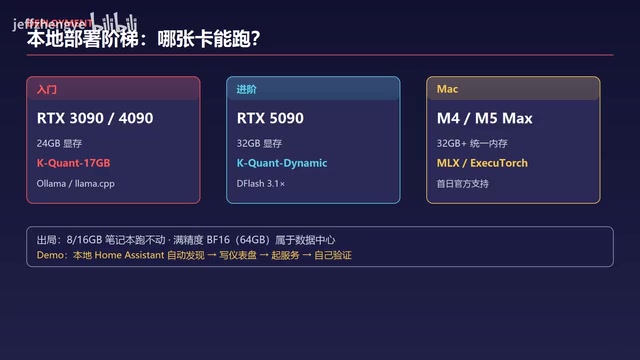
From a deployment tier perspective:
- Entry-level: RTX 3090 / 4090 (24GB VRAM)
- Sweet spot: RTX 5090 (32GB VRAM)
- Mac users: M4 / M5 (32GB unified memory) can also run it
- Full-precision deployment: Requires 64GB VRAM, still in data center territory
It's worth noting that Mac's Unified Memory Architecture has unique advantages for local large model inference. Unlike NVIDIA GPUs with dedicated VRAM, Apple Silicon's CPU and GPU share the same physical memory pool without needing to shuttle data across the PCIe bus. This means that even though memory bandwidth doesn't match professional GPUs, 32GB or even 64GB of unified memory can fully accommodate a quantized 30B model with surprisingly good efficiency. This explains why an increasing number of local model projects target Mac as an important platform.
As we can see, the quantized version brings it within reach of mainstream high-end consumer hardware, but full-precision deployment still has a considerable barrier.
Significance: Putting Superintelligence on Your Desktop
So what does a local Agent actually mean?
For ordinary users, local models deliver a triple value proposition of privacy, cost savings, and decentralization. Data never leaves your machine—this is a hard requirement for healthcare, government, and finance scenarios. Taking healthcare as an example, regulations like HIPAA (Health Insurance Portability and Accountability Act) strictly limit cloud transmission of patient data, and local Agents architecturally eliminate compliance risks. Zero subscription fees fundamentally change the long-term cost structure: a one-time investment in an RTX 4090 costs approximately $1,600 USD, while annual subscriptions for Claude Pro or ChatGPT Plus run $240-$360; heavy users break even within two to three years, with the compute permanently belonging to them. For Zuckerberg, the vision is to bring superintelligence from the cloud down to everyone's device. This aligns with Meta's consistent platform strategy—building ecosystem moats through open source, getting more developers to build applications around Meta's models, thereby replicating an Android-style ecosystem expansion path in the AI Agent era.
What truly changes the world is often not the largest model, but the first model you can actually run on your own desk. Muse Glimmer may be just such a watershed moment—it's not the endpoint, but it turns "personal superintelligence" from a slogan into a downloadable file.
Key Takeaways
Related articles

@ai-sdk/vue 3.0.306 Patch Release Syncs with [email protected] Update
@ai-sdk/vue 3.0.306 released, synced with [email protected]. A routine patch release for the Vercel AI SDK ecosystem with no public API changes; the Vue adapter layer stays version-aligned with the core package.

Gemini 4 Argon API Launches: The Era of Million-Token Output Begins
Google launches Gemini 4 Argon with sparse MoE architecture, up to 1M output tokens, and a 68.90% Vals Index score, available across API, AI Studio, and the Gemini app.

DukaanAI: Turning Product Photos into Inventory Lists with Open-Source AI
DukaanAI is an AI inventory tool for small retailers that turns product photos into inventory entries using the open-source Gemma 3 model, with local inference, editable fields, and CSV export.