Meta Open-Sources Agent Coding Model Muse Spark, Now on Together AI with 1M Context

Meta's open-weight Muse Spark Open lands on Together AI, packing 1M token context for agent coding.
Meta's open-weight model Muse Spark Open, designed for Agentic Coding, has launched on Together AI with serverless and dedicated infrastructure options. Its standout feature is a 1M token context window, letting it ingest entire mid-sized code repositories at once and avoid the cross-file dependency loss of RAG and code chunking. Together AI handles hosting and inference acceleration, lowering integration barriers while open weights keep self-hosting and fine-tuning paths available.
Meta Bets Big on Open Weights Again
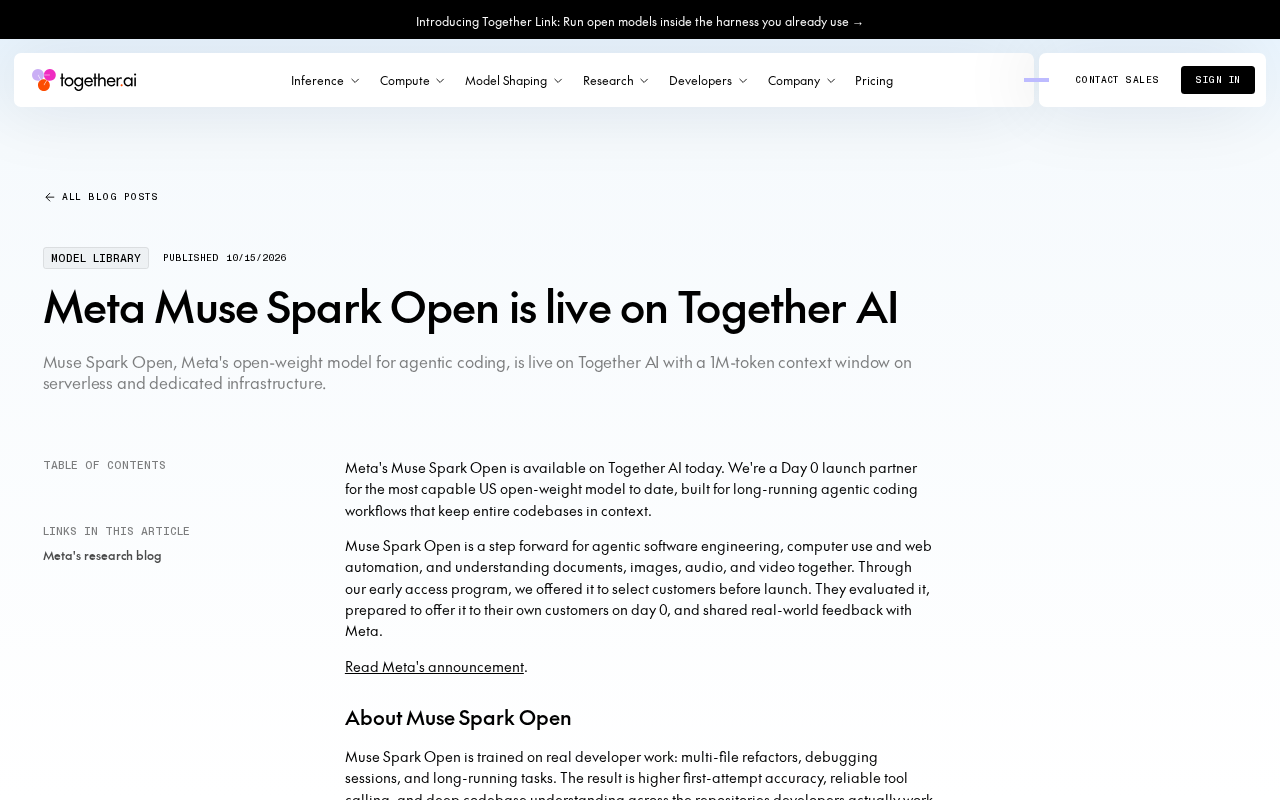
Meta is doubling down on open-weight models. Its model built for agentic coding scenarios, Muse Spark Open, has officially launched on the Together AI platform, and developers can now access it through either serverless or dedicated infrastructure. The headline spec is a 1M token context window — meaning the model can ingest information on the scale of an entire mid-sized code repository in a single inference pass.
What Is Muse Spark Open?
Muse Spark Open is an open-weight model from Meta with a very clear positioning: serving Agentic Coding scenarios.
Traditional code completion models work on a "you write a line, it fills in a block" basis. Agentic Coding demands far more autonomy from the model — understanding multi-file project structure, calling tools, executing multi-step reasoning, and iteratively fixing issues based on error messages. This places simultaneous demands on long-context capability and tool-calling ability.
The "open-weight" release approach deserves separate explanation. Unlike a fully closed-source API, open weights mean the community can download the model weights and deploy or fine-tune them independently. And unlike fully open source (including training data and code), Meta retains the training details. This middle path has become Meta's standard strategy for model releases in recent years.
Agentic Coding is a paradigm distinct from traditional code completion. It treats a large model as a "coding agent" capable of autonomous action, rather than a passive completion tool: the model receives a high-level goal (such as "fix this failing test"), plans its own steps, reads and modifies multiple files, calls tools like the terminal, test frameworks, and search, observes the results, and then decides the next step until the task is complete or it proactively asks for help.
This paradigm places significantly different demands on model capabilities compared to traditional completion. First is long context: an agent needs to continuously retain project structure, historical actions, and environment feedback throughout its reasoning, and context easily balloons to hundreds of thousands of tokens. Second is tool calling and structured output: the model must reliably generate parseable tool-call instructions and maintain state across multiple turns. Third is multi-step reasoning and self-correction: it needs to locate problems based on error messages and iteratively fix them, rather than generating everything in one shot. These three capabilities are exactly what agent-oriented models like Muse Spark Open focus on optimizing.
What 1M Token Context Means for Coding
Million-token context isn't showing off in agentic coding scenarios — it's a hard requirement.
A mid-sized project's codebase, plus dependency files, configuration files, documentation, and test cases, easily exceeds several hundred thousand tokens. Previously, developers had to rely on RAG or code chunking to "feed" the model, a process that inherently loses cross-file global dependency relationships. A 1M window lets the model see the complete project context at once, performing much closer to how a human engineer actually works when understanding inter-module call chains, performing unified refactoring, or tracking down cross-file bugs.
That said, a large context window doesn't equal high effective utilization. The industry widely recognizes the "lost in the middle" phenomenon — the model's attention decays for information in the middle of very long inputs. How accurately Muse Spark Open actually retrieves information within its 1M window still needs real-world testing by developers. Together AI offers two deployment forms: serverless mode is suited to quick validation and low-frequency calls, while dedicated infrastructure is suited to production environments requiring stable throughput.
RAG (Retrieval-Augmented Generation) and code chunking are common approaches for handling inputs that exceed a model's context length. The method is to first split the codebase into fragments by function, class, or fixed number of lines, build a vector index, then retrieve the most relevant fragments and insert them into the prompt when a question is asked. Its advantages are controllable cost and scalability to arbitrarily large repositories, but it has inherent flaws in code scenarios: retrieval granularity determines information completeness, and cross-file call chains, indirectly referenced type definitions, and global configurations often get fragmented or missed. The model only sees a partial puzzle, making it hard to form a global understanding of the entire project.
"Lost in the middle" refers to a common phenomenon in long-context models: when input is very long, the model reliably uses information at the beginning and end, but its attention noticeably decays for information in the middle, causing key content to be "ignored." So whether a million-token window can truly translate into a million tokens of effective understanding depends on the model's attention mechanism and how well it was optimized for long sequences during training. This is also why long-context capability evaluations typically construct "needle in a haystack" retrieval tests specifically.
Together AI's Role
Together AI serves as the model hosting and inference acceleration platform in this chain.
For Meta, releasing an open-weight model requires a reliable inference platform to absorb developer demand — building its own API service has a worse return on investment than handing it to a specialized platform. For Together AI, hosting a Meta-level open-source model launch is an important step in establishing its position in the open-model inference market.
For developers, the practical benefit is lower integration cost — no need to figure out GPU clusters and inference optimization yourself; you can call it through Together AI's interface, while preserving a technical path to migrate to self-hosting in the future (since the weights are open, after all).
The difference between open weights and open source is often conflated in the industry, but the meanings are not the same. Open weights means the model's parameter weights can be publicly downloaded, allowing users to deploy, quantize, and fine-tune them independently, or even train derivative models on top of them. Open source usually also means the training code, data processing pipeline, and even training data are all released, allowing others to fully reproduce the work.
Vendors like Meta often adopt the middle strategy of open weights: leveraging community power to expand the ecosystem and collect fine-tuning results, while retaining training data and methods as commercial secrets. For developers, the practical value of open weights is "locking in optionality" — you can quickly validate with a hosted platform first, and once you have higher demands for cost, privacy, or performance, migrate to your own cluster without changing models or rewriting prompts. This is also why this article emphasizes "preserving a technical path to migrate to self-hosting in the future."
The Competitive Landscape in Agent Coding
Agent coding is becoming one of the most fiercely contested verticals in large model competition.
In the closed-source camp, everyone is strengthening models' tool-calling and multi-step reasoning capabilities. In the open-source camp, Muse Spark Open enters with a combination of open weights plus million-token context, targeting development teams that are sensitive to data privacy, need private deployment, or want to deeply customize models.
Whether Muse Spark Open can secure its place in this race depends on three factors: actual code generation quality, effective retrieval capability within the 1M context, and the vitality of the community fine-tuning ecosystem. The first two require extensive developer testing feedback to validate, while the third depends on Meta's subsequent ecosystem strategy.
For teams currently selecting an agent coding model, it's worth spending time running a round of real project tests on Together AI to use actual data to evaluate whether it fits their tech stack.
One-line Summary
Meta's open-weight model Muse Spark Open launches on Together AI with 1M token context, betting on the agent coding race.
Paragraph Summary
Meta's open-weight model Muse Spark Open, built for Agentic Coding scenarios, has officially launched on the Together AI platform, with developers able to access it via serverless or dedicated infrastructure. The model's biggest highlight is its 1M token context window, capable of ingesting information on the scale of a mid-sized code repository in one pass, eliminating the cross-file dependency loss caused by RAG and code chunking. Together AI handles model hosting and inference acceleration, lowering integration costs for developers, while open weights preserve a path to self-hosting and fine-tuning. The article notes that agent coding is becoming one of the most fiercely contested verticals in large model competition, and whether Muse Spark Open can secure its position depends on code generation quality, effective retrieval within the 1M window, and the vitality of the community fine-tuning ecosystem, recommending that teams selecting a model validate it through real-world testing.
Related articles

Chain of Thought Isn't Just for AI: How Humans Can Use CoT to Improve Thinking Quality
Chain of Thought isn't just a prompt trick for large models. Starting from a Hacker News discussion, this article analyzes why CoT works for human thinking too, breaks down actionable ways to transfer it, and highlights the key differences between human CoT and machine CoT.
Cloudflare Teams Up with OpenAI: Closi…
Cloudflare Teams Up with OpenAI: Closing the Loop from Vulnerability Discovery to Defense with AI
Cloudflare uses OpenAI Daybreak to investigate security vulnerabilities and generate reviewable remediation plans, while developers use Codex to boost coding efficiency and quality.

Orca Multi-Agent Orchestration in Practice: A Guide to Parallel Collaboration with Claude and Codex
Orca is Stable AI's free open-source agent workbench supporting 34 agents like Claude Code and Codex in parallel. Learn its Git worktree isolation, multi-model orchestration, and mobile management.