Meta Open-Sources an 816B Beast: The Opportunities and Barriers of Muse Spark Open

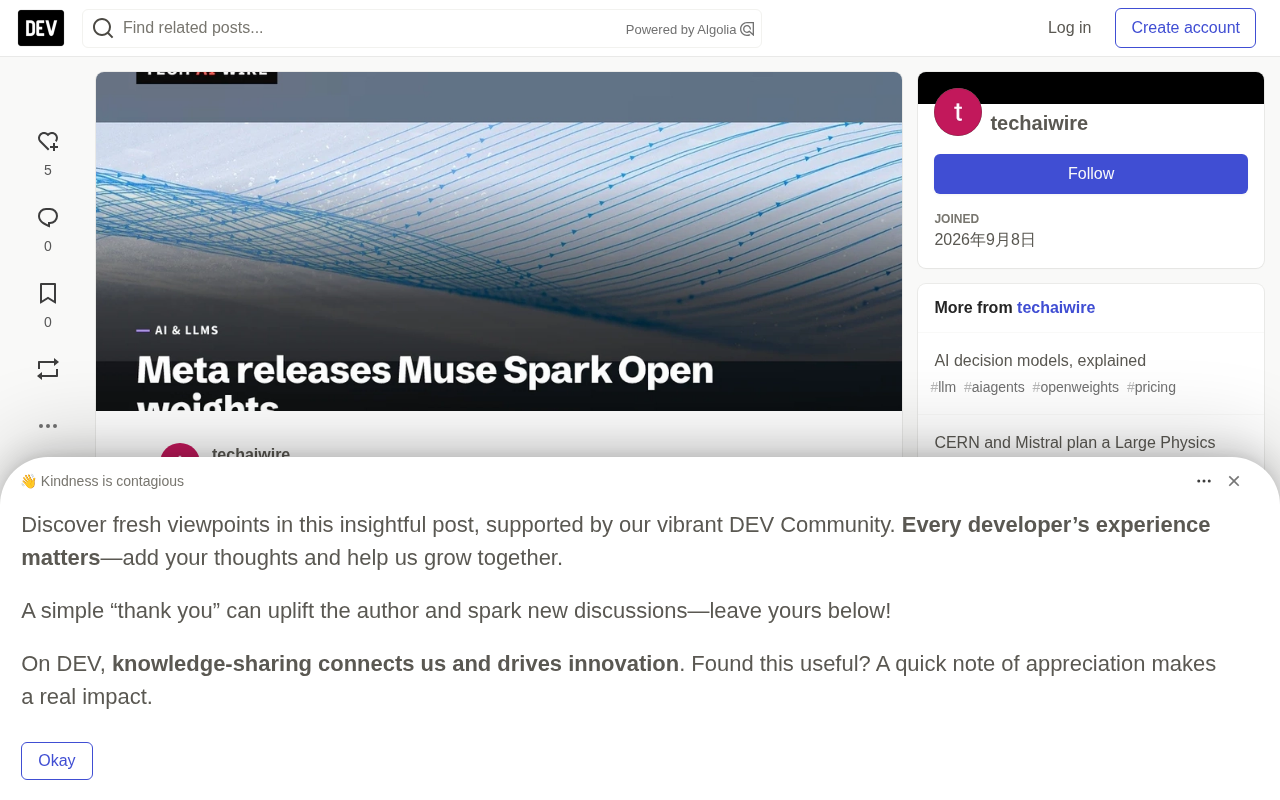
Meta releases Muse Spark Open, an 816B-parameter, 42B-activated open-weights model, but hardware barriers and license boundaries still require careful assessment.
Meta released Muse Spark Open on October 15, the first open-weights version in the recent Muse series, with 816 billion total parameters, 42 billion activated per token, a mixture-of-experts architecture, support for a 1 million token context, and native multimodality. Weights are available from Amazon SageMaker AI, Google Cloud Model Garden, Hugging Face, and Microsoft Foundry Models, or via APIs from seven partners including Baseten, Fireworks AI, and Groq, though no pricing was published. Self-hosting requires two Apple M5 Ultra Mac Studios with up to 512 GB unified memory each, or substantial GPU VRAM; Meta wrote Helion kernels for SGLang to achieve 1.03x to 3.95x speedups. The model uses the non-standard Muse Model License with "limited" commercial terms. Meta calls it "the strongest American open-weights model," but gives no benchmark scores, so developers must evaluate it themselves.
Meta released Muse Spark Open on October 15, an open-weights version of its Muse Spark model that anyone can download. The model has 816 billion parameters, activates 42 billion parameters per token, and can read up to 1 million tokens in a single pass. The significance here is that Meta's recent Muse series (including Monday's Muse Wonder) has been closed-source, and now developers can finally run one of them on their own hardware.
What Was Released: Specs and Architecture
Muse Spark Open uses a mixture-of-experts (MoE) architecture, splitting the model into many smaller expert networks and activating only a few of them per token. So even though the total parameter count reaches 816 billion, only 42 billion parameters participate in computation at each step, making the runtime cost far lower than the parameter scale initially suggests.
| Spec | Muse Spark Open |
|---|---|
| Total parameters | 816 billion |
| Activated parameters per token | 42 billion |
| Context window | 1 million tokens |
| License | Muse Model License |
| Hugging Face model | meta-models/Muse-Spark-Open-816B-A42B |
According to additional reporting by RuntimeWire, the model natively supports multimodality, meaning it was designed from the start to handle content beyond text. Meta's official page calls it "the strongest American open-weights model to date," and RuntimeWire cited the same claim from Meta AI head Alexandr Wang, noting that this is Meta's self-assessment rather than an independent evaluation result. Meta's announcement links to an evaluation report, but the main text gives no benchmark scores.
Mixture-of-experts (MoE) architecture is the key to understanding the parameter numbers in this article. In a traditional dense Transformer, the feed-forward network in every layer performs a full computation for each token, so parameter count and compute are almost proportional. MoE replaces the feed-forward layer with several parallel small "expert" networks and adds a router module: each token is routed to only a few of those experts (usually 2 to 8), while the rest do not participate in computation. This way, the model's total parameters determine its knowledge capacity and memory footprint, while "activated parameters per token" determines actual compute consumption. So 816 billion total parameters and 42 billion activated parameters means: you pay the cost of storing and loading 816 billion weights, but the floating-point operations per forward pass are roughly equivalent to a 42 billion dense model. The tradeoff of MoE is a more pronounced memory bottleneck—the total weight volume is large and cannot fit on a single card the way a small model can, so expert parallelism or layered loading is required, which is why the article emphasizes "hundreds of GB of memory."
Access Channels and Hardware Requirements
Meta lists four ways to download the weights: Amazon SageMaker AI, Google Cloud Model Garden, Hugging Face, and Microsoft Foundry Models. For teams that prefer calling an API, Meta designated seven hosting partners: Baseten, Fireworks AI, Groq, Modal, Nebius, OpenRouter, and Together AI. None of the sources published pricing.
Running it yourself requires substantial hardware. Meta says the model can run on two Apple M5 Ultra Mac Studios with up to 512 GB of unified memory each, using Apple's MLX framework. RuntimeWire described the alternative as "a large amount of GPU VRAM."
Meta also wrote custom GPU code for the SGLang serving engine, called Helion kernels. According to its report, on Nvidia and AMD GPUs the kernels achieve speedups of 1.03x to 3.95x, with a 3% end-to-end speedup on AMD MI350.
The Apple M5 Ultra Mac Studio and MLX mentioned in the article deserve a separate explanation. MLX is Apple's open-source array computing and deep learning framework for its own chips (the M series), taking full advantage of the unified memory architecture: the CPU and GPU share the same physical memory, so weights do not need to be copied between devices. This is especially important for MoE models, because traditional GPU setups with separate VRAM must first confirm whether the total weights can fit in VRAM, whereas unified memory pages on demand and can place both model weights and inference cache in the same address space. If one machine has a unified memory ceiling of 512 GB and two machines are coordinated over a high-speed interconnect, in theory they can carry the weights of an 816 billion parameter model under low-bit quantization. SGLang, meanwhile, is a high-performance serving engine for large model inference, known for RadixAttention prefix caching and efficient batching, and Helion kernels are the custom operators Meta wrote for it to improve throughput on Nvidia and AMD GPUs. The speedups may not look large (1.03x to 3.95x), but in inference serving, an end-to-end improvement of several percentage points is usually practically valuable.
License: Open but With Boundaries
The weights are released under the Muse Model License, not a standard open-source license. Meta says its commercial terms are limited but allow many developers to use it for free. None of the sources published the full terms, so be sure to read the license agreement carefully before building a product on this model.
Open weights are not the same as open source. Open-source licenses (such as Apache 2.0 or MIT) typically grant the freedom to use, modify, and redistribute code, training methods, and weights, without restricting the scope of use. "Open weights" only means the model parameter files can be downloaded publicly; training data, training code, and the full recipe are often not disclosed, and usage rights are governed by a custom model license. Common restrictions in such licenses include: requiring a separate commercial license once monthly active users exceed a certain threshold, prohibiting use for training competing models, requiring attribution or retention of specific notices, and excluding certain high-risk uses (such as medical diagnosis or automated legal decisions). The Muse Model License belongs to this lineage, and its wording about "limited commercial terms" hints that there may be scale thresholds or usage boundaries. Before integrating it, developers should compare their business's user count, revenue structure, and downstream distribution methods against each clause, rather than putting it into production based solely on the phrase "free to use."
A Belated Promise
Meta had previously said it would open the weights of Muse Spark. When Meta released the closed-source Muse Wonder frontier model on October 13, observers noted that the open weights originally slated for delivery on September 2 had still not materialized. The Muse Spark series iterates quickly: in August, The Decoder reported that Meta positioned Muse Spark 1.2 as "mainly a coding upgrade," with standard pricing of $1.25 per million input tokens and $4.25 per million output tokens.
What It Means for Developers
You can now test one of Meta's top models without sending your data to Meta. This is significant for teams with private code or regulated data—teams that often simply cannot use hosted APIs.
But do the hardware math first. An 816 billion parameter model, even with only 42 billion active parameters, still requires hundreds of GB of memory, so most teams will start with the seven hosting partners. Compare pricing across them before committing, because Meta has not published its own pricing.
Have your legal team review the Muse Model License. "Limited commercial terms" may mean a revenue cap or a user-count limit, and the sources do not say which applies.
Finally, run your own evaluations. Meta gave no benchmark numbers in its announcement, so test it against the models you currently use on your real coding and agent tasks.
One-line Summary
Meta released the open-weights model Muse Spark Open with 816 billion parameters and 42 billion activated, but hardware barriers and license boundaries still require careful assessment.
Paragraph Summary
Meta released Muse Spark Open on October 15, the first open-weights version in the recent Muse series, with 816 billion total parameters, 42 billion activated per token, a mixture-of-experts architecture, support for a 1 million token context, and native multimodality. The weights can be obtained from Amazon SageMaker AI, Google Cloud Model Garden, Hugging Face, and Microsoft Foundry Models, or accessed via APIs from seven partners including Baseten, Fireworks AI, and Groq, but none published pricing. Self-hosting requires two Apple M5 Ultra Mac Studios with up to 512 GB unified memory each, or substantial GPU VRAM; Meta wrote Helion kernels for SGLang to achieve 1.03x to 3.95x speedups. The model uses the non-standard Muse Model License, with "limited" commercial terms. Meta calls it "the strongest American open-weights model," but offers no benchmark scores, so developers must evaluate it themselves.
Related articles

Workbuddy for Absolute Beginners: How a Desktop AI Agent Fits Into Real Workflows
A beginner's guide to the Workbuddy desktop AI agent: installation, claiming credits, file management, and building automated workflows—compared with CodeX for fit and cost, helping professionals shift from AI question-askers to AI managers.

OpenAI's New Agent Stack: Computer Use, Decisions API, and Ultra-Fast Workflows
OpenAI Dev Day unveiled a new agent stack: Computer Use outperforms humans, Decisions API delivers ultra-low-latency classification via Luna, Agents API opens the same Computer Use capabilities, and GPT-6.1 Sol costs only one-seventh of Astra. Core updates, benchmark data, and developer insights.

Liang Wenfeng Open-Sources DeepInfo Inference Framework, Takes On U.S. Ban
DeepSeek open-sources its DeepInfo inference framework after its models, featuring GPU/CPU cross-pipelining, small-model prediction with large-model verification, and full Huawei Ascend and NVIDIA chip support—facing the U.S. federal ban head-on. This article analyzes its significance for AI deployment and open-source strategy.