Meta Quietly Launches AI Pet Diary App Waddle World

Meta quietly launches Waddle World, an AI voice diary app disguised as a pet.
Meta has quietly released Waddle World, officially described as "a daily diary disguised as a pet." Users interact with a virtual creature by voice rather than typing, and the pet illustrates conversations with doodles, blending virtual pet mechanics with generative AI dialogue and image generation. The store listing stresses it's a diary, not a game, using the pet to lower the barrier to daily journaling. The article examines privacy and scenario limits of the voice-first trade-off and notes the product targets both AI companionship and light diary tracks, continuing Meta's small-step consumer AI experimentation.
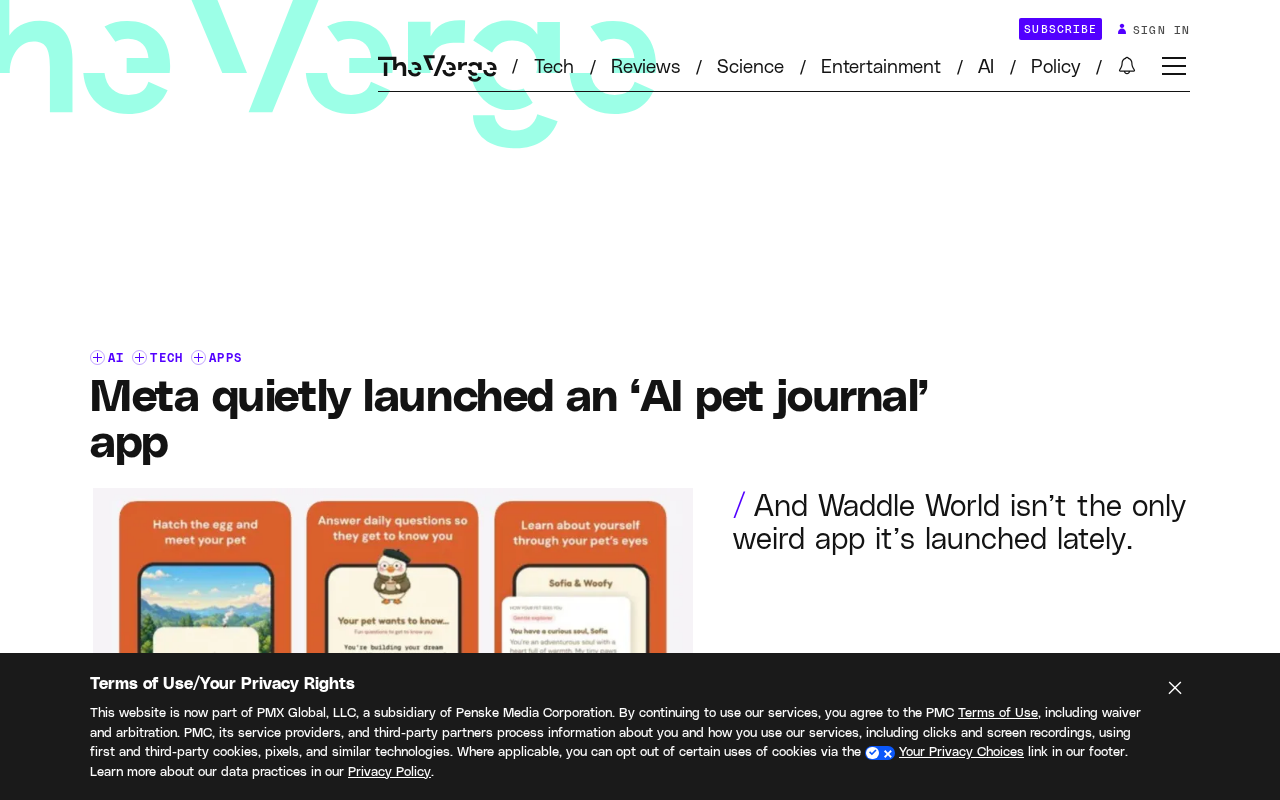
Meta has released an app called Waddle World without any large-scale promotion. According to its App Store and Google Play descriptions, it's packaged as a "16-bit pet-raising game," but the official definition is rather blunt—"a daily diary disguised as a pet."
When Pet Raising Meets the AI Diary
Waddle World's core gameplay revolves around a virtual creature: users interact with the pet through voice conversation rather than typing, and the pet illustrates the conversation with doodles. This design combines the feeding and companionship mechanics of traditional virtual pets with the conversational and image-generation capabilities of generative AI.
"Tamagotchi-style" is the most common analogy outsiders make, but Meta clearly doesn't want users to treat it merely as a game. The store listing explicitly emphasizes that this is not a game but a diary—a daily expression tool that uses a pet character to lower the barrier to journaling.
Tamagotchi is a handheld raising toy released by Bandai in 1996, in which players care for a virtual creature on screen by feeding, cleaning, and playing with it; its core mechanic is low-barrier continuous companionship and emotional projection. This form established the interaction paradigm for subsequent virtual pet products: simple, repetitive care actions, anthropomorphic feedback, and a sense of nurturing that accumulates with time spent. Waddle World borrows this shell, replacing traditional feeding and companionship with voice conversation—the pet shifts from being the object of care to a listener, and the raising mechanic shifts from numerical growth to the accumulation of conversation records. Understanding this prototype helps clarify that the product is not pursuing gamification innovation but rather using a familiar pet image to carry the functional scenario of a diary.
Voice-First: The Trade-offs of Interaction Design
What's intriguing is the prompt to "talk, not type." Diary apps typically rely on text input, whereas Waddle World makes voice the primary entry point, meaning Meta is trying a lighter recording path: users tell the pet about their day, and the AI handles understanding and generating visual feedback.
This design may reduce the psychological burden of journaling, but it also raises questions about privacy and scenario limitations—how the privacy of voice diaries is handled and whether they can be used in noisy environments are not elaborated in the current official information.
The privacy differences between voice diaries and text diaries deserve separate mention. The data surface of a text diary is mainly text, whereas a voice diary involves biometric and contextual information such as voiceprints, intonation, and ambient sound at the collection stage, making it significantly more sensitive. Common industry practices include on-device preprocessing, discarding raw audio immediately after speech-to-text conversion, and specifying clear data retention periods—but Waddle World's store page currently does not disclose its audio processing pipeline. In addition, voice input imposes hard requirements on usage scenarios: commuting, offices, and shared family environments are all unsuitable for speaking aloud, which limits the trigger frequency of journaling. By contrast, text input, though psychologically more demanding, is almost unrestricted by scenario—which is why most diary products still use text as their primary entry point.
Another Member Added to Meta's AI App Matrix
Waddle World's "quiet launch" fits Meta's recent style of testing the waters in consumer AI apps. Compared with high-profile AI assistant launches, these small, vertical products feel more like tests of users' real acceptance of AI companionship formats.
In terms of positioning, it hits two tracks at once: AI companionship apps and light diary tools. The former is fiercely competitive and highly homogenized, while the latter generally suffers from low user retention. Using a pet-plus-doodle combination for differentiation is one solution Meta offers, but whether it can work remains to be seen.
The app is currently available on the Apple and Play stores; specific feature details and regional availability are subject to the store pages.
AI companionship apps and light diary tools are two categories with completely different user retention logic. Retention in AI companionship products depends on the continuity of character personality and the establishment of emotional attachment; once conversational memory breaks or the personality drifts, user churn can be very rapid. Light diary tools depend on habit formation, with retention curves typically dropping sharply in the first two weeks—only products that can cross the habit threshold have a chance at long-term use. Waddle World attempts to solve the habit problem of diary products with a pet personality—users don't open the app to record but to talk to the pet, and recording becomes a byproduct. The cost of this approach is that the product's value depends on the persuasiveness of the pet image: if users don't buy into the presence of this pet, the diary function alone isn't enough to support independent use.
One-line Summary
Meta quietly launches Waddle World, an AI voice diary app disguised as a pet.
Paragraph Summary
Meta has launched Waddle World without large-scale promotion, officially defining it as "a daily diary disguised as a pet." The product centers on a virtual creature: users interact with the pet through voice rather than typing, and the pet illustrates the conversation with doodles, combining virtual pet raising mechanics with generative AI's conversational and image capabilities. The store description emphasizes that it's not a game but a diary, aiming to lower the psychological barrier to daily journaling through a pet character. The article analyzes the privacy and scenario limitations brought by the voice-first interaction trade-off, and notes that the product enters both the AI companionship and light diary tracks at once, differentiating itself with a pet-plus-doodle approach and continuing Meta's style of small-step experimentation in consumer AI apps—whether it can work remains to be seen.
Related articles

Vibe Coding Full-Stack in Practice: AI Programming from Beginner to Enterprise Deployment
From Cursor to Claude Code, this Bilibili AI programming course uses four progressive projects to cover full-stack development, open-source secondary development, and team collaboration. The article analyzes the shock to frontend roles, the efficiency shift from 50 people to 5, and the methodology required for enterprise-grade projects.

David Blaine's Global Quest for Real Magic: From South Africa to Japan and India
David Blaine travels to South Africa, Japan, and India in his Do Not Attempt special, documenting Spinning drivers, black mamba rescuers, iaijutsu masters, and ascetics—exploring the boundary between magic and real human极限 challenges.

Is a Touchscreen MacBook Coming? Vergecast Reveals Apple Executive's Response
Vergecast podcast reveals a conversation between a reporter and Apple executive John Ternus about a touchscreen MacBook and Apple Pencil support. Ternus says iPad is the best device for a stylus, while the reporter bets MacBook will eventually support Apple Pencil.