Meta Releases Muse Ember: The Smallest Model on the Efficiency Frontier

Meta launches Muse Ember, competing on the efficiency frontier for high-frequency agentic tasks.
Meta AI releases Muse Ember, a smallest-and-most-efficient model for high-frequency repetitive agentic tasks, benchmarked against Claude Haiku 5.5 and GPT-6 Luna. Short-prompt pricing aligns across all three at $0.10 input and $0.50 output per million tokens—about one-eightieth of Claude Fable 5.2. Long-context thresholds are 200k for Ember, 272k for Luna, and 100k for Haiku; beyond the threshold, Ember's pricing sits in the middle. The article notes that per-token price comparison has become ineffective and shifts to Artificial Analysis's per-task cost metric, where Ember's high-reasoning tiers land on the Pareto frontier. Six-tier reasoning tests show no positive correlation between tier and output quality—the high tier even failed to return a complete SVG, while max-tier output approaches Muse Wonder at 40 times the price. The conclusion: Ember suits specialized execution-layer use, and prompt-length distribution should be a hard selection criterion.
Meta AI has officially launched Muse Ember, its smallest and most efficient model designed for high-frequency, repetitive agentic tasks, aimed squarely at the Claude Haiku and GPT Luna series. The model's core positioning isn't about being a jack-of-all-trades—it's about supporting the day-to-day operations of agents at extremely low inference cost: tool calls, code subtasks, routing, information extraction, and long-document parsing.
The Pricing Game in the Small Model Arena
For short prompts, Muse Ember's pricing aligns exactly with GPT-6 Luna and Claude Haiku 5.5: $0.10 per million input tokens and $0.50 per million output tokens. For comparison, Claude Fable 5.2, released in the same period, is 80 times more expensive at this tier—$8 input and $40 output per million tokens.
Long prompts, however, widen the gap. All three models support up to one million input tokens, but each has its own price-jump threshold. Muse Ember's threshold is 200k, beyond which input rises to $0.30 and output to $1.50. GPT-6 Luna's threshold is 272k, after which input is $0.20 and output $0.75. Claude Haiku 5.5 has the lowest threshold at just 100k, with input at $0.50 and output at $2.50 beyond it. Adjusted for thresholds, Ember's long-context pricing lands squarely between the other two.
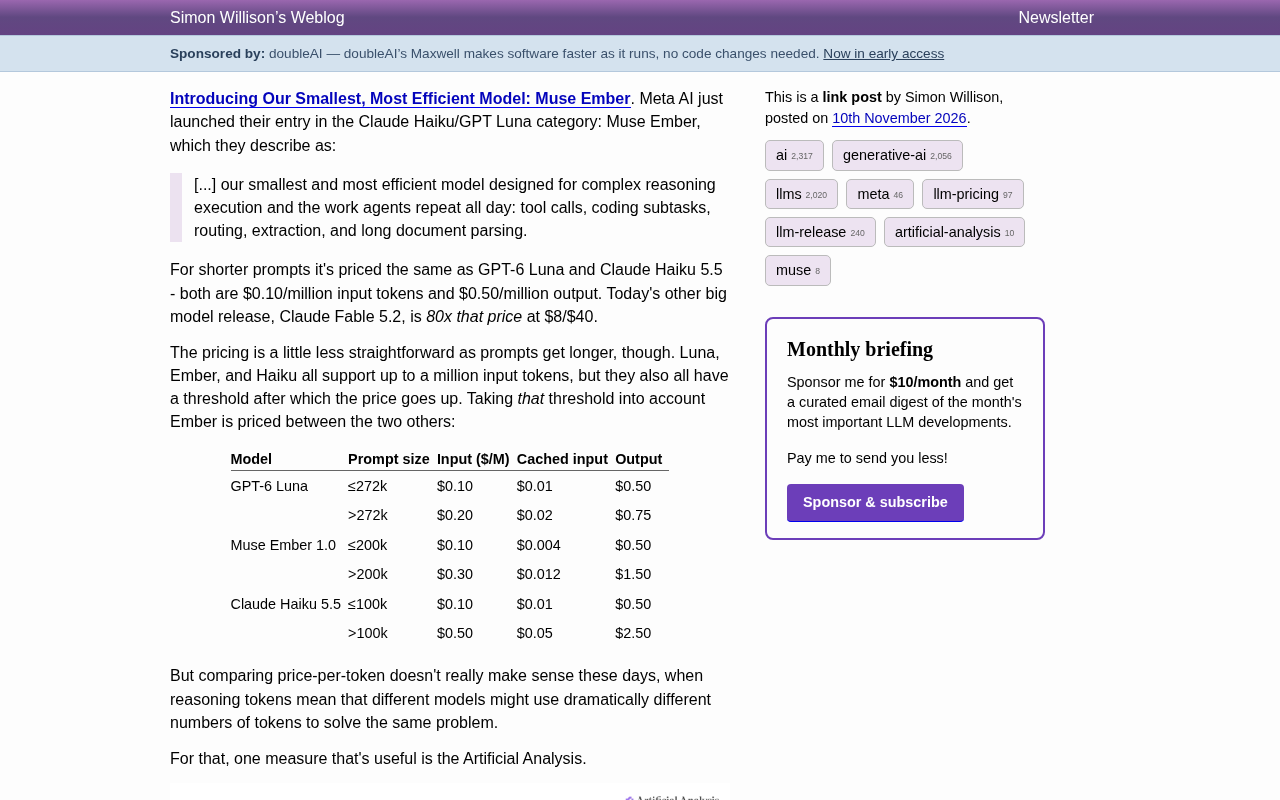
Per-Token Pricing No Longer Tells the Story
With reasoning tokens now mainstream, the value of per-token price comparisons is fading fast—different models can consume wildly different token counts on the same task. What's genuinely useful is Artificial Analysis's task-cost-adjusted comparison.
On the scatter plot of Intelligence Index versus per-task cost, Muse Ember's two high-reasoning tiers sit firmly on the Pareto frontier. Meta explicitly states in its release announcement that the model is on the efficiency frontier of the full leaderboard: no model achieves a higher score at a lower per-task cost. This conclusion gives Meta third-party data backing for its positioning in the small-model race.
The chart also hides an easily overlooked signal: a gray dot for a low-reasoning tier of GPT-6.1 Terra appears on the Pareto frontier. It sits within the green optimal quadrant, meaning the Terra family is worth continued attention on the cost-effectiveness dimension—not just the flagship model deserves discussion.
Artificial Analysis and the Intelligence Index
Artificial Analysis is an independent third-party evaluation organization. Its Intelligence Index is a composite metric that weights multiple standardized benchmarks (reasoning, coding, knowledge Q&A, etc.) into a single score for cross-model comparison of "capability level." Unlike vendor-reported benchmark results, the index's value lies in its unified methodology and reproducibility. More importantly, the organization also measures the actual cost each model incurs to complete the same batch of tasks, placing "capability" and "price" in the same coordinate system. That's why the scatter plot mentioned in the article has per-task cost on the x-axis and intelligence score on the y-axis—a model's position directly reflects cost-effectiveness, not just sticker-price token rates.
Six Reasoning Tiers Analyzed: Higher Tier Doesn't Mean Better Drawing
Muse Ember offers six reasoning effort levels: minimal, low, medium, high, xhigh, and max. In a test generating a "pelican riding a bicycle" SVG from the same prompt, the high tier failed to return a complete SVG, while the remaining tiers showed no clear positive correlation between visual quality and reasoning tier.
This is worth noting for developers: reasoning tiers adjust how much thinking the model invests before answering, but that doesn't necessarily map linearly to the refinement of the final output. For structured-output tasks, blindly cranking up the tier may just add cost rather than improve results.
Take the max-tier pelican: the bicycle frame is structurally complete, there's a fish in the basket, and the pelican is wearing a strange blue hat—overall quality on par with Muse Wonder's output at 40 times the price. For tasks like SVG generation, Ember delivers usable results at a fraction of the unit price.
Reasoning Effort Tiers
Reasoning tiers are a control parameter widely introduced in recent reasoning models. Essentially, they adjust the upper limit of "chain-of-thought" or internal thinking tokens the model may generate before giving its final answer, and whether longer search/self-check processes are enabled. Higher tiers allow the model to iterate, verify, and backtrack more—theoretically beneficial for math, multi-step logic, and similar tasks. But this investment doesn't guarantee better output: for tasks with strong format constraints, simple structure, or that the model already handles well (like generating an SVG), extra thinking tokens may just be redundant confirmation—or even crowd out the structured content actually needed for output due to over-"explaining." That's exactly why the high tier failed while other tiers worked fine.
What the Efficiency Frontier Means
Sitting on the Pareto frontier essentially means any improvement in one dimension must come at the expense of another. For agent developers, this means Muse Ember isn't a "pretty good at everything" general-purpose model—it's a specialized component that pushes capability to the limit under cost constraints.
Its use cases are clear: routing decisions called thousands of times, field extraction, document chunk parsing, and serving as the execution layer in larger agent systems. These tasks have low per-call value but enormous volume, so small differences in unit price and latency get amplified by call frequency into substantial cost differences.
Differences in long-context thresholds also affect architecture choices. If an agent frequently handles inputs over 200k, Ember's price jump kicks in earlier than Luna's. Conversely, in the 100k–200k range, Haiku 5.5 has already entered its high-price tier while Ember remains in the low tier. Prompt-length distribution should be a hard consideration in model selection.
With this entry, Meta pushes competition in the Haiku-class small-model segment toward a battle over the efficiency frontier. For developers, there's now another option for making trade-offs along the Pareto curve. For the industry, the yardstick for small-model value is shifting from parameter counts and benchmark scores to actual output per unit task cost.
Pareto Frontier
The Pareto frontier comes from the economic concept of Pareto optimality: in a set of multi-objective trade-off solutions, a solution is on the frontier if no other solution can improve at least one objective without worsening any other. In the context of model selection, with cost on the x-axis and capability on the y-axis, a point on the frontier means "to be stronger you must be more expensive, to be cheaper you must be weaker"—you can't have both. So "on the frontier" isn't just praise; it's a precise description of a model's positioning—it maxes out capability at a given cost tier, but also means it can't leapfrog in the capability dimension. Developers can use this: frontier points are suitable baselines for cost-sensitive scenarios, while tasks demanding higher capability should turn to models off the frontier at higher prices.
Long-Context Price Thresholds and Tiered Pricing
Mainstream APIs use tiered token-based billing: standard pricing applies within a certain input length, and beyond the threshold the entire request (or the excess portion) is billed at a higher rate. Thresholds exist because the computation and memory overhead of attention mechanisms grows superlinearly with sequence length, and providers pass the real cost of long context on to users. For agents, this means prompt-length distribution is a hard constraint in model selection: if typical requests cluster around 150k, a model with a 100k price-jump threshold will be significantly more expensive, while a model with a 200k threshold stays in the low tier. Architecturally, chunking, summary compression, and retrieval trimming can keep inputs below the threshold, yielding several-fold cost differences at equivalent capability.
One-line Summary
Meta launches the Muse Ember small model, competing on the efficiency frontier for high-frequency agentic tasks.
Paragraph Summary
Meta AI releases Muse Ember, a smallest-and-most-efficient model positioned for high-frequency repetitive agentic tasks, benchmarked against Claude Haiku 5.5 and GPT-6 Luna. Short-prompt pricing aligns across all three at $0.10 input and $0.50 output per million tokens—about one-eightieth of Claude Fable 5.2. Long-context thresholds are 200k for Ember, 272k for Luna, and 100k for Haiku; beyond the threshold, Ember's pricing sits in the middle. The article notes that per-token price comparison has become ineffective and shifts to Artificial Analysis's per-task cost metric, where Ember's high-reasoning tiers land on the Pareto frontier. Six-tier reasoning tests show no positive correlation between tier and output quality—the high tier even failed to return a complete SVG, while max-tier output approaches Muse Wonder at 40 times the price. The conclusion: Ember suits specialized execution-layer use, and prompt-length distribution should be a hard selection criterion.
Related articles

RePlan-VLA: Progress-Aware Replanning Breakthrough for Long-Horizon Robotic Manipulation
The RePlan-VLA framework converts VLA models' short-horizon capabilities into reliable long-horizon execution through progress-aware adaptive replanning, improving success rates by 21.9% and 10.4% on RoboCasa365 and CALVIN, and validating real-world deployment on a Franka Research 3 robot.

Geometric Bridge Flow Matching: A New Breakthrough in Blind Rigid Motion Correction
Geometric bridge flow matching enables blind rigid motion correction in head CBCT, achieving 37.1 dB PSNR and 0.27 mm RPE on simulated data in ~9.1 minutes, outperforming existing methods.

Google Releases Gemini 4 Hydrogen: 2.5x Faster Without Sacrificing Intelligence
Google releases the lightweight Gemini 4 Hydrogen: 2.5x faster task completion, AA Intelligence Index of 54 beating its flagship sibling, 7.3s single-step on Agent Arena faster than Claude and GPT rivals, four thinking levels with pay-as-you-need pricing, now available across AI Studio and more.