Meta Releases Muse Wonder: A New Breakthrough in AI Creative Generation Models

Meta releases Muse Wonder, earning 275 points and 124 comments on HN, with heated community discussion but unclear technical details.
Meta published the AI creative generation project Muse Wonder on research.meta.ai, earning 275 points and 124 comments on Hacker News, with mid-to-upper attention and high engagement. Community reaction is polarized: some approve of Meta's continued investment in creative generation, while others question its differentiated value against mainstream models like Stable Diffusion and DALL·E. The article argues that if the project continues Meta's accumulation in visual generation and multimodal understanding, it may avoid the crowded text-to-image track and turn toward text-to-video or 3D scenes, but the technical paper, demo, and productization path remain undisclosed. For developers, the recommendation is to stay informed without rushing to invest learning costs.
Meta published a new project called "Muse Wonder" on its official research blog, quickly sparking widespread discussion in the tech community. The post earned 275 points and 124 comments on Hacker News — a solid level of attention — though controversy around its technical details and practical value is equally notable.
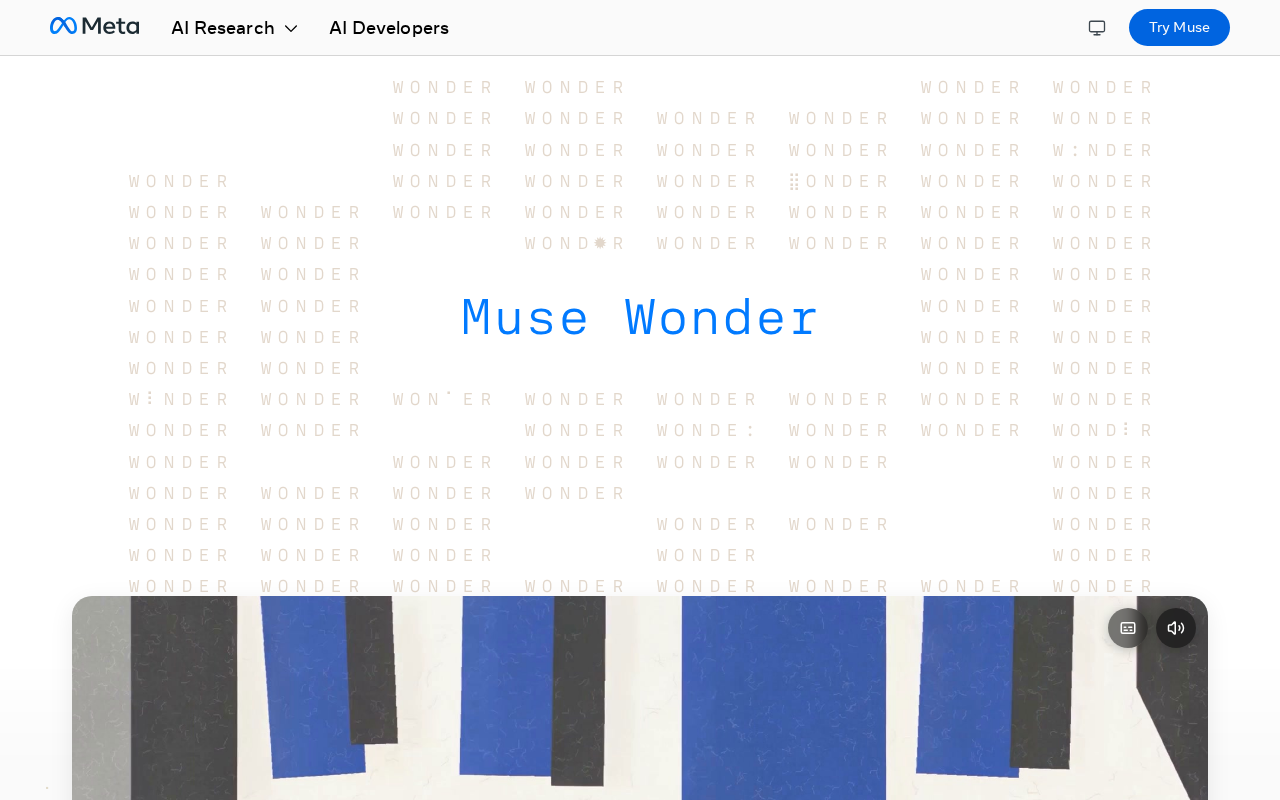
What Is Muse Wonder?
Based on currently public information, Muse Wonder is an AI creative generation project from Meta's research team, published on the official research blog at research.meta.ai. Since the project's specific technical paper and full documentation have not yet been detailed in the source material, we can only infer its positioning from community discussion.
The 124 comments on Hacker News constitute the most concentrated discussion venue at present, with participants focusing on technical architecture, application scenarios, and Meta's strategic positioning in the generative AI space. This density of discussion usually means the project has touched on a core pain point that the developer community cares about.
Key Signals from Community Discussion
In the Hacker News comment section, the discussion shows clear polarization. Some participants approve of Meta's sustained investment in creative generation, believing it aligns with Meta's long-term strategy in the metaverse and virtual content creation. Other commenters question its differentiated value, especially against the backdrop of models like Stable Diffusion and DALL·E already dominating the mainstream.
Interestingly, 275 points is a mid-to-upper level on Hacker News, indicating the project has indeed caught the attention of a considerable number of developers, but has not yet reached "viral" level propagation. The ratio of 124 comments to points (about 0.45) suggests high discussion engagement, with commenters leaning toward in-depth exchange rather than simple upvotes.
Hacker News's points and comments mechanism deserves a brief explanation so readers can understand what this set of data means. Hacker News (HN) is a tech community under Y Combinator where users can "upvote" posts to boost their ranking; points are the net number of upvotes. Points determine a post's position on the front page and how long it stays there, while the comment count reflects discussion depth. Generally speaking, front-page posts range from a few dozen to over a thousand points; 275 points falls in the range of reaching the middle of the front page but being replaced fairly quickly by new content. The comment-to-point ratio (comments ÷ points) is often used as a rough gauge of discussion nature: the higher the ratio, the more users tend to express opinions rather than simply upvote, which is common in controversial topics or those requiring professional judgment; a lower ratio usually indicates popularity-driven content. A ratio of about 0.45 is indeed on the discussion-driven end for HN, consistent with the article's assessment of "in-depth exchange rather than simple upvotes."
Competitive Landscape of the Creative Generation Track
The timing of Muse Wonder's release is worth noting. The AI creative generation field has already moved from "can it generate" to "is the generation good and usable." Meta's choice to launch a new project at this point means it faces a far more complex competitive environment than two years ago.
Judging from Meta's research tradition, its AI team has deep accumulated expertise in visual generation and multimodal understanding. If Muse Wonder continues this technical路线, it will most likely seek breakthroughs in multimodal creative generation (such as text-to-video and text-to-3D scenes) rather than competing head-on in the already highly crowded text-to-image track.
Some voices in the community discussion also pointed out that Meta's research projects often take a long path from release to productization. Whether Muse Wonder will ultimately land as an open-source tool, an API service, or integration into existing products remains unknown.
Multimodal creative generation refers to a model's ability to understand and generate across more than one information modality, such as simultaneously processing text, images, audio, video, or 3D geometric data. Compared with unimodal generation that only does "text-to-image," multimodal systems need to solve the problem of semantic alignment between different modalities — for example, making a text description correspond to the correct object positions and occlusion relationships in 3D space. The technical difficulties in this direction include the high cost of acquiring training data (especially annotated video and 3D scenes), heavy compute consumption, and the lack of unified evaluation standards. Meta has long invested in this direction, and its previous multimodal research work (such as joint vision-language modeling) has accumulated considerable experience. If Muse Wonder indeed falls on the path of text-to-video or text-to-3D scenes, its core challenge will not be "whether the generation looks good," but "whether the generated result is physically and temporally self-consistent."
Significance for Developers and Creators
For developers and content creators interested in AI creative tools, the emergence of Muse Wonder at least sends one signal: Meta is still continuously investing in the creative generation direction. This means more related tools, model weights, or APIs may be opened up in the future.
However, until the official release of more detailed technical documentation and an experienceable demo, it is advisable to stay informed but not rush to invest learning costs. Although the discussion on Hacker News is lively, most comments remain at the level of speculation, lacking first-hand technical verification.
Conclusion
As a new release on Meta's research blog, Muse Wonder has already stirred some ripples in the tech community. The 275 points and 124 comments show it has touched the attention nerves of the developer community, but the project's actual substance still needs to wait for more technical details to be made public. For practitioners in this field, it is a project worth putting on the watchlist, but it is still too early to form a clear judgment.
One-line Summary
Meta releases the Muse Wonder project, earning 275 points and 124 comments on HN, with heated community discussion but unclear technical details.
Paragraph Summary
Meta published the AI creative generation project Muse Wonder on research.meta.ai, earning 275 points and 124 comments on Hacker News, with mid-to-upper attention and high engagement. Community reaction is polarized: some approve of Meta's continued investment in creative generation, while others question what differentiated value it offers against the backdrop of mainstream models like Stable Diffusion and DALL·E already dominating the field. The article argues that if the project continues Meta's accumulation in visual generation and multimodal understanding, it may avoid the crowded text-to-image track and turn toward directions such as text-to-video or 3D scenes, but the specific technical paper, demo, and productization path have all not been made public. For developers, the recommendation at this stage is to stay informed without rushing to invest learning costs, and to wait for more detailed technical verification.
Related articles

Chain of Thought Isn't Just for AI: How Humans Can Use CoT to Improve Thinking Quality
Chain of Thought isn't just a prompt trick for large models. Starting from a Hacker News discussion, this article analyzes why CoT works for human thinking too, breaks down actionable ways to transfer it, and highlights the key differences between human CoT and machine CoT.
Cloudflare Teams Up with OpenAI: Closi…
Cloudflare Teams Up with OpenAI: Closing the Loop from Vulnerability Discovery to Defense with AI
Cloudflare uses OpenAI Daybreak to investigate security vulnerabilities and generate reviewable remediation plans, while developers use Codex to boost coding efficiency and quality.

Orca Multi-Agent Orchestration in Practice: A Guide to Parallel Collaboration with Claude and Codex
Orca is Stable AI's free open-source agent workbench supporting 34 agents like Claude Code and Codex in parallel. Learn its Git worktree isolation, multi-model orchestration, and mobile management.