Meta Releases Muse Wonder: The Personal Superintelligence Model Arrives

Meta releases Muse Wonder, centered on personal superintelligence and entering the consumer agent race.
Meta released Muse Wonder, centered on Personal Superintelligence for everyday life, with the internal Personal Superintelligence Index benchmark. It highlights Active Memory across conversations and Active Focus for long tasks. The model will power Meta's personal agent Muse, first for paying subscribers, signaling a consumer-assistant path rather than a developer coding tool. Muse Wonder Full reportedly leads on long-horizon coding benchmarks like DeepSuite but is only in Meta's coding subscription; the lightweight version is available via API.
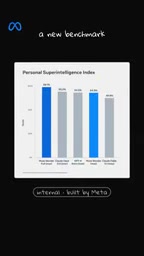
Meta recently released the Muse Wonder model, with the entire launch centered on one core concept: Personal Superintelligence. According to Meta, this refers to a model that is genuinely useful in ordinary people's daily lives, rather than yet another coding agent. To measure this type of capability, Meta also created an internal benchmark—the Personal Superintelligence Index.
Two Core Features: Active Memory and Active Focus
Meta focused on two features with Muse Wonder.
Active Memory means the model can carry key information about you across conversations, so you don't need to re-explain your background and preferences each time. This addresses the pain point of most current assistant products, which "start from scratch in every conversation."
Active Focus allows the model to keep working on long tasks, proactively try different approaches when it gets stuck, and confirm with you before executing important actions.

In one Meta demo, Wonder can work across browsers and other apps, combining your preferences to generate a running plan. This scenario demonstrates exactly the positioning of "personal superintelligence"—it handles life matters, not coding tasks.
Active Memory is fundamentally different from a traditional "context window" or "memory store." Most current assistants rely on the context window of a single session; once the conversation ends, the information is cleared. Some products do have cross-session memory, but users usually need to save or invoke it manually, which is essentially still "passive retrieval." Active Memory means the model itself judges which information is worth retaining long-term—for example, your daily routine preferences, frequently used tools, and dietary restrictions—and can call it up in later conversations without prompting. This involves three layers of mechanisms: memory writing, retrieval, and forgetting, and it also brings new challenges: how to ensure memory accuracy, how to define privacy boundaries, and how to correct erroneous memories. These questions are precisely the technical foundation that determines whether a personalized experience can hold up.
Muse: Meta's Personal Agent
Muse Wonder will also become the model that powers Muse. Muse is Meta's personal agent, and it will first be made available to paying subscribers.

This means Meta has chosen a path in the agent race that differs from coding agents: an everyday assistant for ordinary consumers, rather than a programming tool for developers. The fact that a paid subscription is the first launch channel also shows that Meta views Muse as a commercializable consumer product.
Agent generally refers to a form of large-model application that can autonomously break down goals, call tools, and execute multi-step operations. Over the past year, the most mature agent deployment scenario in the industry has been coding agents, such as programming assistants that can read and write code repositories, run tests, and submit PRs, because programming tasks have clear verification standards and standardized tool interfaces. Everyday agents for ordinary consumers are more difficult: task boundaries are blurry ("help me plan my weekend" has no single correct answer), they involve cross-app operations, and the cost of failure falls directly on user experience. Meta's choice to enter from consumer scenarios is essentially testing whether agents can upgrade from "task executors" to "life collaborators," which is a harder proposition than coding agents.
Coding Capability Has Not Been Abandoned
Muse Wonder still has coding capabilities. According to Meta, the larger-scale version, Muse Wonder Full, is in a leading position on long-horizon coding benchmarks such as DeepSuite.
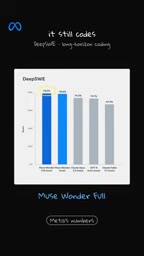
This also reveals Meta's product tiering strategy: the lightweight version is opened to developers through an API, while the full version is only available in Meta's coding subscription service.
Long-horizon Coding Benchmark refers to a test set that evaluates whether a model can maintain goal consistency after operations requiring dozens or even hundreds of steps, spanning multiple files and tool calls. DeepSuite belongs to this category. It measures not only single-point code generation ability, but also whether the model loses direction during long tasks, whether it can recover from errors, and whether the final output is runnable. Such benchmarks are valued because they are closer to the real software development process—real projects can rarely be completed with a single generation. Meta's emphasis that Wonder Full leads on such benchmarks is intended to show that its underlying model capability has not been compromised by the "personal" positioning; only the productization path has been tiered.
Availability and Questions Yet to Be Verified
Muse Wonder is currently available through Meta's API, while the full version exists only within Meta's coding subscription.
The real suspense is whether this "personal" positioning can be delivered in actual experience once users begin using it at scale. The accuracy of cross-conversation memory, the timing of proactive confirmation during long tasks, and the stability of cross-app collaboration are all key to the success or failure of such products. Meta scoring itself with a self-built benchmark is one thing; users voting with their daily needs is another.
From an industry perspective, Meta's move also marks a shift in large-model competition: after general capabilities and coding capabilities become increasingly homogenized, "deep understanding of the individual" may become the next battlefield for differentiation.
Internal Benchmark has become commonplace in AI launches, but its credibility has always been controversial. The advantage of a vendor's self-built benchmark is that it can precisely measure the capability dimensions the company wants to emphasize; for example, the Personal Superintelligence Index clearly focuses on everyday task handling rather than general Q&A. The risk is that the test set, scoring criteria, and data distribution are all undisclosed, so outsiders cannot reproduce it, and it can easily turn into "writing your own exam and grading it yourself." The industry more readily recognizes validation methods that combine third-party benchmarks with real user retention data. Therefore, Meta using a self-built index to prove "personal superintelligence" capability is only the first step; actual performance after the user base expands will be stronger evidence.
One-line Summary
Meta releases Muse Wonder, focusing on personal superintelligence and entering the consumer agent race with active memory and active focus.
Paragraph Summary
Meta recently released the Muse Wonder model, with the core concept of "personal superintelligence" aimed at ordinary people's daily lives, along with the internal Personal Superintelligence Index benchmark. The model focuses on two features: Active Memory, which lets the model retain key user information across conversations; and Active Focus, which enables it to autonomously switch approaches during long tasks and confirm before important actions. Muse Wonder will power Meta's personal agent product Muse, first available to paying subscribers, marking Meta's choice in the agent race of a consumer everyday assistant rather than a developer coding tool. Meanwhile, the full version, Muse Wonder Full, is said to lead on long-horizon coding benchmarks such as DeepSuite, but is only offered in Meta's coding subscription; the lightweight version is already open through the API. Whether the personalization positioning can be delivered in real-world use remains to be verified.
Related articles

Gmod TTT: Boba's Winning Streak and Game Design Insights
An in-depth analysis of Gmod TTT's role system, creative items, and social gameplay mechanics, exploring the relationship between randomness design and game balance through Boba's winning streak phenomenon.

FlexBudget: Fair Comparison of KV Cache Eviction Strategies Under a Unified Compute Budget
AMD engineer proposes FlexBudget at PyTorch Conference: a training-free fair comparison method for KV cache eviction rules using fixed kernels and memory budgets, all in core PyTorch.
