Meta Removes Controversial Clause: No Longer Explicitly Allowing Scraping of News Site Content for AI Training

Meta removes terms language that could authorize scraping news content for AI training, responding to public pressure.
Meta recently updated its terms of service, removing broad authorization language that could have allowed it to scrape third-party content such as news websites to train AI. The move is seen as a response to criticism from news publishers and creators, and reflects compliance pressure over AI training data sources. The article notes that the removal does not mean Meta will stop using public content to train AI, but rather avoids explicit authorization disputes. The industry is shifting from a rough "scrape first, explain later" model to a phase focused on compliance and authorization, but how AI training data is acquired remains the core conflict, and real protection requires clearer legal frameworks and industry standards.
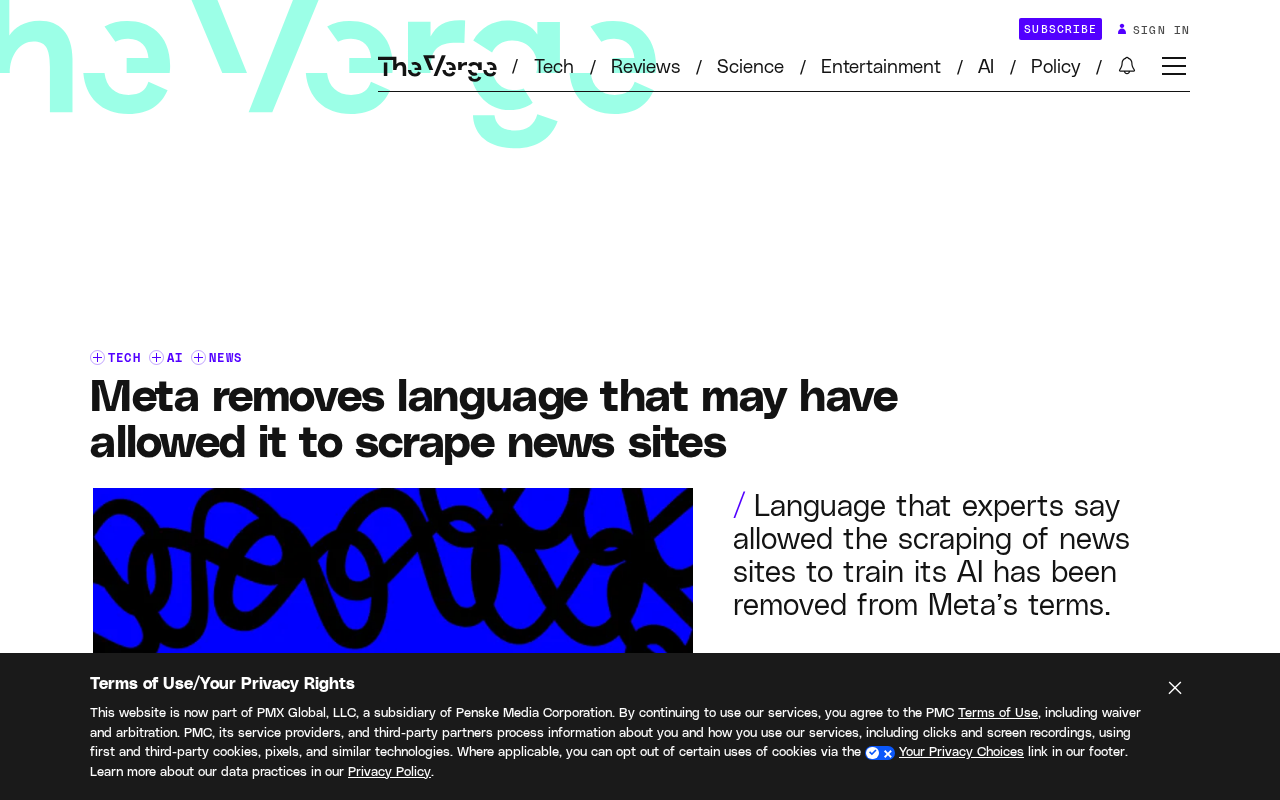
Meta recently updated its terms of service, removing language that could have allowed it to scrape content from news websites and other sources to train AI. This change is a response to external criticism and reflects the compliance pressure surrounding AI training data sources.
Clause Revision: From Vague Authorization to Explicit Restriction
According to RSS, Meta has removed a passage from its terms of service page that originally stated Meta could use any content from specific domains, web pages, or URLs to "provide, develop, and improve" its services. Although the full original text is not shown, in context this amounted to a broad authorization for Meta to scrape third-party website content (including news sites) to train AI models.
The removal of the clause does not mean Meta will stop using public content to train AI, but rather avoids an explicit written authorization dispute. This kind of "textual adjustment" is not uncommon among tech giants: they want to retain flexibility in data acquisition while avoiding public and regulatory criticism.
Terms of Service are legal contracts between tech companies and their users and business partners, typically granting platforms rights to use user-generated content, third-party web data, and other resources. In AI training scenarios, platforms often use broad language in their terms to frame scraping public data as an incidental right of "providing services" or "improving products," thereby circumventing licensing obligations under traditional copyright law. The legal basis for this approach is that publicly accessible content is not equivalent to content freely usable for commercial AI training, but the ambiguity of the terms allows platforms to operate in a gray area. Meta's removal of the relevant language is essentially a withdrawal of a "pre-authorization," rather than an admission that its previous conduct was unlawful.
Public Pressure and Industry Context
Meta's move is not an isolated incident. In recent years, the use of web content by large tech companies to train AI models has continued to spark controversy. News publishers, content creators, and copyright holders have repeatedly accused tech companies of using their content without permission or without paying reasonable fees. Meta's terms revision comes against this backdrop.
It is worth noting that Meta, the parent company of Facebook and Instagram, is not the only company facing such scrutiny. OpenAI, Google, and others have also come under examination over the sources of their AI training data. The industry is shifting from a rough "scrape first, explain later" model to a phase that places greater emphasis on compliance and authorization.
Copyright compliance for AI training data is a focal issue in global regulation today. The U.S. Copyright Office has held multiple rounds of public comment on whether the use of copyrighted works in AI training constitutes "fair use," while the EU AI Act requires general-purpose AI models to disclose summaries of their training data. At the same time, organizations such as news publisher alliances and creator associations continue to pressure tech companies to pay licensing fees for content scraping or at least provide an opt-out mechanism. Against this backdrop, terms adjustments by tech companies are often a form of "regulatory anticipation"—proactively tightening written authorizations to reduce the risk of future lawsuits or penalties, while retaining flexibility to acquire high-quality datasets through bilateral licensing agreements.
Potential Impact on the Content Ecosystem
The removal of the clause may ease tensions between Meta and news organizations in the short term, but in the long run, how AI training data is acquired remains the core conflict. If tech companies no longer explicitly authorize scraping through their terms, they may turn to other channels, such as signing licensing agreements with publishers or relying on datasets for which authorization has already been obtained.
For content creators and publishers, this change is a positive signal, but it is far from enough. Real protection requires clearer legal frameworks and industry standards, not just unilateral terms adjustments by companies.
Shifting from "terms-authorized scraping" to "licensing agreement acquisition" implies a transformation in the data transaction model. Traditionally, tech companies relied on crawler technology to scrape public web pages in bulk—extremely low cost but high legal risk; the licensing agreement model requires negotiating with publishers one by one—higher cost but clear rights and responsibilities. For large news organizations, this could bring new revenue streams; for small and medium-sized creators, they could be marginalized due to insufficient bargaining power. In addition, opt-out mechanisms such as robots.txt are respected by some platforms but lack legal enforceability, and industry standards have yet to be established.
Conclusion
Meta's removal of the controversial clause is a tactical adjustment in response to public pressure, not a strategic pivot. The compliance issue of AI training data will continue to intensify, and the contest between tech companies and content providers is far from over.
Related articles

Understanding DeepSeek in 3 Minutes: The Rise from a Quant Hedge Fund to an Open-Source AI Leader
DeepSeek's history in 3 minutes: from High-Flyer Quant's compute build-up to V2's MLA inference cost cuts, V3's $5.576M training bill, R1's open-source global shock, and V4 with a $7B Series A.

Local Creative Writing Model Showdown: Fine-tuned Qwen3.8 27B Wins, DeepSeek v4.1 Underwhelms
Bilibili creator tests seven local creative writing models: Hemingway and HumanLike Chat based on Qwen3.8 27B perform best, DeepSeek v4.1 is plain, Dongfang Shuo ranks last with confused characters. Includes three test prompts, scores, and usage advice.

Liang Wenfeng's Three Big Bets: Why Did DeepSeek Open-Source Its 82% Gross Margin?
Why did DeepSeek open-source DeepInfer, its 82% gross margin inference framework, and then launch a hundred-billion funding round? An analysis of Liang Wenfeng's three big bets and the open-source strategy.