Meta's Liquid-Cooled Network Rack IcePack: How Cooling Becomes a New Network Resilience Mandate

Meta's first liquid-cooled network rack IcePack signals that cooling events can directly become connectivity events for AI infrastructure.
Meta's engineering blog announced IcePack, its first liquid-cooled network rack, and the accompanying IceCube switch blade—a 102.4 Tbps platform with 128×800G non-blocking switching, available with Broadcom Tomahawk6C or NVIDIA Spectrum-6 chips running FBOSS and SAI. The article argues that once liquid cooling enters network racks, cooling equipment maintenance, isolation, or failure can directly cut network connectivity, so network resilience reviews must incorporate switch cooling dependencies. It recommends mapping cooling dependencies onto network dependencies, identifying whether redundant paths share the same thermal resource, defining thermal alarm response sequences and post-recovery checks, and clarifying measurement boundaries for thermal efficiency claims—including pump and heat rejection energy—while reviewing service access and responsibility in liquid-cooled environments.
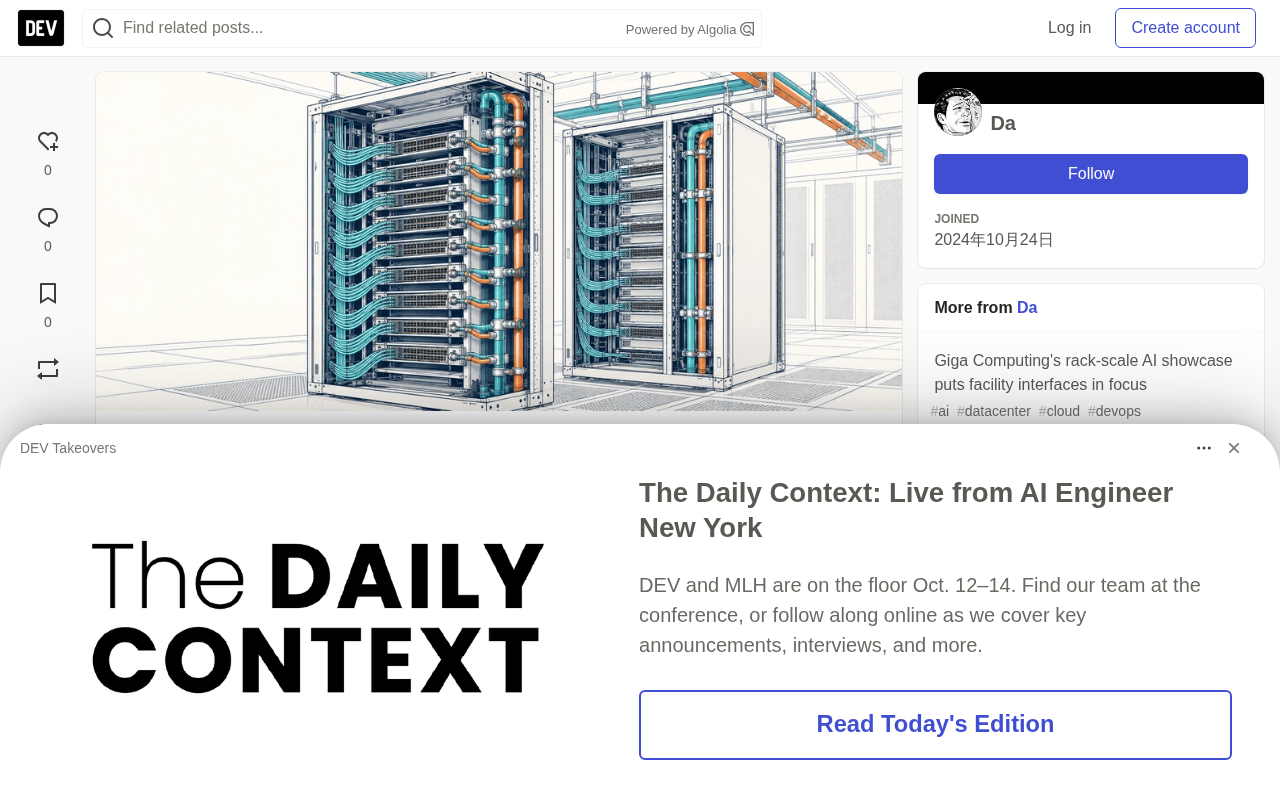
When cooling systems extend into network racks, a single facility event can escalate into a connectivity event. According to a post on Meta's engineering blog, the company has unveiled its first liquid-cooled network rack, IcePack, along with the accompanying IceCube switch blade. This development deserves attention from AI infrastructure teams at the design review stage—especially when the network carries communication between AI accelerators.
IcePack and IceCube: What Meta Announced
Meta describes IceCube as a 102.4 Tbps platform with 128×800G non-blocking switching capacity, available in versions based on Broadcom Tomahawk6C or NVIDIA Spectrum-6 chips, both running FBOSS and the Switch Abstraction Interface (SAI).
These figures come from the operator's own disclosure and describe platform specifications—they don't directly translate into application throughput or reproducible energy savings. In other words, this update provides an architectural direction, not a complete deployment blueprint that buyers can copy wholesale.
FBOSS is Meta's open-source switch operating system that runs on switch hardware, handling forwarding-plane control, routing protocols, and low-level driver management. The Switch Abstraction Interface (SAI) is a vendor-neutral API layer that abstracts the capabilities of different switch chips (such as Broadcom and NVIDIA) into a unified programming interface, so upper-layer software doesn't need to rewrite logic for each chip. IceCube offering versions based on both Broadcom Tomahawk6C and NVIDIA Spectrum-6 is precisely enabled by the FBOSS + SAI combination, allowing the same network software stack to run across chip platforms. For buyers, this means relatively lower software ecosystem lock-in risk, but the underlying chip still determines capacity, latency, and the available feature set—so procurement teams still need to confirm whether the target version fully supports the required features.
800G non-blocking switching means each port can simultaneously send and receive at 800 Gbps without internal congestion, and 128 such ports aggregate to a total switching capacity of 102.4 Tbps. Non-blocking is a key metric for whether a switch can maintain line-rate forwarding under high load, and it's especially important for bursty traffic patterns like All-Reduce in AI training clusters.
Why Cooling Becomes a Network Resilience Issue
In traditional data centers, network racks and cooling systems are typically managed as two separate domains. Liquid cooling changes this boundary—when coolant lines run directly into switch racks, maintenance, isolation, or failure of cooling equipment can directly cut network connectivity.
My assessment is that the practical impact of this shift is both thermal and organizational: network resilience reviews need to incorporate the cooling dependencies of switching equipment. The following design questions can help project teams put this shift into practice.
In traditional air-cooled data centers, switch rack cooling is handled by room air conditioning and ductwork, with network teams and facilities teams typically operating in separate domains. Cooling failures generally manifest first as temperature alarms, then propagate to equipment through relatively long thermal time constants. Liquid cooling dramatically shortens this chain: coolant flows directly through cold plates or heat exchange units inside the switch rack, and once a pump, valve, pipe, or coolant distribution unit (CDU) fails or requires isolation for maintenance, heat removal capacity drops within seconds to minutes, potentially triggering protective throttling or shutdown of switch chips. As a result, cooling system maintenance windows, isolation points, and control logic effectively become part of the network availability path—a coupling that didn't exist in the air-cooled era.
Mapping Cooling Dependencies onto Network Dependencies
Start by cataloging the services and workloads that depend on each switch, then add the cooling equipment, distribution paths, and control systems needed to keep those switches operating within supported conditions.
This merged dependency graph should reveal whether seemingly independent network paths depend on the same thermal resource. If switches at both ends share the same component that's under maintenance or isolation, then redundant connections may offer limited value during a cooling event.
This is a suggested review methodology, not a judgment on Meta's implementation. The answer depends on the buyer's own layout. Have network and facilities teams jointly mark the boundaries, then confirm that maintenance plans use the same set of boundaries.
Defining Behavior During Thermal Alarms
Cooling alarms need a response sequence that both teams understand. Clarify the available sensor signals, equipment limits, and what actions are permitted before protective shutdown triggers.
Determine who has authority to migrate traffic, pause workloads, isolate equipment, or abort maintenance tasks. Tie decisions to validated, real-world conditions. With only a generic alarm level, operators may not be able to tell whether affected services still have usable backup paths.
The handoff process should also specify what happens after cooling is restored. Restoring a pump or valve doesn't by itself mean the network is ready to carry the original load. Define the checks required before restoring traffic and closing the incident.
Reviewing Service Access While the Network Is Still Running
Liquid cooling connections change how technicians physically access network components. Request supported replacement procedures, isolation points, and coolant handling requirements, and confirm whether the task can be completed while adjacent equipment remains running.
Bring physical cabling planning into the discussion as well. High-density fiber layouts make access difficult, and the space needed for cooling interventions may overlap with network maintenance space. These issues should be resolved before racks are fully populated.
Also document who supplies replacement parts and who bears responsibility when a failure spans both switching and cooling domains. Customers should have a clear escalation path rather than having to figure out on their own which vendor owns an unfamiliar symptom.
Measuring System Boundaries That Matter to Customers
Claims about thermal efficiency improvements require a clearly defined measurement boundary. For buyer evaluation, document the load, environmental conditions, cooling settings, and equipment configuration used in testing.
Include supporting equipment in energy consumption discussions. Moving heat rejection to liquid cooling loops may change where energy is consumed and measured. First agree on which pumps, heat rejection equipment, and other supporting loads should be included in the comparison, then report results under those conditions.
Pair performance and reliability evidence with this record. Procurement teams need to understand how the system behaves during planned interventions, not just during steady-state operation. Well-scoped testing is useful—provided its boundaries remain visible.
Common metrics for evaluating liquid cooling solutions include PUE (Power Usage Effectiveness) and pPUE (partial PUE). PUE is the ratio of total data center energy consumption to IT equipment energy consumption, and liquid cooling shifts some heat rejection from room air to liquid loops, moving where energy is "consumed" from the IT side to the cooling side. If supporting loads such as CDUs, pumps, dry coolers, or cooling towers aren't included in the boundary, PUE figures will look better but total energy consumption may not actually decrease. Buyers should therefore require vendors to clearly state: which boundary level is being reported, whether liquid loops and heat rejection equipment are included, and what the inlet water temperature and ambient temperature were during testing. Only when compared under the same boundary and same conditions do thermal efficiency claims have procurement value.
What This Means for AI Infrastructure Teams
Meta's IcePack announcement makes liquid-cooled networking a concrete design issue for AI infrastructure teams. For technical B2B vendors, the opportunity lies in integrating thermal planning, network dependency mapping, and service procedures into a single review. When the cooling system itself demands attention, this work gives operators a clearer basis for maintaining connectivity.
The real test of a liquid-cooled network rack isn't how high the peak specifications are—it's whether the operational boundaries between thermal and network domains can be clearly defined, rehearsed, and handed off.
Related articles

Gmod TTT: Boba's Winning Streak and Game Design Insights
An in-depth analysis of Gmod TTT's role system, creative items, and social gameplay mechanics, exploring the relationship between randomness design and game balance through Boba's winning streak phenomenon.

FlexBudget: Fair Comparison of KV Cache Eviction Strategies Under a Unified Compute Budget
AMD engineer proposes FlexBudget at PyTorch Conference: a training-free fair comparison method for KV cache eviction rules using fixed kernels and memory budgets, all in core PyTorch.
