Meta Takes Another Swing at VR Glasses: Lightweight Design Meets IMAX Entertainment

Meta bets on lightweight design and IMAX viewing to finally break VR glasses into the mainstream.
Meta has announced a return to the VR glasses space, this time centered on two core propositions: a lightweight form factor that approaches the comfort of everyday eyewear, and an enhanced entertainment experience anchored by IMAX-level viewing. With most current headsets exceeding 500 grams, comfort remains the fundamental adoption barrier that lightweight design directly targets. On the content side, Meta is expanding beyond its gaming-centric roots toward passive entertainment, positioning the device as a portable personal cinema. These moves reflect a broader strategic shift — away from spec stacking and toward user experience and content ecosystem — in search of a more practical path to mainstream adoption of its long-running metaverse vision.
Meta Re-enters the VR Glasses Arena
Meta is once again setting its sights on VR glasses. Unlike its previous headset products, this push centers on two core propositions: a lighter, more wearable form factor, and a significantly enhanced entertainment experience. For a company that has poured enormous capital into VR hardware without ever truly cracking the mass market, this shift carries real strategic weight.
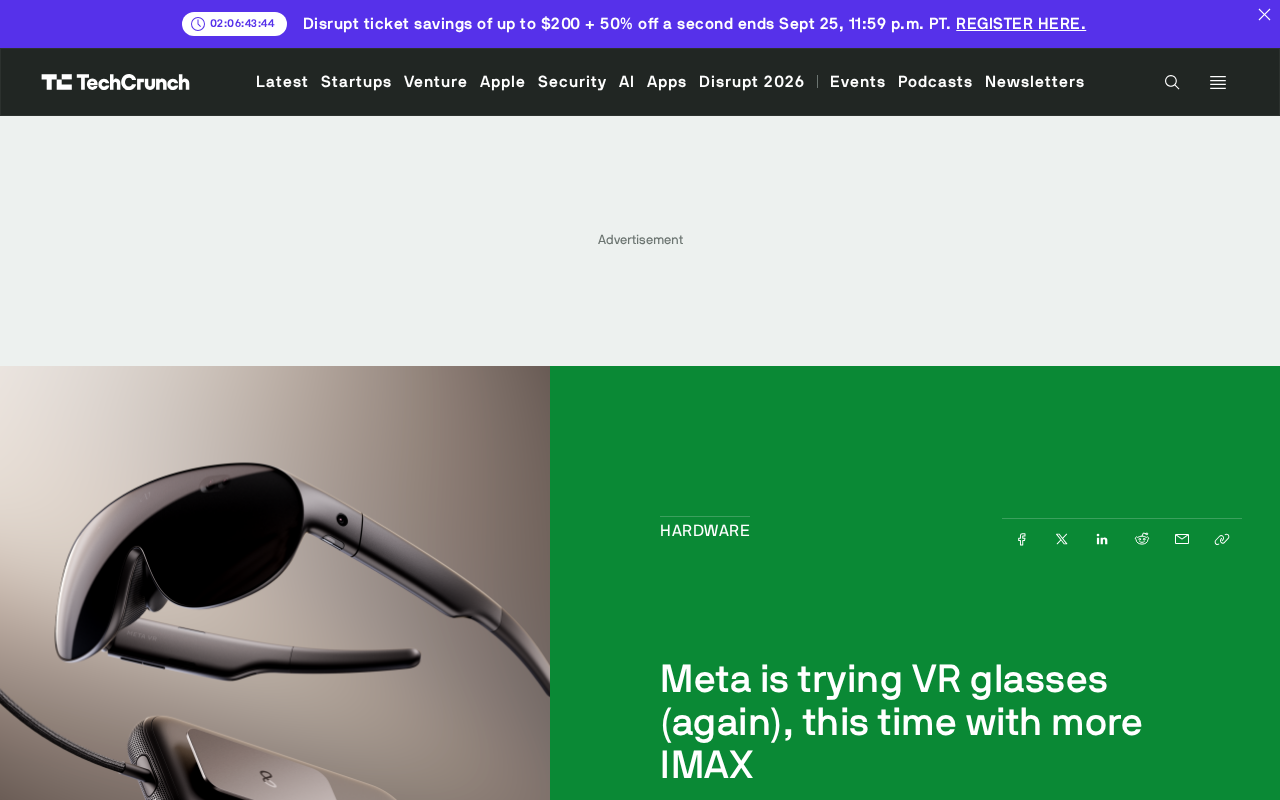
Meta's previous VR lineup was anchored by the Quest series of headsets, which carved out a foothold in gaming and enterprise use cases but drew consistent complaints about bulk and wearing comfort. The return to a "glasses" form factor signals that the company is trying to solve the most fundamental barrier to consumer adoption — making a device people are actually willing to wear for extended, everyday use.
Lightweight Design: The Critical Threshold for VR Adoption
The emphasis on a lightweight form factor at the top of the official narrative is no accident. Most mainstream VR headsets today weigh upward of 500 grams, and prolonged use routinely leads to facial pressure and neck fatigue — directly limiting how long and how often people reach for the device.
If Meta can meaningfully reduce weight while maintaining performance — bringing the wearing experience closer to that of ordinary glasses — then the leap from "occasional novelty" to "everyday wearable" becomes genuinely plausible. This aligns with the industry's broader expectation for next-generation XR devices: the closer the form factor gets to traditional eyewear, the higher the likelihood of mainstream acceptance.
Existing devices offer useful reference points: the Apple Vision Pro weighs approximately 600 grams, the Meta Quest 3 around 515 grams, and the Sony PlayStation VR2 roughly 560 grams. Standard optical glasses, by contrast, typically weigh just 20–40 grams. That order-of-magnitude gap illustrates the formidable engineering challenge of "glasses-grade" VR — achieving sufficient display brightness and field of view (FOV) within a thinner lens structure while miniaturizing compute and power components enough to preserve balance. Some manufacturers address this by offloading the compute module to a belt pack or neck-worn unit, but that reintroduces cable management headaches. Whether Meta can genuinely deliver all three — cordless, lightweight, and high-performance — is the central benchmark for evaluating how far this product pushes the technical frontier.
The IMAX Entertainment Experience
The other headline feature of this generation is an enhanced entertainment offering, specifically including IMAX-related content experiences. IMAX represents large-format, immersive cinema standards, and bringing that into a pair of VR glasses signals that Meta wants to position the device as a portable personal IMAX theater.
Shifting from Gaming to Content Consumption
VR's primary use case has historically been gaming and interactive experiences. Passive content consumption — watching films and streaming video — has always represented enormous untapped potential, but has never become a killer application due to insufficient image quality and immersion. Introducing IMAX-caliber viewing is Meta's explicit attempt to unlock that market.
For the average consumer, slipping on a lightweight pair of glasses and getting a cinema-quality viewing experience is a value proposition far easier to grasp and accept than complex VR gaming. The richness of available entertainment content is often what determines whether a device retains its users.
In technical terms, applying IMAX as a specification in VR typically points to higher display resolution, broader color gamut coverage, and optimized spatial audio processing — not merely brand licensing. IMAX Enhanced certification requires devices to meet 4K HDR or better image quality standards and support DTS:X or Dolby Atmos immersive audio. For VR glasses specifically, delivering an "IMAX experience" also depends on a high enough pixels-per-degree (PPD) count to eliminate the screen-door effect, and a horizontal FOV exceeding 90 degrees to replicate the visual envelopment of a large screen. Content licensing is another critical variable — without a stable library of IMAX content to back the hardware, spec-sheet advantages will struggle to translate into sustained user retention.
Meta's Strategic Calculus
The word "again" in the headline is telling. It reminds us that Meta's journey through VR and XR has been far from smooth, with multiple previous attempts failing to ignite the consumer market. This renewed emphasis on lightweight design and entertainment reflects a meaningful strategic recalibration: moving away from pure spec accumulation and back toward the fundamentals of user experience and content ecosystem.
Zooming out, this is also a continuation of Meta's long-term bet on the metaverse vision. Iterating on hardware form factors is, at its core, about laying the groundwork for a more immersive digital world. Lightweight glasses paired with quality content represent one of the most pragmatic paths to mainstream adoption.
Since Meta rebranded and went all-in on the metaverse in 2021, the Reality Labs division has accumulated losses exceeding $60 billion (through 2024). That scale of sustained investment is exceptional even by tech industry standards, and it means every new product launch is scrutinized as a test of strategic conviction. Meanwhile, the competitive landscape is intensifying: Apple has entered the premium segment with Vision Pro, ByteDance's Pico continues to apply pressure in the mid-range, and Sony remains entrenched in the gaming console ecosystem. Against this backdrop, Meta's pivot toward lightweight design and entertainment is both a response to user feedback and a deliberate move to carve out a differentiated position under competitive pressure — targeting consumers who have little interest in gaming but may have latent demand for portable, immersive entertainment.
Questions Worth Watching
Publicly available information remains limited, and several key questions await answers: Can the device actually achieve a truly "glasses-grade" weight? What will the real-world IMAX image quality and content library depth look like? And will the final price point be accessible to mainstream consumers?
These factors will together determine whether Meta's latest return to this space manages to distinguish itself from previous attempts. For anyone tracking the direction of the XR industry, this product's ongoing disclosures are well worth following.
Related articles

Workbuddy for Absolute Beginners: How a Desktop AI Agent Fits Into Real Workflows
A beginner's guide to the Workbuddy desktop AI agent: installation, claiming credits, file management, and building automated workflows—compared with CodeX for fit and cost, helping professionals shift from AI question-askers to AI managers.

OpenAI's New Agent Stack: Computer Use, Decisions API, and Ultra-Fast Workflows
OpenAI Dev Day unveiled a new agent stack: Computer Use outperforms humans, Decisions API delivers ultra-low-latency classification via Luna, Agents API opens the same Computer Use capabilities, and GPT-6.1 Sol costs only one-seventh of Astra. Core updates, benchmark data, and developer insights.

Liang Wenfeng Open-Sources DeepInfo Inference Framework, Takes On U.S. Ban
DeepSeek open-sources its DeepInfo inference framework after its models, featuring GPU/CPU cross-pipelining, small-model prediction with large-model verification, and full Huawei Ascend and NVIDIA chip support—facing the U.S. federal ban head-on. This article analyzes its significance for AI deployment and open-source strategy.