Meta Teams Up with Apple: Muse AI Model Runs Locally on Mac

Meta releases Muse Spark Open, the first open-weights model to run locally on dual M5 Ultra Mac Studios via Apple's MLX framework.
Meta has released Muse Spark Open, an open-weights model it claims is the most powerful American open-weights model to date and the first of its kind that can run locally on two M5 Ultra Mac Studios via Apple's MLX framework. The significance lies in solving the "last mile" deployment challenge for open-weights models. Apple's MLX framework leverages the unified memory architecture of M-series chips, eliminating CPU-GPU data transfer bottlenecks and enabling consumer-grade hardware to handle desktop-level inference. Meta's MLX adaptation signals that deployability now rivals capability ceiling in importance.
Meta and Apple's collaboration could redefine the boundaries of desktop AI.
An Unusual Partnership
Meta today released the Muse Spark Open AI model, which the company calls "the most powerful American open-weights model to date." But what's more striking than the parameter count is a detail it announced: this is "the first among comparable models" that can run locally on two Mac Studios equipped with Apple M5 Ultra chips, with the help of the latest MLX framework.
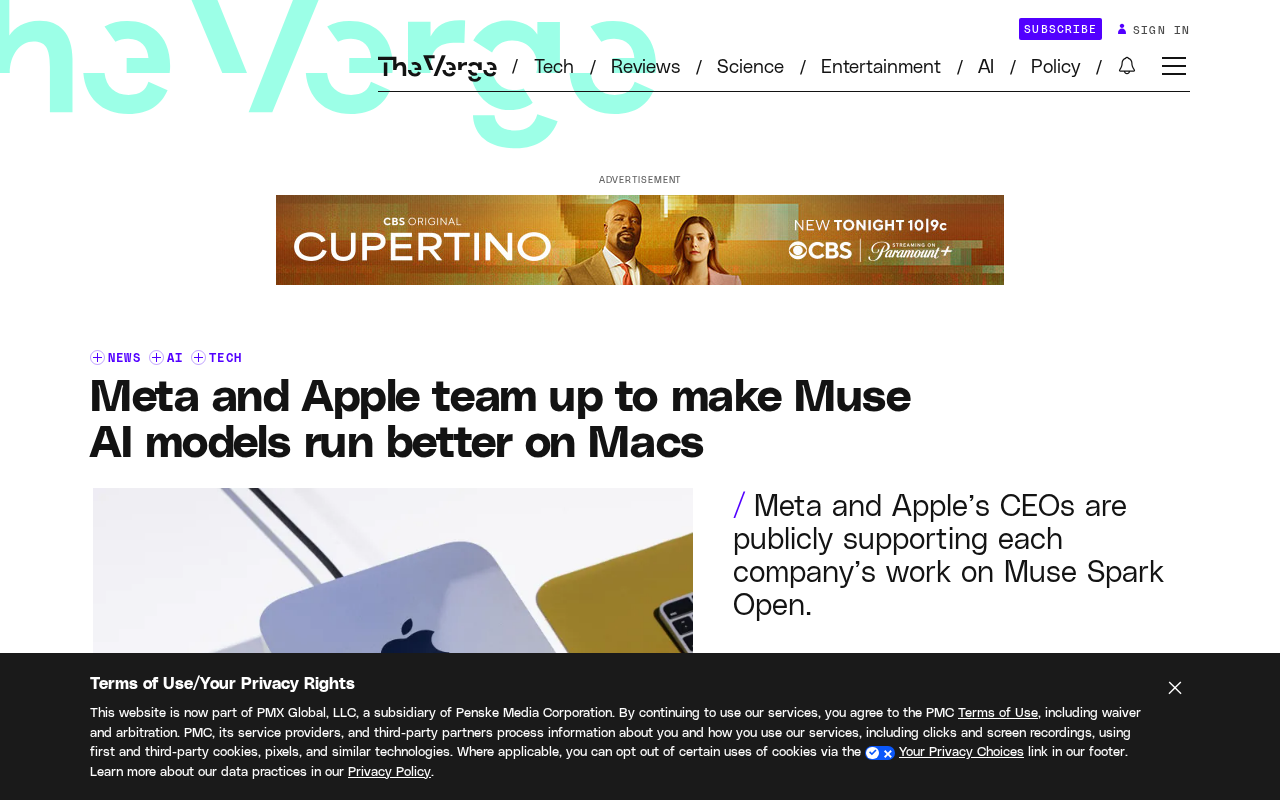
Meta making open-source models isn't new, and Apple making the MLX framework isn't new either. But the fact that both companies are mentioned together at a model launch, with an explicit focus on "local desktop execution," is itself worth unpacking.
What are open-weights models? Open-weights models refer to models whose trained parameter files are publicly available—anyone can download, deploy, fine-tune, and even use them commercially (depending on the specific license). It's not entirely synonymous with "open source"—open source typically also requires disclosing the complete pipeline including training data and training code, whereas open weights only guarantee that the final model parameters are accessible. Meta's Llama series and the Mistral series are typical open-weights models. The core value of open weights lies in the fact that enterprises can deploy models in their own private environments without sending sensitive data to third-party APIs, while also being able to fine-tune for specific domains. However, open weights also face controversy, such as difficulty tracing safety issues and higher risks of misuse. In recent years, "open weights" has become a key policy topic in the AI competition between the US and China.
Why "Running on Mac" Is a Key Signal
Over the past two years, the race in open-source large models has focused primarily on two dimensions: parameter scale and benchmark scores. But what really determines whether a model can be widely used is often a third dimension—whether it can run on devices that ordinary people own.
The cost structure of cloud inference determines that not all tasks are worth calling an API for. For scenarios requiring data privacy, low latency, or high-frequency calls, local execution is the only reasonable option. Meta's choice to emphasize Mac Studio's local execution capability in the Muse Spark Open launch shows that it places "deployability" on equal footing with "capability ceiling."
The combination of two M5 Ultra Mac Studios is essentially using consumer-grade hardware to assemble a desktop-level inference node. This configuration isn't cheap, but compared to server solutions that require multiple professional GPUs, the barrier has dropped by an order of magnitude.
What is Unified Memory Architecture (UMA)? Unified Memory Architecture is one of the core designs of Apple's M-series chips. It integrates the memory of the CPU, GPU, and Neural Engine into a single physical memory pool, with all compute units sharing the same address space. In traditional PC architectures, the CPU uses system memory (DDR), the GPU uses separate video memory (VRAM), and the two exchange data through the PCIe bus, which has limited bandwidth and higher latency. When running large model inference, model weights often need to be loaded into system memory first and then copied to VRAM, which becomes a performance bottleneck. UMA eliminates this transfer process, allowing the GPU to directly access model weights. More critically, M-series chips allow most of the unified memory to be allocated for GPU use—for example, if an M5 Ultra is equipped with 192GB of memory, in theory the GPU can access the vast majority of it. This enables Mac Studio to provide large-capacity usable "VRAM" at relatively low cost when running large models—a key advantage that distinguishes it from consumer-grade NVIDIA graphics cards.
Apple's MLX Framework: The Underestimated Variable
In this collaboration, Apple's role isn't simply providing hardware. MLX is Apple's machine learning framework optimized for its own chips, designed to fully leverage the unified memory architecture of M-series chips.
Traditional large model inference relies on dedicated VRAM, with model weights needing to be repeatedly transferred between CPU and GPU. The unified memory architecture of M-series chips allows the CPU and GPU to share the same memory pool, theoretically eliminating this bottleneck. The MLX framework is tailor-made for this architecture.
Meta's choice to adapt to MLX amounts to acknowledging a fact: Apple's chip architecture has its own unique advantages in large model inference scenarios, worthy of dedicated engineering resources for optimization.
What is the MLX framework? MLX is an open-source machine learning framework released by Apple in late 2023, designed specifically for Apple Silicon chips. It adopts a NumPy-like API style, supports automatic differentiation and dynamic graph construction, and natively supports the unified memory model—arrays can reside in unified memory, with CPU and GPU accessing them on demand without explicit copying. This differentiates it from mainstream frameworks like PyTorch: while the latter can also run on Mac (via the MPS backend), its performance optimization is far less deep than MLX. MLX also includes features tailored for large model inference such as quantization, KV cache optimization, and speculative decoding. Its community ecosystem is growing rapidly, having already supported mainstream models like Llama, Mistral, and Qwen. Meta's choice to adapt for MLX means that the deployment path for open-weights models is beginning to diversify from "CUDA ecosystem dominance" toward multiple platforms.
The "Last Mile" Problem of Open-Weights Models
The open-source model community has long faced an awkward reality: model weights are open, but not many people can actually get them running. Environment configuration, dependency management, inference optimization—each step can deter non-expert users.
Meta and Apple's collaboration is essentially solving the "last mile" problem. When the official announcement explicitly provides a configuration like "two M5 Ultra Mac Studios + MLX framework," the message it conveys is: we've validated this path, you can follow it.
This is far more valuable than simply releasing model weights. What it lowers isn't the access barrier, but the usage barrier.
Why is the "last mile" so important? In software engineering, "last mile" originally referred to the final stage of logistics delivery, later extended to mean the gap between a technology being "available" and "easy to use." For open-weights models, this gap is particularly pronounced: even if model weights are fully public, ordinary users still face a series of technical barriers including Python environment configuration, CUDA/driver version matching, insufficient VRAM, and quantization precision tuning. According to community feedback, many people download models but never successfully run them. Solutions typically fall into three categories: first, official one-click deployment scripts or Docker images; second, joint optimization with hardware vendors to provide validated configuration plans; third, reducing operational complexity through wrapper tools like Ollama and LM Studio. Meta and Apple's explicit reference configuration of "two M5 Ultra Mac Studios + MLX" falls under the second path—official endorsement lowers trial-and-error costs, which has more practical significance than simply releasing model weights.
The Possibilities of Desktop AI
If Muse Spark Open can indeed run smoothly on desktop, then some previously impractical scenarios become feasible: local code assistants don't need to send code snippets to the cloud, semantic search over personal knowledge bases can be completely offline, and creative professionals can invoke large model capabilities in environments without network access.
What these scenarios share in common is that their requirements for data sovereignty and response speed exceed their requirements for the model's absolute capability.
Meta and Apple's collaboration may not generate much discussion on benchmark leaderboards, but the direction it points toward—bringing large models from cloud servers into personal desktops—may be more practically meaningful than any score.
One-line Summary
Meta releases Muse Spark Open, an open-weights model that is the first of its kind to run locally on dual M5 Ultra Mac Studios via Apple's MLX framework, advancing desktop AI deployment.
Paragraph Summary
Meta has released Muse Spark Open, an open-weights model it claims is the most powerful American open-weights model to date and the first of its kind that can run locally on two M5 Ultra Mac Studios via Apple's MLX framework. The significance of this collaboration lies not in parameter scale, but in solving the "last mile" deployment challenge for open-weights models. Apple's MLX framework fully leverages the unified memory architecture of M-series chips, eliminating the data transfer bottleneck between CPU and GPU, enabling consumer-grade hardware to handle desktop-level inference tasks. Meta's choice to adapt for MLX indicates that it elevates "deployability" to equal importance with "capability ceiling." The collaboration points toward a clear direction: bringing large models from the cloud into personal desktops, driving AI applications in privacy-sensitive, low-latency scenarios.
Related articles

JobRunner MCP Server: AI Agents Can Now Fix Failed Java Jobs
JobRunner launches an open-source MCP server enabling AI agents to view cluster status, diagnose failures, and recover Java jobs—incident response from any cloud coding environment or existing agent.

MLAI Digital Launches 9 Security Agents: MCP Server Safeguards the Full Lifecycle of Agentic AI
MLAI Digital launches Security MCP Server with nine built-in specialized security agents covering vulnerability discovery, attack simulation, prompt injection detection, API and infrastructure assessment, and accelerated remediation—embedding security validation across the full Agentic AI lifecycle from development to production.

Running Isaac Lab on H100 GPUs: Exploring Better Approaches
Exploring optimization methods for running Isaac Lab on NVIDIA H100 GPUs, including MIG configuration, mixed precision, TensorRT acceleration, and community experience to improve robotics simulation and reinforcement learning efficiency.