MicroCodex: A C++ Programming Agent Under 1MB — A Fresh Take on Minimalist AI Tools

MicroCodex rebuilds OpenAI's Codex agent in C++ under 1MB, proving AI tool orchestration can be ultra-lean.
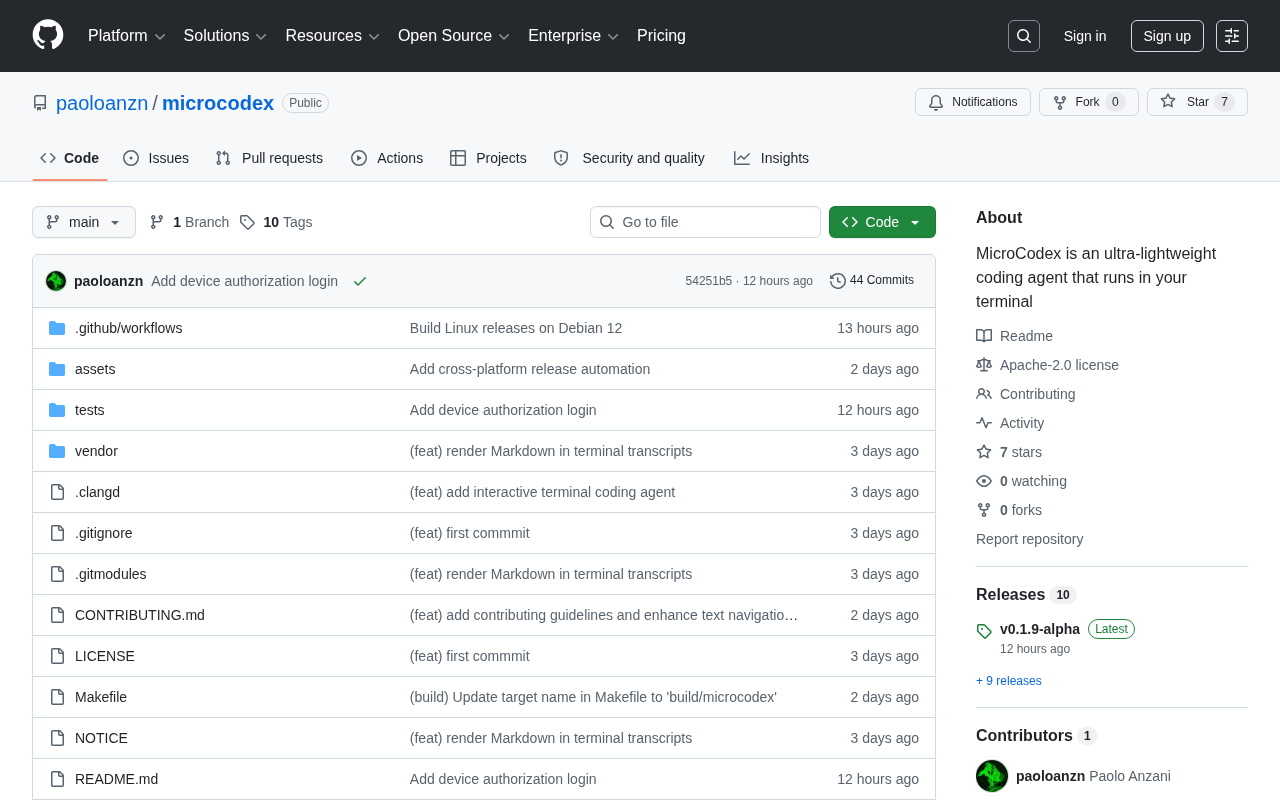
MicroCodex is an open-source project that re-implements OpenAI's Codex programming agent in C++, producing a binary under 1MB. By leveraging static linking, LTO, and symbol stripping, it eliminates runtime dependencies entirely. The project demonstrates that since AI agents are essentially orchestration layers — with real intelligence residing in remote LLMs — they don't need heavy runtimes. It's particularly promising for CI/CD pipelines, embedded devices, and security-sensitive environments.
An Ultra-Lightweight Programming Agent
In an era of increasingly bloated AI programming tools, an open-source project called MicroCodex has caught attention on Hacker News. Its core selling point is refreshingly direct: it re-implements OpenAI's Codex programming agent in C++, compressing the final binary to under 1MB.
For users accustomed to modern AI tools that require hundreds of megabytes of dependencies and full Node.js or Python runtime environments, a programming agent of this size is almost unimaginable. It represents an engineering philosophy diametrically opposed to the mainstream "heavyweight" approach — achieving usable AI-assisted programming capabilities with minimal resource footprint.
Why Size Matters for AI Programming Tools
Most mainstream AI programming assistants today are built on top of Electron, Node.js, or the Python ecosystem. Take common CLI programming tools as an example: their installation packages and dependency trees are often enormous, and they need to load interpreters and numerous runtime libraries at startup. This not only slows down cold-start times but also makes deployment difficult in resource-constrained environments like lightweight containers, edge devices, or aging machines.
To understand the severity of this problem, consider the actual overhead of current mainstream tech stacks. The Electron framework essentially bundles a complete Chromium browser engine with the Node.js runtime — even a simple text editing feature requires loading the full browser rendering engine underneath. While Node.js's npm ecosystem offers extremely high development efficiency, the recursive nature of its dependency trees often causes the node_modules folder to balloon to hundreds of megabytes. Python faces similar issues, with virtual environments plus scientific computing dependencies easily exceeding the gigabyte level. These runtimes need to complete interpreter initialization, JIT compilation warm-up, module loading, and other steps at startup, resulting in cold-start delays ranging from hundreds of milliseconds to several seconds.
MicroCodex uses a single natively compiled C++ binary, bypassing the entire runtime overhead of interpreted languages. Through static linking, all dependent library code is embedded directly into the final executable, eliminating dependencies on external dynamic libraries. Combined with compilation techniques like Link-Time Optimization (LTO) and symbol stripping, the final binary size can be compressed to the extreme. The developer selectively uses lightweight library alternatives to replace heavy standard library components, precisely controlling every byte of overhead — a stark contrast to the "import and use" black-box model of scripting languages.
This means:
- Ready to use immediately: No runtime installation needed — download a single executable and run it;
- Fast startup: No virtual machine warm-up or dependency loading delays;
- Deployment-friendly: A file under 1MB can be easily embedded into any workflow, CI pipeline, or container image.
Engineering Trade-offs of Rebuilding a Programming Agent in C++
Porting an agent originally implemented in a scripting language to C++ is far from a simple language translation. The core logic of a programming agent typically includes: interaction with LLM APIs, context management, tool use (such as reading/writing files and executing commands), and parsing and executing model outputs.
Among these, "Tool Use" (also known as Function Calling) is one of the most critical capabilities of a programming agent. This mechanism typically follows the ReAct (Reasoning + Acting) paradigm: the model first reasons about what operation needs to be performed, then outputs a structured tool call request (such as reading a file or executing a Shell command). The agent parses this request and executes it in the local environment, then feeds the execution result back to the model as new context. This "observe-think-act" loop is the core pattern of current mainstream Agent architectures. Typical tools supported by OpenAI's Codex agent include file system read/write, Shell command execution, and code search.
Implementing these in C++ requires developers to manually handle HTTP requests, JSON parsing, streaming response processing, and other functionalities that come "out of the box" in higher-level languages. Streaming response processing is particularly challenging — LLM APIs typically support the Server-Sent Events (SSE) protocol, where generated tokens are returned to the client one by one or in batches. Implementing SSE stream parsing in C++ requires handling HTTP chunked transfer encoding, partial JSON parsing (since each SSE event contains a JSON fragment), and reconnection logic for network interruptions. These functionalities, which are well encapsulated in Python's aiohttp or Node.js's EventSource, require manually implementing a state machine based on low-level sockets or libcurl to handle incomplete data streams in C++.
This is a harder but more controllable path — every byte of dependency is deliberately introduced, which is precisely why the size can be compressed to the extreme.
The Essence of a Programming Agent Is a "Glue Layer"
An important point worth noting: the programming agent itself isn't "intelligent" — the real intelligence comes from the large language model behind it. The agent's role is more like a glue layer — responsible for organizing prompts, managing conversation context, translating the model's intent into actual file operations and command execution, and feeding results back to the model.
This also explains why MicroCodex can be so compact: since the actual reasoning happens on the remote API side, the local client only needs an efficient orchestration layer and has no need to carry a heavy runtime. This insight is quite illuminating for understanding the architectural evolution of AI tools — an agent's value lies in its orchestration logic, not its size.
The Value of Minimalist AI Tools in Real-World Scenarios
From a broader perspective, projects like MicroCodex embody an "anti-bloat" movement against the current AI tool ecosystem. While more and more tools chase feature accumulation and flashy interfaces, a subset of developers chooses to return to fundamentals, pursuing ultimate efficiency and controllability.
Potential Use Cases for MicroCodex
A native programming agent under 1MB has unique advantages in the following scenarios:
- CI/CD Integration: Invoking AI for code review or fixes in automation pipelines without bloated dependencies. CI/CD (Continuous Integration/Continuous Deployment) pipelines have core requirements for tools: fast startup, deterministic execution, and minimal image size. On platforms like GitHub Actions and GitLab CI, each build typically starts from scratch in a temporary container — any additional dependency means longer pipeline execution time and higher billing costs. Current approaches to integrating AI capabilities into CI/CD usually require installing a Python runtime or pulling large Docker images, which contradicts the CI philosophy of "fast feedback." A small, statically linked binary can be directly downloaded via curl and executed, minimizing integration overhead.
- Resource-constrained environments: Running AI-assisted programming on hardware like Raspberry Pi or embedded development boards;
- Rapid prototyping: Serving as a minimal implementation reference for learning and researching agent architectures;
- Security-sensitive scenarios: A smaller codebase means a smaller attack surface and easier auditing. In software security, "attack surface" refers to the collection of all possible entry points in software that an attacker could exploit. More dependencies mean more potential supply chain attack vectors — the Log4Shell vulnerability in 2021 and the xz backdoor incident in 2024 are both classic examples of supply chain attacks. In a tool that depends on hundreds of npm packages, any single package being injected with malicious code could compromise the entire system. In contrast, a lean C++ project with minimal dependencies allows security auditors to read through all source code within a reasonable timeframe and confirm the absence of backdoors or vulnerabilities. This is particularly important for enterprise environments handling sensitive code.
Limitations to View Rationally
Of course, as an early-stage open-source project, MicroCodex is still far from being a mature tool. Ultra-lightweight design often comes with functional trade-offs — it may lack the rich plugin ecosystem, graphical interface, multi-model support, or comprehensive error handling found in mature tools.
Additionally, as a "re-implementation" of OpenAI Codex, its compatibility, stability, and long-term maintainability still await community validation. For teams pursuing production-grade reliability, it's currently more suitable as a technical proof-of-concept and learning case rather than a direct production tool replacement.
Conclusion
MicroCodex provides an interesting case study: amid the prevailing trend of AI tools growing heavier, is there a viable "small but beautiful" technical path? It proves with a C++ binary under 1MB that the core orchestration logic of a programming agent can actually be remarkably lean.
For developers interested in the engineering details of AI implementation, this open-source project is worth studying: it strips away all the fancy shells, revealing the most essential skeleton of a programming agent. Whether or not it ultimately matures into a full-fledged tool, this commitment to minimalism is itself a valuable contribution to the current AI tool ecosystem.
Related articles

Multiple States Join Forces to Pressure OpenAI: Demanding AI Agents Be Isolated in Sandboxes
Multiple U.S. states led by Iowa demand OpenAI isolate AI agents in sandbox environments, sparking debate over AI autonomy, safety guardrails, and liability in the emerging era of autonomous AI systems.

The Silicon Valley AI Paradox: Why Those Selling AI Replacement Never Replace Themselves
Silicon Valley elites promote AI replacing human labor but never apply the same logic to themselves. This article dissects the double standard in AI narratives and the power dynamics behind efficiency rhetoric.

From Leibniz to ChatGPT: A 350-Year History of Machines Understanding Human Language
From Leibniz's 17th-century dream of a universal symbolic language to today's prompt engineering with LLMs, humanity has spent 350 years trying to make machines unambiguously understand intent.