Microduck Open-Source Micro Humanoid Robot: A Decentralized Revolution in Reinforcement Learning Training

Microduck brings decentralized reinforcement learning to hobbyists via an open-source micro humanoid robot.
Pollen Robotics has launched Microduck, an open-source micro humanoid robot that lets ordinary hobbyists perform reinforcement learning on real hardware. With its open-source software stack, effective sim2real pipeline, and the support of AI coding assistants, Microduck dramatically lowers the barrier to robot training — charting a decentralized path that contrasts sharply with the centralized world of LLM development.
A Decentralized Experiment in Robot Training
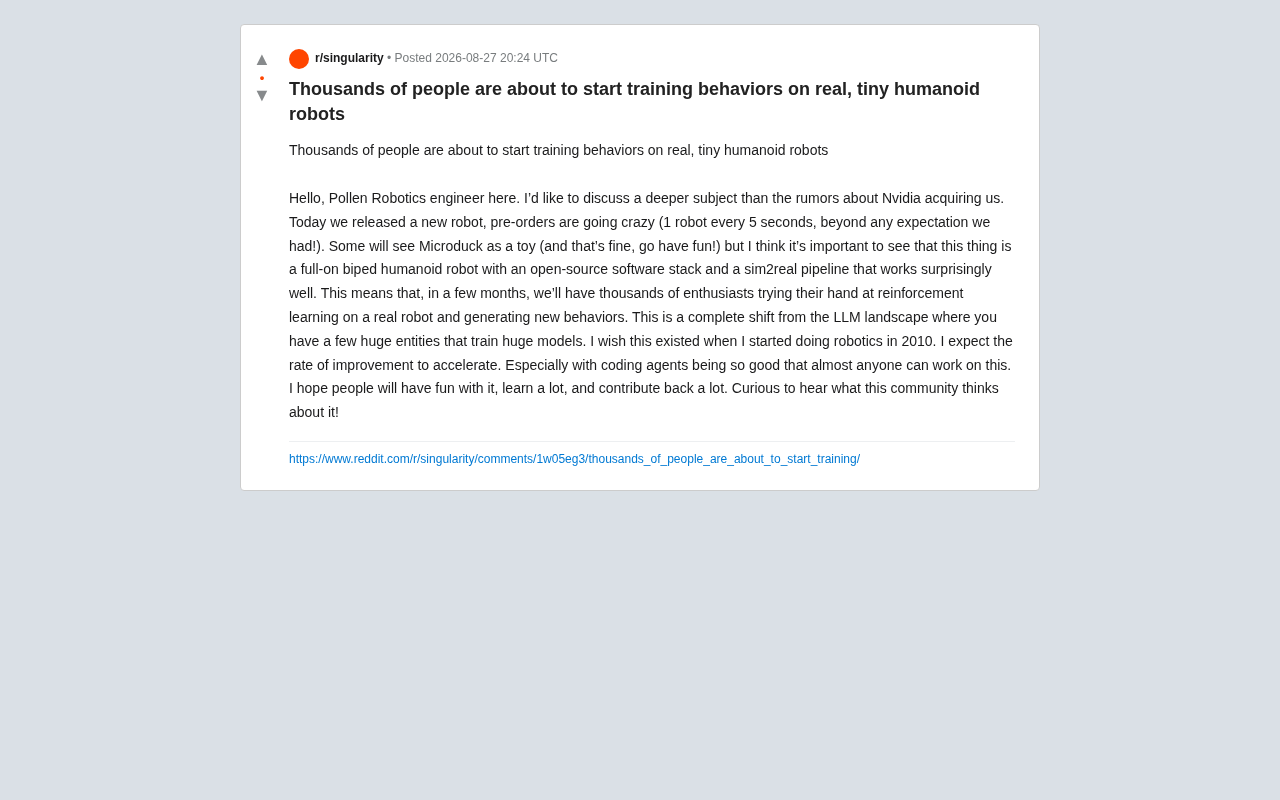
An engineer at Pollen Robotics recently shared a thought-provoking perspective on Reddit. Rather than addressing the buzz around rumors of "NVIDIA acquiring Pollen Robotics," he wanted to talk about something with far greater implications for the entire robotics industry: thousands of ordinary hobbyists are about to start training behaviors on real micro humanoid robots.
Pollen Robotics is a robotics company headquartered in Bordeaux, France, previously known in the industry for developing Reachy, a full-sized open-source humanoid robot. Reachy was primarily designed for research institutions and enterprise clients at a premium price point, while the newly released Microduck represents a completely new foray into the consumer market. Pre-orders exploded upon launch — averaging one unit every 5 seconds — far exceeding the team's expectations. Some people treat it as a toy, and that's perfectly fine. But in this engineer's view, its real value lies elsewhere: it's a complete bipedal humanoid robot equipped with an open-source software stack and a sim2real (simulation-to-reality) pipeline that works "surprisingly well."
A "bipedal humanoid robot" refers to a robot with two legs capable of mimicking human walking posture. This configuration is far more complex to control than wheeled or quadruped robots because it requires continuously solving dynamic balance problems — the robot must constantly adjust its center of gravity during walking to avoid falling over. The miniaturized design dramatically reduces the risk of damage from falls and allows ordinary users to safely experiment on a tabletop at home — a seemingly simple but critically important design decision.
A Development Path Radically Different from Large Language Models
The most noteworthy aspect of this path is the stark contrast it forms with the current large language model (LLM) landscape.
LLM Training Is a Game for a Handful of Giants
In the LLM world, only a handful of giants with massive compute resources and capital — OpenAI, Google, Anthropic, and the like — can train powerful models. Ordinary developers are mostly "users" rather "trainers" of models, with an extremely high barrier to participating in training. The entire ecosystem exhibits a highly centralized structure.
This centralization has deep economic roots. The compute cost of training a frontier LLM (GPT-4 class) is estimated at tens of millions to over a hundred million dollars, requiring thousands or even tens of thousands of high-end GPUs running continuously for months. Additionally, collecting, cleaning, and labeling high-quality training data demands substantial human effort and financial investment. These extremely high fixed costs create natural barriers to entry, meaning only well-funded tech giants and heavily financed startups can participate in frontier model training. Although open-source models (such as Meta's LLaMA series) have lowered the barrier to usage, training itself remains highly concentrated.
Open-Source Robot Training Goes Decentralized
Microduck paints a completely opposite picture. As the engineer put it:
"This is a complete reversal of the LLM landscape — where you have just a few massive entities training huge models."
When thousands of hobbyists have a real robot in their hands, each of them can try reinforcement learning (RL) on a real robot, generating new behaviors of their own. Reinforcement learning is an important branch of machine learning whose core idea is to let an agent learn by repeatedly interacting with an environment, continuously optimizing its behavioral strategy based on reward signals. Unlike supervised learning, which relies on labeled data, RL learns autonomously through trial-and-error. In robotics, RL is particularly well-suited for solving complex motion problems that are difficult to model precisely with traditional control theory, such as bipedal walking and object manipulation.
Compared to the compute demands of LLM training, the computational resource requirements for robot RL training are relatively manageable — a personal computer with a decent GPU can complete policy training in a simulation environment. This fundamentally determines that the robotics field has the potential to follow a decentralized path. It means the volume, diversity, and iteration speed of experiments will grow in an unprecedented, distributed manner. This is the unique energy that the combination of open-source hardware and open-source software can unleash.
Sim2Real: The Key Technology for Making Robot Training Practical
For robot reinforcement learning, sim2real is an unavoidable core challenge.
Researchers typically train policies in simulation environments first — because simulation is fast, cheap, and massively parallelizable. RL training usually requires millions of interactions to converge, and training directly on a real robot is both slow and risks hardware damage — this is the fundamental reason simulation-based training is indispensable. However, a "reality gap" exists between simulation and the real world: physics engines cannot perfectly replicate real-world friction, latency, sensor noise, and other factors, causing policies trained in simulation to often fail when transferred to physical hardware.
To bridge this gap, the research community has developed several mature strategies. Domain Randomization is one of the most widely used methods — it randomizes physical parameters in simulation (such as mass, friction coefficients, actuator delays, etc.), forcing the policy to learn robust responses to uncertainty so it can still function properly when facing real-world parameter deviations. System Identification takes the opposite approach, precisely measuring the physical parameters of the real system to calibrate the simulation environment, making the simulation approximate reality as closely as possible. In recent years, the emergence of GPU-accelerated simulation platforms like NVIDIA Isaac Gym has enabled researchers to run thousands of parallel simulation environments simultaneously, dramatically shortening training time — this is also why the Microduck team was able to build such an efficient sim2real pipeline.
Microduck emphasizes that its sim2real pipeline "works surprisingly well," which is precisely the prerequisite for ordinary hobbyists to actually get started. Without a reliable sim2real pipeline, amateur enthusiasts would find it nearly impossible to stably reproduce training results on real hardware. Once this link is established, individual developers can complete the full loop of "simulation training → real-robot deployment → feedback collection → retraining."
AI Coding Assistants Dramatically Lower the Barrier to Entry
The engineer also mentioned an easily overlooked accelerating factor: today's coding agents are powerful enough that virtually anyone can participate in robot development.
This is an insight worth exploring in depth. In the past, robot development required deep expertise in control theory, kinematics, and embedded programming, locking out a large number of hobbyists. Specifically, developers needed to simultaneously master control theory (PID controllers, state estimation algorithms), kinematics and dynamics (forward and inverse kinematics solving, for computing the mapping between joint angles and end-effector positions), embedded systems programming (low-level communication with servos, IMUs — inertial measurement units — and other hardware), and reinforcement learning frameworks (Python libraries such as Stable Baselines3, rl_games, etc.). This cross-disciplinary knowledge barrier kept robot development the exclusive domain of a small number of professionals for a long time.
But with the maturation of AI coding assistants like GitHub Copilot, Cursor, and Claude, this landscape is being fundamentally transformed. These code generation and comprehension tools based on large language models can generate code from natural language descriptions, explain the logic of complex open-source frameworks, automatically debug errors, and even help users understand how to use specialized tools like ROS (Robot Operating System — a widely used robotics software middleware). Hobbyists can quickly understand and modify code through conversations with AI, compressing what used to require years of accumulated cross-disciplinary knowledge into a learning cycle of just weeks. The cost of writing training scripts, debugging control code, and understanding open-source frameworks has dropped dramatically.
In other words, affordable robot hardware + open-source software stack + working sim2real + AI coding assistants — the convergence of these four factors makes "individuals doing reinforcement learning on real robots" a practically feasible endeavor for the first time. This also explains why this engineer, who has been in robotics since 2010, remarked: "I really wish I had something like this when I started."
The Far-Reaching Impact of Open-Source Robots on the Industry
Distributed Collaboration Accelerates the Pace of Improvement
When participation expands from a handful of labs to thousands of distributed hobbyists, the accumulation of behavior libraries, the exposure of failure cases, and the collision of innovative ideas will all accelerate significantly. The engineer himself expects "the pace of improvement to accelerate." The open-source community has repeatedly proven the power of collective collaboration in the software domain, and robot behavior libraries may replicate a similar flywheel effect.
The flywheel effect, originating from Jim Collins' management theory, describes a process where a positive feedback loop continuously reinforces itself. In the open-source robotics domain, this flywheel operates as follows: more users purchase hardware → more people participate in development and training → the community contributes richer behavior libraries and toolchains → the product becomes more attractive to new users → more users join. The development trajectories of Arduino and Raspberry Pi have already validated this pattern — they evolved from simple development boards into massive ecosystems with millions of users and vast collections of open-source projects. The RepRap project in the 3D printing community similarly demonstrates this dynamic: when enough users contribute improved designs, the entire platform's capabilities advance far faster than any single company's R&D could achieve.
From "Consumption" to "Contribution": Open-Source Community Culture
The engineer's expectations are clear: he hopes everyone will "have fun, learn a lot, and contribute heavily back to the community." Behind this is a quintessential open-source ethos — users aren't just buying a product; they're co-builders of the ecosystem. Every new behavior trained by a hobbyist could become shared wealth for the entire community. This model stands in stark contrast to traditional commercial robotics: in the traditional model, behavioral policies are a company's core intellectual property, jealously guarded; in the open-source model, the sharing and flow of knowledge is itself the driving force behind progress.
Real-World Challenges That Deserve Sober Assessment
Of course, we should also maintain a measure of caution. Micro robots have limited physical capabilities, and there's still a significant gap between "producing interesting behaviors" and "achieving practical utility." The quality of behaviors generated through distributed training will vary widely, and how to screen, validate, and integrate these contributions is a challenge the community will need to face — similar to the role of code review and quality gating mechanisms in open-source software communities, but in the domain of robot behavior, mature standards and tools are still lacking. Moreover, scale transfer from micro robots to full-sized humanoid robots is itself an unsolved problem — control strategies validated on small robots cannot simply be scaled up proportionally to large robots because mechanical characteristics change nonlinearly with scale. Impressive sales numbers are eye-catching, but what will truly determine the success or failure of this experiment is the retention rate of active developers and high-quality contributions several months from now.
Conclusion
Microduck may be just a cute little "duck" robot in many people's eyes, but the path it represents — open-source, low-cost, trainable, community-driven — may be more important than the robot itself. If the era of large language models belongs to a few giants, then learning and training for consumer-grade humanoid robots is attempting to forge a path that belongs to everyone.
This reinforcement learning experiment, involving thousands of hobbyists working together, and the unexpected behaviors and innovations it might spark, deserves sustained attention from the entire robotics community.
Related articles

RAG Getting Started in Practice: From Principles to Building an Enterprise Knowledge Base
Bilibili RAG course highlights: from retrieval-augmented generation principles, document chunking and vectorization, to five accuracy factors and enterprise knowledge base boundaries, with fine-tuning vs RAG selection advice.

AI Model Selection Guide: DeepSeek vs. Qwen3 in Practice
How should AI developers choose models? Based on a Bilibili tutorial, this article breaks down the Function Calling differences between DeepSeek V3 and R1, Qwen3's programmatic thinking mode switching and agent capabilities, and outlines a multi-model learning path and practical selection logic.

Anchoring, Loss Aversion, and Nudges: 5 Psychological Tactics Retailers Use to Make You Spend
Behavioral economics reveals how retailers use anchoring, framing, loss aversion, and nudge theory to manipulate your spending decisions. This article breaks down 5 common psychological tactics and offers counterstrategies like slowing down decisions and setting your own anchors to see through the pricing design behind discounts.