MicroG: A Free and Open-Source Alternative to Google's Android User Space

MicroG reimplements GMS in an open-source way, providing a de-Googled compatibility solution for Android.
MicroG is a free and open-source project aimed at reimplementing Google's proprietary Android user-space components (GMS), with its core being the GmsCore repository on GitHub. Through a compatibility layer, it intercepts apps' requests for location, push notifications, and account authentication, and instead satisfies them with open-source implementations or third-party services, reducing data flow to Google. The project recently received 264 points and 24 comments on Hacker News, with community interest focused on privacy protection, device freedom, and extending older hardware lifespan. However, MicroG faces maintenance costs from continuous Google API updates, compatibility issues from app signature and integrity checks, and technical barriers such as requiring a ROM that supports signature spoofing, making it more suitable for developers, privacy advocates, and ROM enthusiasts.
What Is MicroG?
MicroG is a free and open-source software project that aims to reimplement Google's proprietary Android user-space components. Simply put, it attempts to provide a similar functional experience for Android devices without relying on Google's official service framework (GMS). The project's core repository is GmsCore on GitHub, and it recently sparked discussion on Hacker News, garnering 264 points and 24 comments.
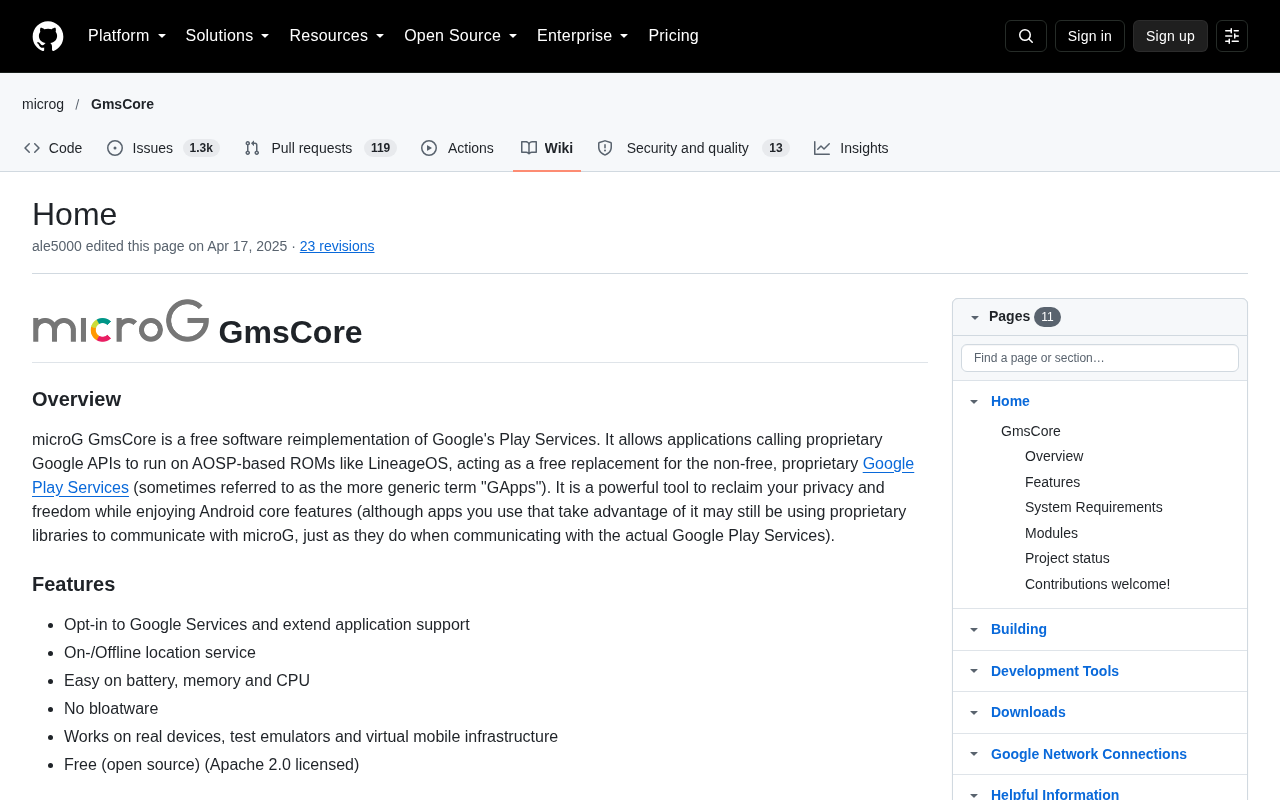
For many users concerned about the freedom of the Android ecosystem, MicroG represents a possibility of breaking free from Google's service bundling. It is not simply reverse-engineering GMS, but rather building a compatibility layer from scratch that allows apps to call the necessary APIs while avoiding sending data to Google's servers.
GMS (Google Mobile Services) is a suite of closed-source apps and service frameworks that Google licenses to Android device manufacturers, including Google Play Services, the Play Store, account sync, push services, and more. The vast majority of commercial Android apps depend on APIs provided by GMS by default to obtain location, receive push notifications, or complete login, so devices lacking GMS often cannot run these apps properly. One of the core components of GMS is Google Play Services, which exists as a system-level background service that runs continuously and collects device and user data. MicroG's positioning is precisely to replace this set of user-space components with an open-source implementation, rather than replacing the Android operating system itself—it does not involve the kernel or low-level system layers, only the service interfaces that apps depend on.
MicroG's Core Components and How It Works
At the heart of MicroG is GmsCore, which plays the role of a replacement for Google Play Services. When apps request services such as location, push notifications, or account authentication, GmsCore intercepts these requests and attempts to fulfill them with open-source implementations or third-party services.
Main Functional Modules
- Location Services: Provides geographic location through Mozilla Location Service or custom backends, rather than Google's location APIs.
- Push Notifications: Supports integration with open-source solutions like UnifiedPush, reducing dependence on Google Firebase Cloud Messaging.
- Account Management: Allows users to sign in with non-Google accounts and sync contacts, calendars, and other data.
- Security and Authentication: Provides basic SafetyNet alternatives, though compatibility is limited.
The design goal of these modules is to be as compatible as possible with existing apps while maintaining code transparency and auditability. Developers can compile and modify them themselves to suit different privacy needs.
Signature spoofing is a key technical prerequisite for understanding MicroG's feasibility. When Android apps call Google Play Services, the system verifies whether the target service's signature matches Google's official signature; although MicroG's package name and some interfaces are the same as GMS, the signature is necessarily different, so the ROM level must allow "spoofing" signature verification, making apps believe they are connecting to official GMS. Stock Android does not expose this capability, so it is usually necessary to flash a modified ROM (such as LineageOS for microG) or enable it at the system patch level. This is also one of the fundamental reasons why MicroG has a high configuration threshold—ordinary users cannot complete deployment simply by installing an APK; the system must be customized.
SafetyNet is a device integrity verification service provided by Google, through which apps (especially banking, payment, and some games) determine whether a device has been tampered with or is Google-certified. MicroG's alternative implementation can only simulate part of the verification results, and as Google introduces the stricter Play Integrity API to replace SafetyNet, compatibility becomes even more difficult. Such verification mechanisms essentially use "whether official GMS is used" as the basis for trust judgments, so MicroG users will continue to encounter obstacles with apps that rely on strong integrity verification—this is also one of the core sources of its limitations.
Why Is MicroG Worth Attention?
In the Android ecosystem, Google Mobile Services (GMS) is almost a prerequisite for most commercial apps to function properly. However, GMS is closed-source and collects large amounts of user data. MicroG's emergence offers a compromise for users who want to use the Android system but do not wish to accept Google's data collection.
Judging from the Hacker News discussion, the community's interest in MicroG is mainly focused on privacy protection and device freedom. Some comments noted that MicroG allows older or uncertified devices to run apps that depend on GMS, extending hardware lifespan. At the same time, it has also attracted some custom ROM developers; for example, some branches of LineageOS have integrated MicroG.
Challenges and Limitations
Despite its good vision, MicroG still faces many challenges. First, because Google continuously updates GMS APIs and behavior, MicroG needs to keep pace, resulting in high maintenance costs. Second, some apps detect GMS signatures or integrity, causing them to fail to run in a MicroG environment, especially banking, payment, and some game apps.
In addition, MicroG cannot provide a functional experience fully identical to Google's; for example, the real-time performance of certain advanced location services or push notifications may be reduced. Community discussions also mention that configuring MicroG requires a certain technical threshold for ordinary users, including flashing a custom ROM and manually granting permissions.
How to Get Started with MicroG?
For users who want to try it, an Android device with an unlocked bootloader is usually required, along with flashing a ROM that supports signature spoofing, such as LineageOS for microG. Then install the MicroG components through the F-Droid repository and enable the relevant services in system settings.
One detail to mention: MicroG is not designed for ordinary consumers; it is more suitable for developers, privacy advocates, and ROM enthusiasts. If you are interested in the internal mechanisms of the Android system, or want to reduce dependence on Google services, MicroG provides an open-source solution worth studying.
F-Droid is an Android app repository that only includes free and open-source software (FOSS), and it is the recommended channel for obtaining MicroG components. Because MicroG components need to run with system privileges, they usually must be installed through the official MicroG repository on F-Droid or flashed as system apps. UnifiedPush, meanwhile, is an open-source push framework that allows apps to receive messages through a user-selected push distributor, thereby replacing Google's Firebase Cloud Messaging (FCM); MicroG can integrate with it, but only if the app itself supports UnifiedPush. Otherwise, it still relies on MicroG's compatibility implementation for FCM, and real-time performance and reliability may decline.
Conclusion
MicroG is an important response from the open-source community to Google's proprietary services. It demonstrates the possibility of achieving service compatibility on a mobile operating system, while also exposing the difficulties of ecosystem fragmentation and compatibility maintenance. As privacy awareness grows, such projects may receive more attention, but their development still depends on community contributions and changes in Google's policies.
One-line Summary
MicroG reimplements GMS in an open-source way, providing a de-Googled compatibility solution for Android.
Paragraph Summary
MicroG is a free and open-source project aimed at reimplementing Google's proprietary Android user-space components (GMS), with its core being the GmsCore repository on GitHub. Through a compatibility layer, it intercepts apps' requests for services such as location, push notifications, and account authentication, and instead satisfies them with open-source implementations or third-party services, thereby reducing data flow to Google. The project recently received 264 points and 24 comments on Hacker News, with community interest focused on privacy protection, device freedom, and extending the lifespan of older hardware. However, MicroG faces maintenance costs from continuous Google API updates, compatibility issues caused by app signature and integrity checks, and technical barriers such as the need to flash a ROM that supports signature spoofing, making it more suitable for developers, privacy advocates, and ROM enthusiasts.
Related articles

Python 3.15 New Feature: Is the sentinel Type Better Than None?
Python 3.15 adds the sentinel type, using named unique sentinel objects to replace None and bare object(), resolving confusion among missing values, explicit emptiness, and invalid input while avoiding type hint failures.

Deep Learning's Three Architectures and the Universal Approximation Theorem: A Complete Guide to MLPs, CNNs, and Transformers
Explaining the inductive bias differences among MLP, CNN, and Transformer, the existence meaning of the Universal Approximation Theorem (UAT), and the role of Taylor expansion in approximation analysis, while clearing up common misconceptions.

GitLab Emergency Patch Release: Analysis of Critical Security Fixes
GitLab releases critical patch 19.5.1, sparking 355 points of discussion on Hacker News. This article analyzes the background, upgrade steps for self-hosted instances, and verification points to help DevOps teams respond quickly to security updates.