Microsoft BitNet: The Official Inference Framework for 1-bit LLMs That Runs Large Models on CPU

Microsoft open-sources BitNet, an inference framework that runs 1-bit LLMs efficiently on ordinary CPUs.
BitNet is Microsoft's official open-source inference framework for 1-bit large language models, with over 40,000 GitHub stars. Written in C++, it focuses on efficient inference after training rather than training itself. 1-bit quantization compresses weights to about 1/16 of FP16, fundamentally changing inference memory footprint and computation patterns, enabling large models to run on ordinary laptops and edge devices without GPUs. The article analyzes BitNet's advantages in memory, energy, and CPU portability, highlighting its value for developers, researchers, and hardware engineers, and noting from community hype that low-cost large model inference is becoming as important as model capability.
What Is BitNet?
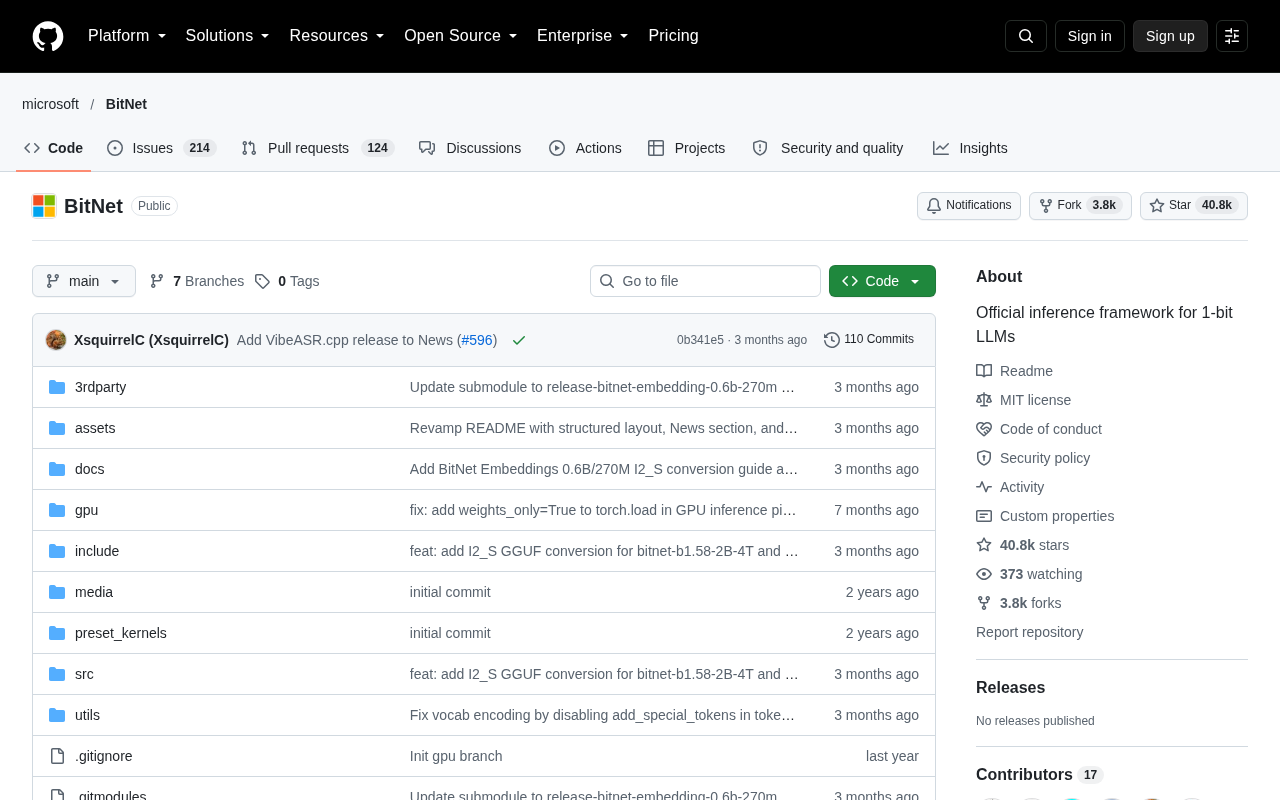
BitNet is Microsoft's open-source official inference framework, purpose-built for 1-bit large language models (1-bit LLMs). On GitHub, the project has amassed 40,728 stars and 3,796 forks, with 195 new stars added in a single day — its popularity keeps climbing.
Traditional large models typically run at FP16 or INT8 precision, while 1-bit LLMs compress model weights into an extreme binarized representation (-1 or 1), fundamentally changing the computational pattern and memory footprint of inference. As the official inference framework, BitNet is written in C++, with the goal of running these extremely quantized models efficiently on a wide range of hardware — including ordinary CPUs without a GPU.
The technical meaning of 1-bit quantization (binarization): Traditional model quantization usually refers to compressing FP32 or FP16 weights into INT8 (8-bit integers), achieving roughly a 4x compression ratio over the original precision with relatively controllable accuracy loss. 1-bit quantization goes much further — each weight retains only two possible values (typically represented as -1 and +1), with each parameter occupying just 1 bit. As a result, weight storage size is theoretically only 1/16 of FP16 and 1/8 of INT8.
But the real change brought by binarization isn't just memory savings. When weights can only take ±1, matrix multiplication can be reduced to a combination of additions and sign flips, avoiding most floating-point multiplications. This is especially friendly to hardware like CPUs that excel at integer operations but lack large-scale parallel floating-point units. The trade-off is limited model expressiveness, so 1-bit LLMs typically need to adopt quantization-aware approaches during training (such as Microsoft's previously proposed BitNet architecture and BitLinear layers), rather than simply "rounding" weights after training is complete.
Why 1-bit Inference Deserves Attention
A Dual Breakthrough in Memory and Energy
The biggest bottleneck in large model deployment is often not compute power, but memory bandwidth and VRAM capacity. 1-bit quantization compresses weight size to about 1/16 of FP16, meaning the same memory can hold a larger model, or the hardware barrier can be substantially lowered for the same model scale.
For edge devices and local deployment scenarios, the benefits of this compression ratio are very direct: no high-end graphics card is needed — an ordinary laptop can load and run models that would otherwise require server-grade hardware.
The Feasibility of CPU Inference
BitNet is implemented in C++, making it naturally suited for execution on CPU. It avoids a strong dependency on CUDA or specific accelerators, greatly improving the portability of the inference framework. For developers and researchers who want to run models locally without investing in GPU costs, this is a pragmatic choice.
Why inference is so sensitive to memory bandwidth: Large model inference can be divided into two phases — prefill and per-token decode. During the per-token decode phase, generating each word requires reading all of the model's weights from memory into the compute units once, while the actual computation is very small. This makes the decode phase a classic "memory-bound" task: the bottleneck isn't compute power, but the speed of weight movement.
Therefore, compressing weights from FP16 to 1-bit directly reduces the amount of data that needs to be moved per decode step, potentially increasing inference speed several times over. For GPUs, this means reduced VRAM pressure; for CPUs, it means models that previously couldn't run smoothly locally due to insufficient bandwidth become viable. This also explains why 1-bit quantization is particularly attractive in on-device and edge scenarios.
BitNet's Technical Positioning
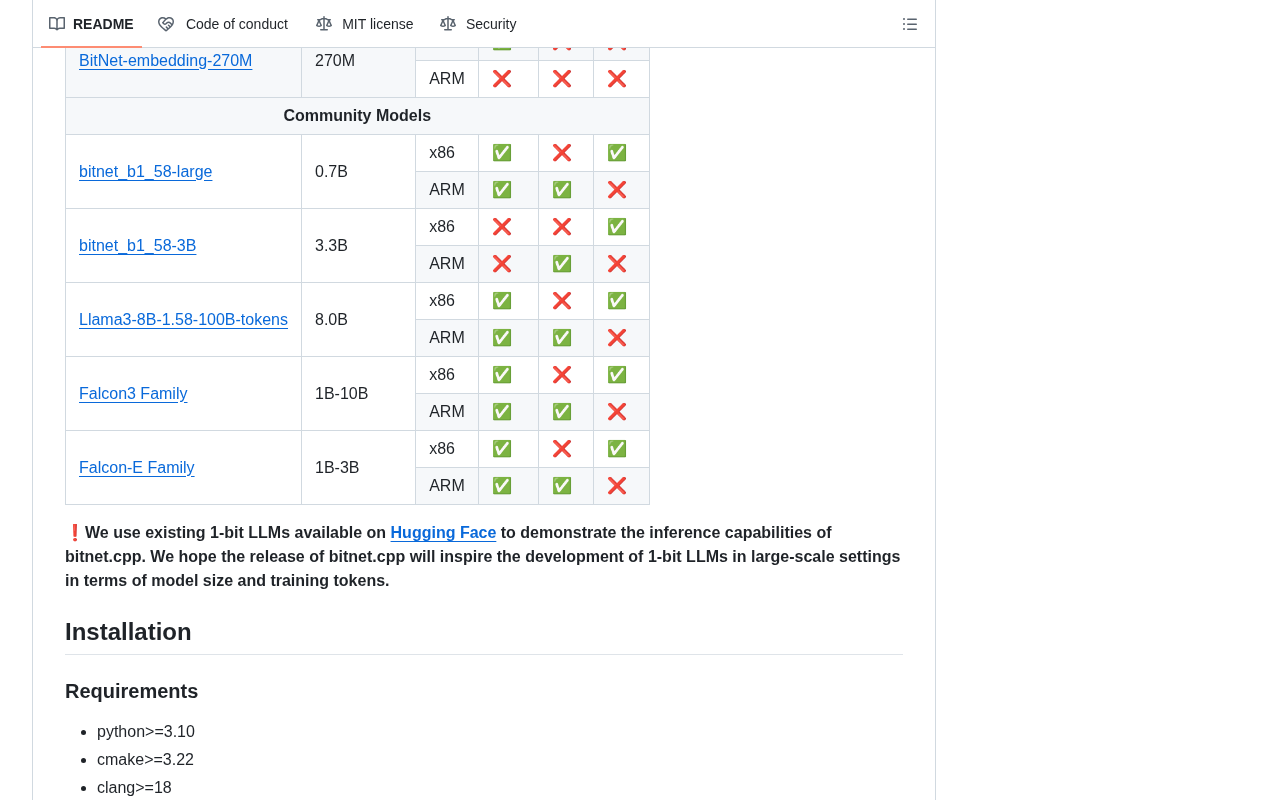
Judging from the repository information, BitNet is positioned as an "official inference framework," not a training framework. The core keyword is inference — it solves the problem of how to efficiently run 1-bit LLMs after training is complete.
C++ as the implementation language shows the project has clear goals for performance and low-level control. Compared to Python inference stacks, the C++ version has inherent advantages in startup speed, memory footprint, and cross-platform deployment.
The division of labor between inference and training frameworks: In AI engineering, training frameworks (such as PyTorch and TensorFlow) are responsible for adjusting model parameters through backpropagation, with extremely high demands on compute, VRAM, and numerical precision; inference frameworks focus on efficiently executing already-trained models, with optimization priorities on low latency, low memory footprint, and cross-platform deployment.
BitNet clearly stands on the inference side, meaning it doesn't train 1-bit models but provides an efficient execution engine for existing 1-bit weights. This positioning is similar to projects like llama.cpp and vLLM, except it specifically serves the extreme quantization scenario of 1-bit. Therefore, a user's typical path is: first obtain model weights using a method that supports 1-bit training, then hand them to BitNet to run on the target hardware — rather than expecting it to "compress" an ordinary model into 1-bit.
What Developers Can Gain from It
For AI application developers, BitNet provides an entry point for exploring extremely low-precision inference. You can use it to verify how 1-bit models perform on real tasks, assess the impact of quantization on output quality, and test inference efficiency across different hardware platforms.
For researchers, this framework is an experimental platform for studying the inference characteristics of 1-bit LLMs. It opens up the low-level implementation, making it easy to analyze how binarized weights behave in a real inference pipeline.
For hardware and systems engineers, BitNet demonstrates the possibility of running large models in resource-constrained environments, offering direct reference value for edge computing and on-device AI.
What the Community Hype Says
40,728 stars is a considerable number. It reflects the developer community's strong demand for "running large models at low cost." As model sizes continue to swell, making inference lightweight and accessible is becoming an issue as important as model capability itself.
BitNet's popularity also shows that 1-bit LLMs are no longer just a concept in papers — they now have an official engineering implementation and active community attention. For anyone following model compression, efficient inference, and on-device deployment, this is a project worth tracking.
Related articles

Chain of Thought Isn't Just for AI: How Humans Can Use CoT to Improve Thinking Quality
Chain of Thought isn't just a prompt trick for large models. Starting from a Hacker News discussion, this article analyzes why CoT works for human thinking too, breaks down actionable ways to transfer it, and highlights the key differences between human CoT and machine CoT.
Cloudflare Teams Up with OpenAI: Closi…
Cloudflare Teams Up with OpenAI: Closing the Loop from Vulnerability Discovery to Defense with AI
Cloudflare uses OpenAI Daybreak to investigate security vulnerabilities and generate reviewable remediation plans, while developers use Codex to boost coding efficiency and quality.

Orca Multi-Agent Orchestration in Practice: A Guide to Parallel Collaboration with Claude and Codex
Orca is Stable AI's free open-source agent workbench supporting 34 agents like Claude Code and Codex in parallel. Learn its Git worktree isolation, multi-model orchestration, and mobile management.