Microsoft Discovery: Multi-Agent Collaboration Accelerates Scientific Discovery

Microsoft Discovery uses multi-agent collaboration to compress vast scientific search spaces into focused paths, with scientists always in control.
Using "designing better batteries" as an example, the article explains how Microsoft Discovery coordinates specialized agents to accelerate research. The challenge is integrating heterogeneous evidence from papers, expert knowledge, proprietary data, simulations, and experiments, while the research space branches exponentially with candidates. Discovery simulates the scientific method through multi-agent collaboration—questioning, hypothesizing, simulating, validating, and iterating—forming a continuous cycle rather than a one-time answer. When new evidence arrives, the system dynamically adjusts tasks and plans. But key decisions remain with scientists; Discovery augments rather than replaces expertise, aiming to reduce experiments, focus on more promising candidates, and serve as a human-in-the-loop "thinking partner."
The bottleneck in scientific research is often not a lack of data, but rather how to extract verifiable scientific paths from fragmented, multi-format information. Ali Zaman, a product manager at Microsoft, uses "designing better batteries" as an example to demonstrate how Microsoft Discovery accelerates this process by coordinating specialized agents.
Why the Scientific Search Space Is Hard to Converge
To design a battery that charges faster, lasts longer, and uses safer materials, researchers need to integrate multi-source evidence from papers, expert knowledge, proprietary data, simulation results, and laboratory experiments. These sources come in different formats, with inconsistent assumptions and terminology.
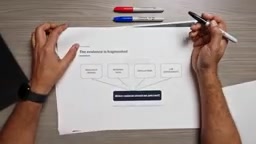
Ali Zaman points out that simple search plus summarization is not enough. As each material, formulation, and test is added, the research space keeps branching, and the number of paths grows extremely fast. Scientists must determine which branches are scientifically sound and focus their energy on the most promising candidates. This is precisely the coordination problem that Discovery aims to solve.
What Is a Scientific Search Space?
A scientific search space can be understood as a high-dimensional combinatorial problem: given multiple tunable variables (material elements, ratios, process parameters, test conditions, etc.), the space of all possible combinations grows exponentially with the number of variables. In the case of batteries, considering only the proportions of a few transition metals, coating materials, and sintering temperatures, the number of candidate combinations can reach the order of hundreds of thousands.
What makes it even more challenging is that the search space is not flat—many regions are physically or chemically infeasible (e.g., thermodynamically unstable, toxicity exceeding limits), and some regions lack data support. Therefore, the researcher's core task is not exhaustive enumeration but pruning: using partial evidence to quickly eliminate unreasonable paths and directing resources toward the most promising regions. This is exactly where multi-agent systems can add value—they can collect evidence, assess feasibility, and flag high-potential branches in parallel, while human scientists focus on judging which pruning assumptions hold. This division of labor—"machines expand the search, humans set the pruning criteria"—is what distinguishes Discovery from traditional automated search.
How Multi-Agent Collaboration Simulates the Scientific Method
Discovery coordinates specialized agents to analyze evidence, propose candidates, run scientific tools, and validate experimental results. Its workflow mimics the scientific method: ask questions, form hypotheses, run simulations, validate results, and decide the next experiment accordingly.
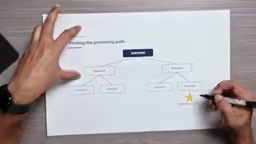
The key is that scientists always retain control: setting goals, monitoring progress, and applying scientific judgment at critical decision points. Discovery augments rather than replaces scientific expertise.
Foundations of Agents and Multi-Agent Collaboration
In the AI context, an agent refers to a software entity capable of perceiving its environment, making autonomous decisions, and taking actions. Unlike a single general-purpose large model, specialized agents are typically assigned clear roles: some are responsible for reading literature and extracting structured parameters, some for invoking simulation tools to calculate electrochemical performance, and some for designing experimental validation plans. They can each maintain their own memory, tool interfaces, and evaluation criteria.
"Multi-agent collaboration" refers to these roles working together through message passing, task decomposition, or shared blackboards, thereby covering multi-step, multi-tool workflows that a single model struggles to handle simultaneously. Its advantages lie in specialized division of labor and parallel exploration: each agent is more reliable on the subtasks it excels at, and multiple agents evaluating different candidate paths simultaneously can accelerate convergence. However, multi-agent systems also introduce coordination costs, redundant computation, and the risk of error propagation, so a coordinator is needed to assign tasks and aggregate evidence, with human scientists arbitrating at key junctures.
Continuous Cycles Rather Than One-Time Answers
Discovery's output is not a fixed answer at a single point in time, but a continuous cycle. When new evidence arrives, the discovery engine adjusts tasks and plans, refocusing on the most promising candidates.

This mechanism allows scientists to approach results faster with fewer experiments and better candidates while maintaining control.
The Role of "Human-in-the-Loop" in Scientific AI
Human-in-the-loop is a system design pattern in which AI does not make fully autonomous decisions but instead introduces human judgment at key points in the process. In Discovery's cycle, scientists set optimization goals (such as weighting energy density, cost, and safety), review candidates proposed by agents, and decide the direction of the next round after experimental data returns.
This pattern addresses two pain points of fully automated scientific research: first, AI may propose seemingly reasonable but physically absurd solutions based on erroneous or one-sided evidence, and human experts' intuition and domain knowledge can quickly reject them; second, scientific goals themselves often shift as discoveries are made, and only humans can redefine what constitutes a "worthwhile" question. Keeping control in the hands of scientists also makes the system's outputs more interpretable and accountable, which is especially important in high-stakes fields such as drugs and materials.
Practical Implications for Scientific Workflows
For fields with high experimental costs such as materials and drugs, Discovery's value lies in compressing a vast research space into focused paths.
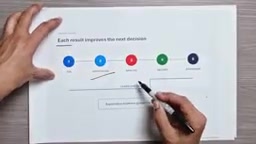
It is more like a "thinking partner" that helps scientists navigate complex evidence, rather than delivering black-box conclusions. This human-in-the-loop, multi-agent model may be an important form of AI-assisted scientific research in practice.
One-line Summary
Microsoft Discovery uses multi-agent collaboration to compress vast scientific search spaces into focused paths, with scientists always in control.
Paragraph Summary
Using "designing better batteries" as an example, the article introduces how Microsoft Discovery coordinates specialized agents to accelerate scientific research. The difficulty lies in integrating heterogeneous, multi-source evidence from papers, expert knowledge, proprietary data, simulations, and experiments, while the research space branches exponentially as candidates increase. Through multi-agent collaboration, Discovery simulates the scientific method—asking questions, forming hypotheses, simulating, validating, and iterating—creating a continuous cycle rather than a one-time answer. When new evidence arrives, the system dynamically adjusts tasks and plans. But key decisions remain in the hands of scientists; Discovery augments rather than replaces expertise, aiming to reduce experiments, focus on more promising candidates, and become a human-in-the-loop "thinking partner."
Related articles

How Big Can Stars Really Get? The Physical Limits of the Largest Stars
Red supergiants are the largest stars by volume, with radii up to 2,000 times the Sun, engulfing the inner solar system. But there is no precise upper limit on stellar size—models predict up to 15,000 solar radii. The most massive blue stars are far smaller than red supergiants—biggest and heaviest are two different things.

Apple HomeView Smart Display Full Feature Breakdown: Wall-Mount or Desktop, $299
Apple launches HomeView, a $299 smart display with wall-mount and desktop options, 12MP camera for facial recognition, smart home control, music playback, and recipe step-by-step cooking. Full breakdown of watch faces, apps, privacy, and cooking integration.

Where Did the Promised New Studio Go? Craft Computing Answers After Five Years
Craft Computing's host responds to viewer questions: the new studio promised five years ago was shelved as construction costs soared from $30,000 to $75,000, and was replaced by a 168-square-foot garage conversion.