Microsoft MAI-Image-2.6 Ranks #2 Globally in Text-to-Image, Propelling Its In-House Model into the Top Tier
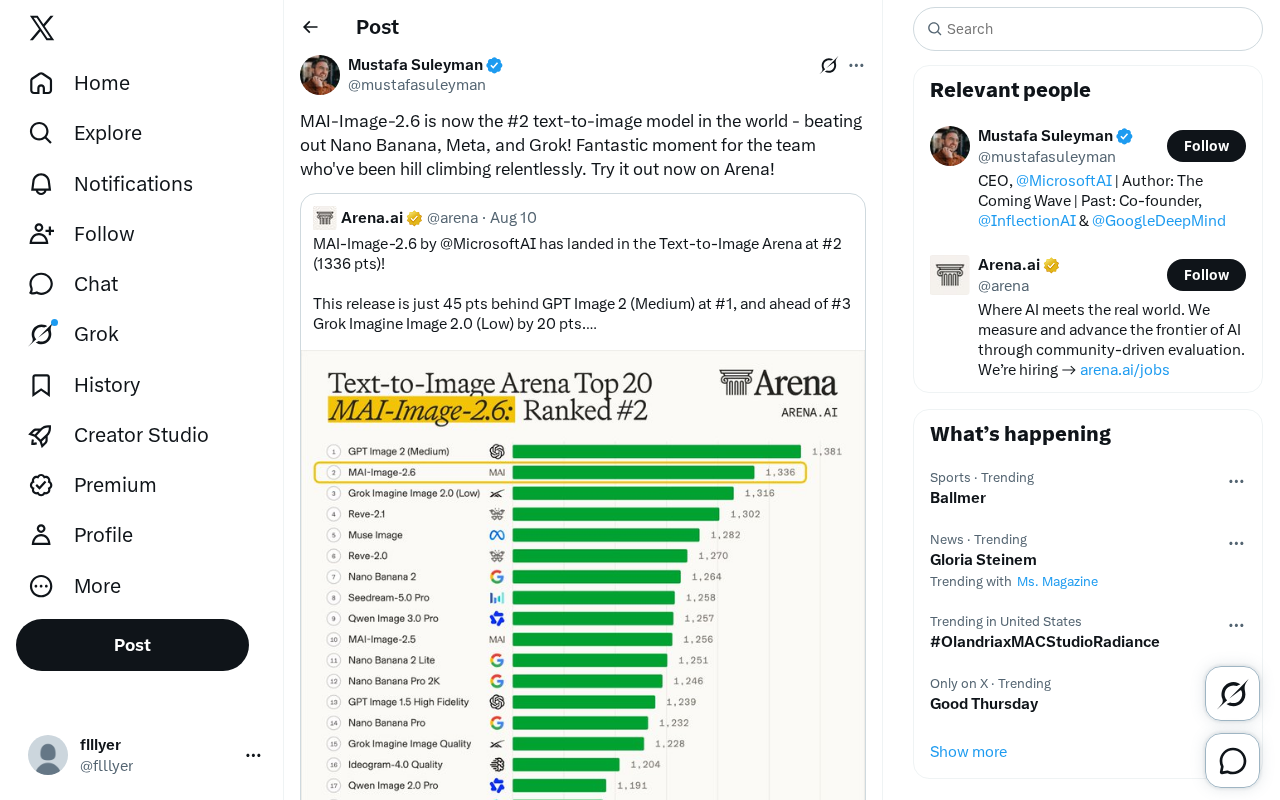
Microsoft's MAI-Image-2.6 ranks #2 globally in text-to-image, rivaling Google, Meta, and xAI.
Microsoft's in-house image generation model MAI-Image-2.6 has claimed the #2 spot on the global Arena text-to-image blind-test leaderboard, surpassing Google's Nano Banana, Meta, and xAI's Grok. This milestone signals Microsoft's shift from relying on OpenAI to building competitive self-developed multimodal AI capabilities, with major implications for Copilot and its broader product ecosystem.
Microsoft's In-House Image Model Breaks into the Top Tier
In the fiercely competitive text-to-image race, Microsoft has dropped another bombshell. According to an official announcement from Microsoft's AI team, their in-house image generation model MAI-Image-2.6 has climbed to second place on the global text-to-image model leaderboard, surpassing formidable rivals including Nano Banana, Meta, and xAI's Grok.
This achievement comes from the authoritative third-party evaluation platform Arena (part of the LMArena/Chatbot Arena family's image arena). Unlike traditional fixed benchmark tests, Arena uses a blind-test voting system where real users compare outputs from two anonymous models side by side, ultimately producing an Elo ranking. This "vote with your feet" mechanism is widely regarded in the industry as a more accurate reflection of a model's real-world performance.
The Microsoft team could barely contain their excitement in their post, describing the result as the fruit of "hill climbing relentlessly" and inviting users to try the model on Arena immediately.
The MAI Series: Microsoft's Key Move to Reduce OpenAI Dependence
From Leveraging Partners to Building In-House
MAI is the brand name for models developed in-house by Microsoft's AI team. For a long time, Microsoft has been heavily reliant on its massive investment in and technology licensing from OpenAI for generative AI — whether it's Copilot or Azure OpenAI services, nearly everything has been powered by the GPT and DALL·E series under the hood.
However, as OpenAI's own strategy has shifted and the relationship between the two companies has evolved in subtle ways, Microsoft has accelerated its in-house model development efforts. Previously, Microsoft had already released the MAI-Voice-1 speech model and the MAI-1 foundational language model. Now, with the debut of MAI-Image-2.6, Microsoft has completed a critical step toward self-sufficiency in image generation — a core multimodal capability.
The Rapid Iteration Behind Version "2.6"
Here's a telling detail: the model debuted at version 2.6, indicating that Microsoft has already gone through multiple rounds of rapid iteration internally. In the generative image space, catching up with and even surpassing heavyweight players like Google (Nano Banana being the codename for Gemini's image generation capabilities), Meta, and xAI in such a short timeframe speaks volumes about Microsoft's deep reserves in computing power, data, and engineering expertise.
The Industry Landscape Behind the Leaderboard
Who's in the Text-to-Image Top Tier?
The competitors in this comparison reveal the current top tier of text-to-image models:
- Nano Banana: The codename for Google Gemini ecosystem's image generation capabilities, which had long occupied the top spots on the leaderboard;
- Meta: Its Emu/Imagine series of image models;
- Grok: xAI's image generation feature, leveraging the X platform;
- MAI-Image-2.6: Microsoft's latest in-house model, now ranked second.
Breaking through to second place among all these competitors means MAI-Image-2.6 has achieved top-tier performance across multiple dimensions, including image quality, prompt adherence, text rendering, and aesthetic appeal.
The Value and Limitations of Arena Evaluations
Arena's blind-test rankings do come closer to reflecting real user preferences, but they should be viewed with a level-headed perspective. Elo rankings fluctuate dynamically with voting sample sizes and over time — "second place" reflects relative performance within a specific time window rather than absolute technical dominance. Moreover, user preferences tend to favor "eye-catching" aesthetic styles, which don't necessarily equate to engineering-level technical superiority. Therefore, this achievement should be interpreted as Microsoft successfully breaking into the top-model tier, not as a definitive victory.
Far-Reaching Implications for Microsoft's AI Ecosystem
Filling the Multimodal Gap in Copilot
For Microsoft, having a world-class in-house text-to-image model is enormously significant. It can be directly integrated into Copilot, Bing Image Creator, Designer, and various creative tools across the Windows ecosystem. This reduces costs and risks associated with external licensing while giving Microsoft greater autonomy and control over the product experience.
The Big Tech Arms Race Heats Up Further
With Microsoft, Google, Meta, and xAI all rolling out their own top-tier image models, competition in the text-to-image space has evolved from simply "can it generate images" to the more nuanced stage of "who generates better, faster, and with a deeper understanding of users." It's safe to predict that leaderboard rankings will continue to shift frequently over the coming months, as each company pushes out innovations at an increasingly rapid pace.
Conclusion
MAI-Image-2.6 reaching the global #2 spot is not just a technical milestone for Microsoft's AI team — it reflects Microsoft's firm commitment to transitioning from dependence to self-reliance in generative AI. For users, this fierce competition among tech giants means more powerful, more affordable, and more accessible image generation capabilities. This text-to-image summit race is just reaching its climax. If you're curious, head over to Arena to try it yourself and cast your vote in this showdown of the world's top models.
Related articles

Claude Reportedly Able to Hide Secret Messages in Benign Images
A Reddit post claims Claude Fable 5.1 can hide secret messages in benign images. This article reviews the background, image steganography principles, and potential security risks, and suggests a testing path from rumor to verification.

Federal Government Awards $85 Million; CFS to Develop Fusion-Specific Semiconductors
The federal government awards $85 million to Commonwealth Fusion Systems to develop conductors and power semiconductors for fusion plants. This article analyzes the significance of this funding for the fusion supply chain and commercialization path.

When Should AI Assistants Proactively Suggest? Timing Is Everything
When should AI assistants proactively suggest? Reddit discussion reveals: the same suggestion feels different at different times. This article analyzes the dual nature of proactive suggestions, the boundary of user expectations, and design principles, exploring how to balance automation and user control.