Microsoft Open-Sources Copilot: A Seismic Shift in AI Coding — Was the $3B Windsurf Acquisition Worth It?

Microsoft open-sources GitHub Copilot, reshaping the AI coding tools competitive landscape.
Microsoft announced open-sourcing GitHub Copilot, driven by three factors: advancing LLM capabilities making prompts no longer a moat, AI coding features converging across products, and competitive pressure from Cursor and Windsurf. This move also raises questions about OpenAI's $3B Windsurf acquisition, though long-term value remains in the team, data, and vertical integration strategy. Future AI coding competition will focus on ecosystem integration, model evolution, and community operations.
Microsoft recently announced the open-sourcing of GitHub Copilot, sending shockwaves through the developer community. At the same time, OpenAI's $3 billion acquisition of Windsurf has sparked widespread debate — with Microsoft open-sourcing Copilot, is that massive acquisition still worth it? The AI coding tools market is undergoing a profound transformation.
Why Did Microsoft Choose to Open-Source Copilot?
Microsoft's decision to open-source Copilot wasn't impulsive — it's backed by clear strategic logic. Three core reasons drove this decision.
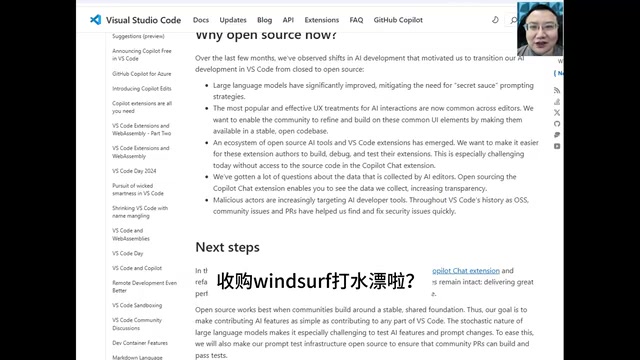
Rapid Advances in LLM Capabilities Mean Prompts Are No Longer a Moat
As models like GPT-4o, Claude 3.5 Sonnet, and Gemini continue to leap forward in capability, the technical barriers between AI coding tools are dissolving rapidly. In the past, AI coding products built differentiated competitive advantages through carefully crafted "proprietary prompts" (System Prompts), but today these prompt engineering secrets are no longer mysterious.
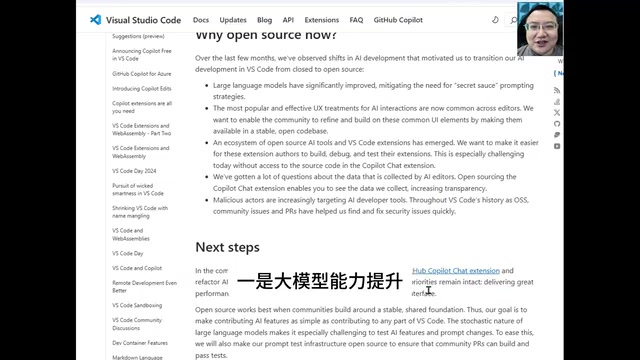
"Prompt Engineering" refers to the practice of carefully designing input instructions for large language models to guide them toward more precise, expected outputs. In AI coding tools, System Prompts play a crucial role — they are hidden instructions pre-injected every time the product calls the LLM, defining how the model should understand code context, what style to use when generating code, how to handle edge cases, and other core behaviors. In the past, companies invested enormous R&D effort into their System Prompts, treating them as core trade secrets. However, as community members have increasingly used techniques like "Prompt Injection" to extract various products' System Prompts, these so-called "secret weapons" have been widely circulated in developer communities, allowing competitors to easily reference or even directly reuse them.
When the underlying model is powerful enough, simple prompts can achieve high-quality code generation. This means the strategy of building a moat purely through prompt optimization has become ineffective. Products are converging in performance across core functions like code completion, code generation, and bug fixing, with the user experience gap continuously narrowing. The deeper reason is that once a model's code comprehension and generation capabilities reach a certain level, the marginal returns from prompt optimization diminish sharply — the model is already "smart" enough to understand developer intent without overly elaborate prompt guidance.
AI Coding Product Features Are Stabilizing, with Narrowing Innovation Space
After nearly two years of rapid iteration, the core feature set of AI coding tools has essentially solidified. Whether it's auto-completion, multi-file editing, context understanding, terminal command generation, or autonomous programming in Agent mode, all mainstream products now cover developers' primary use cases.
It's worth explaining "Agent mode" in particular — this represents the latest stage in AI coding tool evolution and the current focal point of competition. Unlike the traditional "human asks, AI answers" conversational mode, AI in Agent mode possesses autonomous planning and execution capabilities: it can independently analyze task requirements, break complex tasks into multiple sub-steps, autonomously read project files, write code, run tests, fix errors, and even execute terminal commands, all with minimal human intervention. From a technical evolution perspective, AI coding tools have progressed through four stages: from "single-line code completion" to "multi-line code generation," then to "conversational programming assistance," and finally to "Agent autonomous programming." All mainstream products have now entered the Agent stage, and the space for feature differentiation is indeed significantly narrowing.
Innovation space at the feature level is shrinking, and competition between products is gradually shifting from "does it have the feature" to "how well does it work." In this context, open-sourcing becomes a smarter strategy — by opening source code to attract community contributions, leveraging the global developer community to continuously optimize the product experience. This strategy has successful precedents in the software industry: Microsoft itself grew VS Code from a latecomer into the world's most popular code editor by open-sourcing it, defeating predecessors like Sublime Text and Atom. The core business logic of open source is "free product to acquire users, premium services to monetize" — Microsoft can lock in users by open-sourcing Copilot's core features, then monetize through GitHub Enterprise, Azure cloud services, and other commercial products.
Competitive Pressure from Cursor and Windsurf
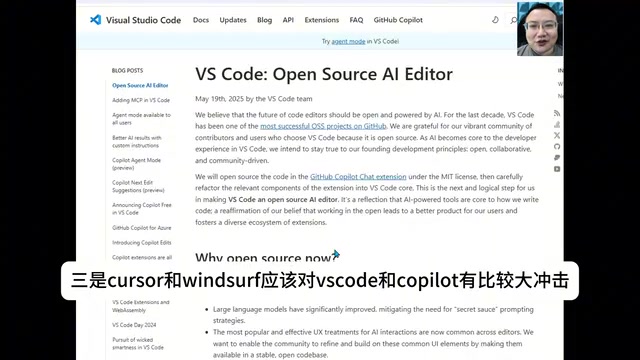
It must be acknowledged that emerging AI coding tools like Cursor and Windsurf have posed significant challenges to the VS Code + Copilot combination.

Notably, neither Cursor nor Windsurf built their editors from scratch — they're both based on VS Code's open-source core (Microsoft's Code OSS project, released under the MIT license), with deep customization and secondary development. This means they naturally inherit VS Code's rich plugin ecosystem and familiar user interface, while making bold innovations at the AI capability layer. This "standing on the shoulders of giants" strategy allows them to rapidly ship mature products at extremely low cost, competing directly with Microsoft's official solution — in a sense, Microsoft's own decision to open-source VS Code paved the way for future competitors.
Cursor quickly won over a large number of developers with its excellent user experience and powerful Agent capabilities. Its core advantage lies in deeply embedding AI capabilities into every interaction point of the editor, rather than existing merely as a plugin like early Copilot. Windsurf (formerly Codeium) attracted users with its smooth editing experience and innovative Cascade feature — Cascade is an AI function that understands the developer's complete workflow and proactively provides multi-step programming suggestions, tracking the upstream and downstream impact of code changes across files to provide more globally-aware programming assistance. The rise of these competitors made Microsoft realize that a closed-source strategy could lead to continued user attrition.
Open-sourcing Copilot is essentially Microsoft's "dimension-reduction strike" — since they can't completely suppress competitors on the closed-source track, they might as well open up the ecosystem and use VS Code's massive user base and Microsoft's brand influence to redefine the rules of competition. Once Copilot's core code is fully open, community developers can directly contribute the excellent features already validated by Cursor and Windsurf, rapidly closing the experience gap.
OpenAI's $3B Windsurf Acquisition — Does the Math Still Work?
OpenAI's acquisition of Windsurf for approximately $3 billion seemed like a strategic investment to secure an AI coding entry point. But Microsoft's open-sourcing of Copilot has undoubtedly cast a shadow over this deal.
To understand the strategic significance of this deal, we need to review Windsurf's history. Windsurf's predecessor was Codeium, founded in 2022 by former Google engineers, initially positioned as a free AI code completion tool that rapidly accumulated a large user base through a "freemium" model. Codeium later launched a standalone IDE product and rebranded as Windsurf, attempting to upgrade from a plugin tool to a complete AI programming platform. Before the acquisition, Windsurf already had millions of registered users and an engineering team with deep experience in AI coding. For OpenAI, the core motivation behind this acquisition was gaining a product entry point directly facing developers — while OpenAI possesses the world's most powerful large language models, it has long primarily provided capabilities to other applications via API, lacking its own end-user products (aside from ChatGPT). Acquiring Windsurf allows OpenAI to directly reach millions of developer users and build vertically integrated capabilities from model training to programming applications.
In the short term, Windsurf's standalone product value has indeed taken a hit. Once Copilot becomes an open-source project, any developer can customize and improve upon its code, and some of Windsurf's previously accumulated technical advantages may be quickly matched. Especially for editor-level differentiation features — once the Copilot open-source community becomes sufficiently active, these features will likely be quickly replicated by the community in the form of plugins or forks.
But from a long-term perspective, this acquisition may not be a complete waste. What OpenAI acquired with Windsurf wasn't just the product itself, but also the engineering team, user data, and hands-on experience in the AI coding domain. More importantly, OpenAI can deeply integrate Windsurf into its own model ecosystem, creating a complete closed loop from model to application. This "vertical integration" strategy has deep roots in the tech industry — Apple built unparalleled user experiences through its self-designed chips + operating system + App Store closed loop; Google built a powerful data flywheel through search engine + Chrome browser + Android system. OpenAI's logic in acquiring Windsurf is similar: by controlling the complete chain from underlying models to upper-layer programming tools, OpenAI can obtain massive amounts of real programming interaction data to further optimize its code models' capabilities, forming a positive cycle of "better models → better products → more user data → better models."
The Future Direction of the AI Coding Market
Microsoft open-sourcing Copilot marks the AI coding tools market entering a new competitive phase. Future competition will shift from product features to the following dimensions:
Ecosystem Integration Capability: Whoever can better integrate IDE, cloud services, and CI/CD pipelines will hold the advantage. CI/CD (Continuous Integration/Continuous Deployment) refers to indispensable automation processes in modern software development — continuous integration means developers frequently merge code changes into the main branch and verify code quality through automated testing; continuous deployment means automatically releasing tested code to production environments. If AI coding tools can deeply embed into CI/CD pipelines, it means AI can not only help developers write code but also automatically complete code review, test generation, deployment configuration, and other subsequent steps, truly achieving end-to-end development automation. Microsoft possesses a complete ecosystem chain of Azure (the world's second-largest cloud computing platform) + GitHub (the world's largest code hosting platform with over 100 million developers) + VS Code (the world's most popular code editor with over 70% market share), and the synergy between these three is its greatest trump card. Developers can write code with Copilot in VS Code, manage versions and collaborate through GitHub, and deploy and run applications through Azure — the entire process is seamless with shared data, creating a competitive moat that no single product can replicate.
Continuous Evolution of Model Capabilities: The ceiling of AI coding tools ultimately depends on the capabilities of the underlying models. As models with stronger reasoning abilities continue to emerge, AI coding tools will evolve from "assisted programming" to "autonomous programming." Specifically, this evolution can be divided into several stages: we're currently in the "AI assists human programming" stage, where AI primarily plays the role of an intelligent assistant; the next stage will be "AI leads, humans supervise," where AI can independently complete most programming tasks and humans only need to review key decisions; the final stage is "fully autonomous programming," where AI can independently complete the entire process from architecture design to code implementation to testing and deployment based on high-level product requirement descriptions. OpenAI's o-series reasoning models, Anthropic's Claude, and Google's Gemini are all developing toward stronger multi-step reasoning and long-horizon planning capabilities, and breakthroughs in these capabilities will directly propel AI coding tools to higher stages.
Developer Community Operations: Open source means community-driven — whoever can build a more active developer community will achieve faster product iteration and stronger user stickiness. Successful open-source projects like Linux, Kubernetes, and VS Code have all proven a pattern: once an open-source project forms a sufficiently active community ecosystem, it generates powerful network effects — more contributors lead to a better product, a better product attracts more users, and more users incentivize more contributors to join, forming a self-reinforcing growth flywheel. Microsoft has rich experience in open-source community operations, and GitHub itself is the world's largest open-source collaboration platform, giving Microsoft a natural advantage in building the Copilot open-source community.
Overall, Microsoft open-sourcing Copilot is a carefully calculated move. It not only redefines the competitive landscape of AI coding tools but also sends a clear signal to the entire industry: in an era where AI capabilities are increasingly democratized, open ecosystems hold more long-term value than closed barriers. For developers, this is undoubtedly good news — more intense competition means better tools and lower barriers to entry.
Related articles
Meta Muse Hits 900K Downloads in Six D…
Meta Muse Hits 900K Downloads in Six Days: The AI Agent Era Has Officially Arrived
Meta's AI agent Muse hit 902K downloads in 6 days, topping US App Store and Google Play charts above ChatGPT and Claude. A deep dive into Muse's capabilities and the AI Agent race.
 Industry Insights
IRS Fully Embraces Claude AI, Accelerating Federal Government's AI Adoption
The IRS is recruiting staff with 24/7 Claude AI access, marking Anthropic's breakthrough into the federal government. Explore the strategic implications and tax use cases.
 Industry Insights
The IRS Mobile App Debate: A Trust Crisis in Government Digital Transformation
The IRS's proposed mobile app has sparked heated debate. This article analyzes the core arguments, exploring data security, privacy, and the trust crisis in government digital transformation.