Microsoft Patent: Train AI on Your Idle GPU for Points—Is It Worth the Electricity Bill?
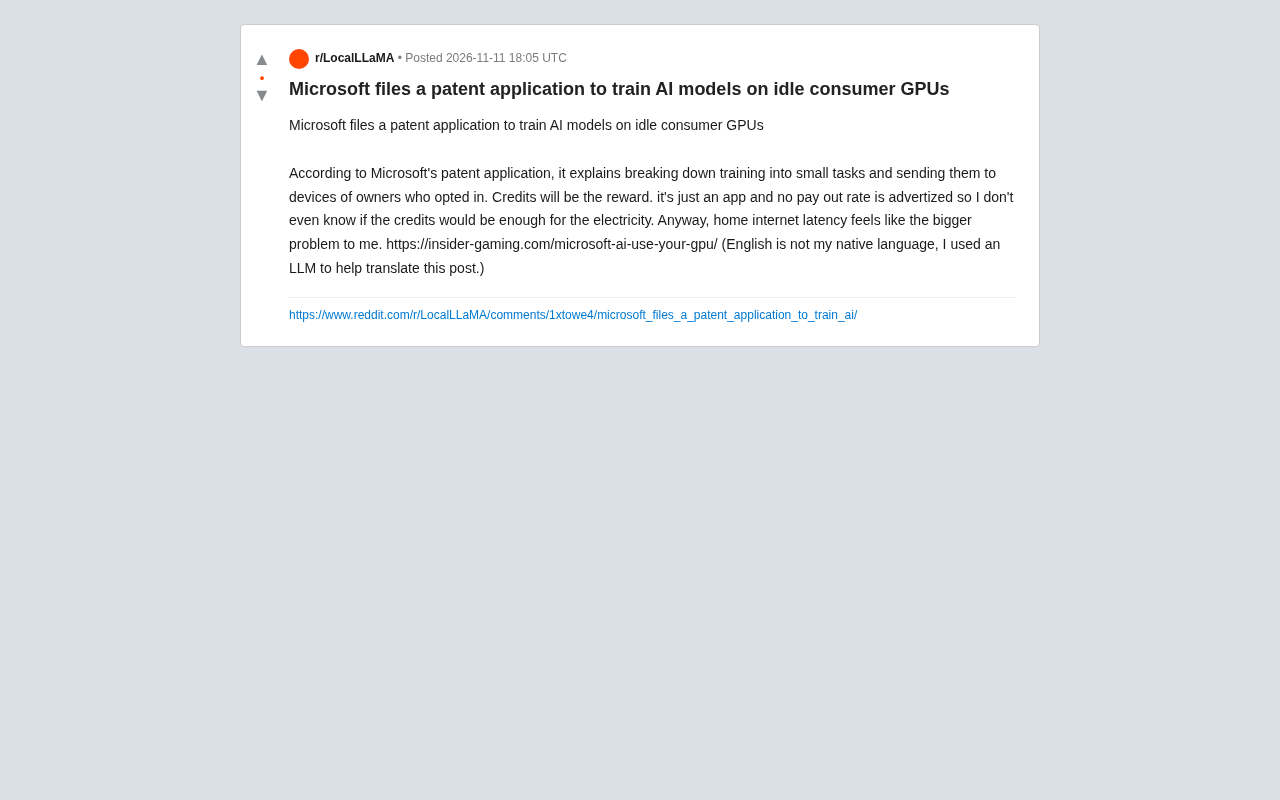
Microsoft patent aims to crowdsource AI training to consumer GPUs with point incentives, but electricity costs and network latency are bottlenecks.
A new Microsoft patent reveals the company is exploring splitting AI model training into fine-grained tasks distributed to voluntarily joined consumer GPUs with points as rewards—similar to traditional distributed computing projects like BOINC. But the idea faces dual challenges: the patent does not disclose point redemption ratios, so users cannot judge whether earnings cover GPU electricity costs; and home network upstream bandwidth and latency are far inferior to data centers, with gradient synchronization and task scheduling overhead potentially slowing training and affecting convergence. The patent also lacks details on privacy, fault tolerance, and communication optimization; compared to existing data center distributed training, heterogeneous hardware, unstable networks, and dynamic node exits remain unresolved. The patent is only in application stage with no productization plans.
Title
Microsoft Patent: Train AI on Your Idle GPU for Points—Is It Worth the Electricity Bill?
Meta Description
A Microsoft patent proposes splitting AI training tasks across users' idle GPUs with points as rewards. This article analyzes its incentive design, network latency bottlenecks, and differences from existing distributed training, exploring whether the model can be deployed.
Article Content
A new Microsoft patent reveals that the company is exploring splitting AI model training tasks into small pieces and distributing them to consumer-grade GPUs on voluntarily joined user devices, rewarding participants with points. This idea resembles the old approach of distributed computing, but in the AI training context, it faces dual challenges of network latency and incentive rationality.
Patent Core: Crowdsourcing Training Tasks to Idle GPUs
According to the patent description, Microsoft decomposes the AI training process into fine-grained small tasks and sends them to opt-in consumer devices. These devices use idle GPU compute to execute the calculations and receive points as rewards upon completion.
This is essentially a crowdsourced compute model, similar to traditional distributed computing projects like BOINC, but targeted at AI model training. The patent does not disclose specific point redemption ratios or payout rates, only mentioning points as rewards.
BOINC (Berkeley Open Infrastructure for Network Computing) is a distributed computing platform launched by UC Berkeley in 2002, initially serving the SETI@home project and later hosting numerous scientific projects such as climate simulation, protein folding, and gravitational wave data analysis. Its operation: project organizers divide computing tasks into independently verifiable small work units; volunteer clients download tasks, execute them on local CPU/GPU, and return results; the platform ensures credibility through redundant computation or verification mechanisms. The model envisioned in Microsoft's patent is highly similar to BOINC in task distribution and result collection structure, but there are key differences: BOINC tasks are usually independent and highly parallelizable, whereas neural network training involves gradient synchronization and parameter updates with strong dependencies between tasks—this is the fundamental reason for the communication bottleneck faced by this idea.
Can Points Cover Electricity Bills? Incentive Design Questioned
The original Reddit poster raised a practical issue: without a published payout rate, users cannot determine whether the points earned are sufficient to offset the electricity costs of running GPUs at full load.
For ordinary consumers, GPU power consumption rises significantly under high load, and long-term electricity costs may exceed the value of points. If incentives are insufficient, the scale of willing participants will be limited, affecting the overall network's compute supply.
Network Latency: A More Critical Bottleneck Than Electricity Bills
The original poster believes that home internet latency is the bigger problem. AI training tasks typically require frequent synchronization of gradients or parameters between devices, and consumer broadband's upstream bandwidth and latency are far inferior to dedicated networks in data centers.
Splitting training into small tasks can reduce per-communication volume, but task scheduling, result return, and synchronization overhead still introduce latency. For tightly coupled model training, this loose network structure may slow overall progress and even affect model convergence.
Gradient synchronization is a core环节 of data-parallel training. In standard data-parallel schemes, each GPU holds a complete model replica, computes gradients using different data batches, then averages gradients across all devices via collective communication operations like All-Reduce, updates parameters, and proceeds to the next iteration. This process occurs at every training step, so inter-device communication latency directly determines training throughput. Data centers typically use InfiniBand or high-speed Ethernet with microsecond-level inter-node latency; home broadband upstream bandwidth is often only tens of Mbps with round-trip latency in the tens of milliseconds, plus jitter and NAT traversal issues. When model parameter counts reach billions, a single gradient transfer can involve several GB of data—home networks can hardly sustain such frequent synchronization, which is why the industry needs specialized techniques like gradient compression, asynchronous updates, or federated learning to mitigate this problem.
Comparison with Existing Distributed Training
The industry already has distributed training frameworks, but they are mostly deployed in high-bandwidth data center environments. Microsoft's patent envisions extending to home devices, which requires solving issues like heterogeneous hardware, unstable networks, and dynamic node join/exit.
The patent does not disclose specific fault-tolerance mechanisms or communication optimization schemes, so its practicality remains to be seen.
Fault-tolerance mechanisms are crucial in loosely connected node networks. Distributed training in data centers assumes nodes are basically reliable, with hardware failures being low-frequency events, so checkpointing is commonly used to periodically save state. But in crowdsourcing scenarios, users may shut down, disconnect, or actively exit at any time, making nodes highly dynamic. Academia has proposed various solutions: first, redundant computation, assigning the same task to multiple nodes and taking majority results; second, asynchronous parameter server architecture, allowing nodes to submit updates at different speeds to avoid slow nodes dragging down the whole; third, task rescheduling and checkpoint rollback, recovering from the latest model snapshot after node dropout. These mechanisms all incur additional overhead, and balancing efficiency and reliability is the technical key to whether consumer-grade GPU crowdsourced training can be deployed.
Privacy and Security Considerations
After users opt in, their devices will execute training tasks distributed by Microsoft. The patent does not detail data privacy protection measures, such as whether training data will touch user devices and how task code is isolated. These details will directly affect user trust.
Outlook: Concept Feasible, Deployment Challenges Significant
Microsoft's patent demonstrates an approach to training AI using edge compute, but the rationality of point incentives and overcoming network latency are two major thresholds. If the value of points cannot cover electricity bills, or training efficiency drops significantly due to network issues, this model will be difficult to scale.
Currently, the patent is only in the application stage, and Microsoft has not announced any productization plans. For gamers with high-performance GPUs, this might be a new way to generate revenue from idle hardware, but only if Microsoft can offer a competitive reward scheme.
One-line Summary
Microsoft patent aims to crowdsource AI training tasks to consumer GPUs with point incentives, but electricity costs and network latency are deployment bottlenecks.
Paragraph Summary
A new Microsoft patent reveals the company is exploring splitting AI model training into fine-grained small tasks, distributing them to voluntarily joined consumer GPUs for execution with points as rewards—an approach similar to traditional distributed computing projects like BOINC. But the idea faces dual challenges: first, the patent does not disclose point redemption ratios, so users cannot judge whether earnings can cover electricity costs of running GPUs at full load; second, home network upstream bandwidth and latency are far inferior to data centers, and gradient synchronization and task scheduling overhead may slow training progress and even affect convergence. Additionally, the patent does not disclose privacy protection, fault-tolerance mechanisms, or communication optimization details, and compared to existing data center distributed training frameworks, heterogeneous hardware, unstable networks, and dynamic node exits are all unresolved issues. Currently, the patent is only in the application stage with no productization plans.
Related articles

AlphaGenome 2 Released: Predicting Variant Effects by Cell Type
Google DeepMind releases AlphaGenome 2, a conditional DNA sequence model predicting regulatory activity and variant effects by cell type, open via AlphaGenome API for non-commercial research. This article examines the significance of conditional modeling, API distribution trade-offs, and validation challenges.

Reddit User Shares Free Fable Credits, Sparking Discussion
A Reddit user claims to have received 3 free Fable credits, sparking debate over whether AI tool freebies are universal. This article reviews the post and common operational logic, reminding users to rely on official statements.

Replit Wins Microsoft 2026 Partner of the Year Award: AI Coding Democratization Takes Another Step Forward
Replit wins Microsoft's 2026 Microsoft for Startups Partner of the Year award. This article interprets the signals behind Microsoft's recognition: how AI lowers the barrier to software development, and why enterprise-grade security and governance have become key to competition among AI coding platforms.