Microsoft President Calls for AI Regulation: The UK Is Best Positioned to Lead

Microsoft President Smith uses milk and washing machines as an analogy to call for the UK to lead global AI regulation.
Microsoft President Brad Smith publicly called for urgent AI regulation, comparing AI companies unfavorably to milk and washing machines in terms of oversight. He argues the UK, with its common law tradition and GDPR-era regulatory experience, is best positioned to lead a global AI governance framework. His proposals target transparency, high-risk application reviews, and cross-border coordination, overlapping with the EU AI Act. The article notes Microsoft is both an AI beneficiary and a regulatory target, so its motives deserve scrutiny. With global AI regulation fragmented across the EU, US, and China, compliance may soon become a market entry requirement.
Microsoft President Brad Smith recently issued a public call for urgent regulation of the AI industry, offering a striking analogy: milk and washing machines are subject to stricter regulation than AI companies. In his view, the UK — with its legal traditions and regulatory experience — is best positioned to lead the establishment of a global AI governance framework.
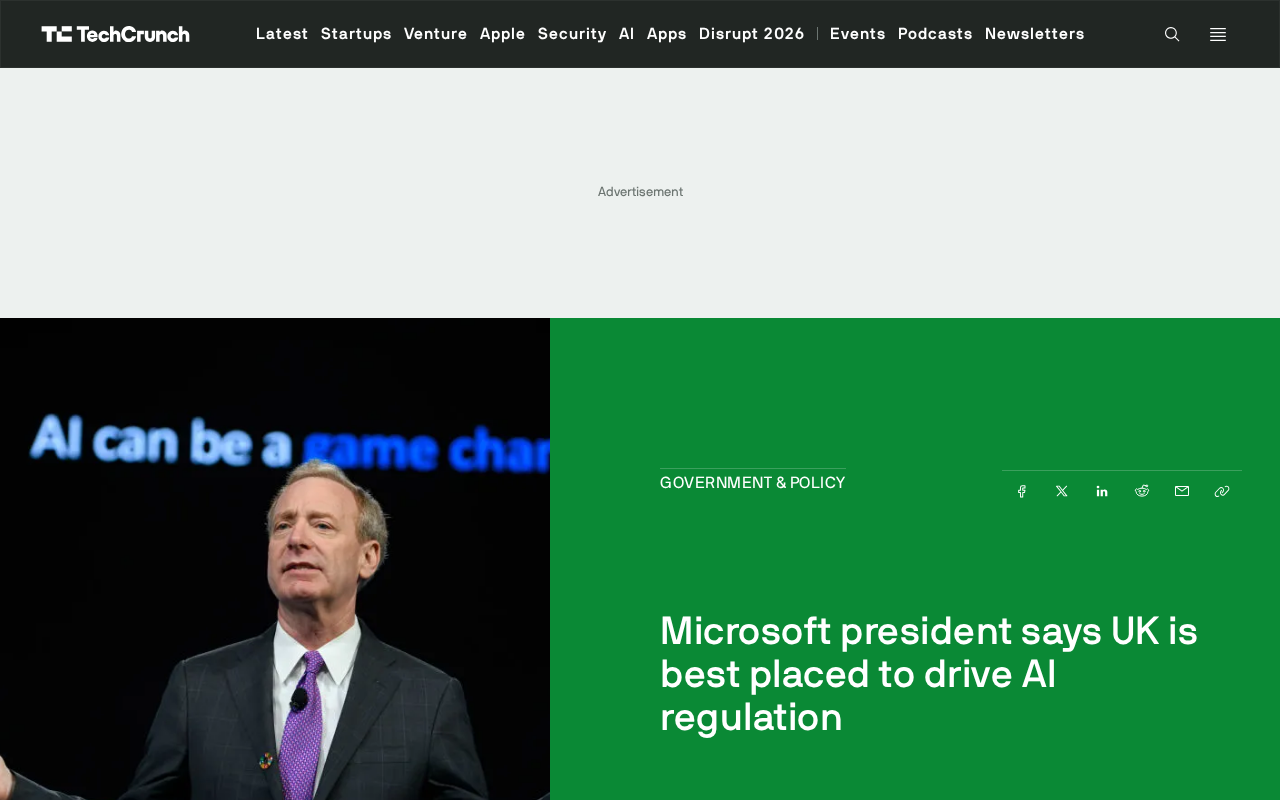
A Striking Analogy: Milk Is Regulated More Strictly Than AI
Smith's core argument rests on an everyday comparison. He points out that milk on supermarket shelves is subject to clear production standards, shelf-life requirements, and traceability mechanisms; household washing machines must meet safety standards before they can be sold. Yet companies developing AI systems that could affect the lives of hundreds of millions of people largely operate in an environment devoid of targeted legislation.
The analogy is powerful because it sidesteps debates about technological complexity and cuts straight to a fundamental question: when a technology has broad social impact, is industry self-regulation sufficient? Smith's answer is clearly no. He argues that AI risks have moved from theoretical discussion into reality — deepfakes, algorithmic bias, job displacement — and that these problems demand a legal response, not just voluntary corporate commitments.
Why the UK?
Smith positions the UK as the "best promoter" of AI regulation, a judgment worth examining closely.
The UK has deep roots in the common law system and has already established internationally influential frameworks in areas such as financial regulation and data protection. Experience from the GDPR era shows that regulatory designs from the UK (and the EU) are often referenced or even adopted by other jurisdictions. Smith appears to believe this "rule export" capability can be replicated for AI governance.
Another implicit factor is timing. Global AI regulation is currently fragmented: the EU is advancing its AI Act, the US favors industry self-regulation and decentralized legislation, and China has its own approach to algorithm governance. Smith's choice to speak in the UK may reflect a search for a middle ground that is politically feasible, legally mature, and internationally promotable.
The common law system refers to a legal tradition centered on case law, originating in England and contrasting with the civil law (continental law) system of statutory codes. Under common law, prior court rulings are binding on subsequent similar cases, and legal rules accumulate and evolve gradually through individual precedents rather than relying entirely on legislative codes. This system is characterized by strong flexibility and a relatively fast ability to adapt to new technologies and business models, because judges can interpret and apply existing principles in specific cases. It is precisely on this tradition that the UK has built principle-oriented regulatory frameworks supplemented by specific guidance in areas such as financial regulation and data protection. Smith's positioning of the UK as the "best promoter" of AI regulation implies the logic that a common law system can gradually form AI governance rules through regulatory guidance and precedents without relying on lengthy legislative processes, thereby responding more quickly to technological iteration.
GDPR (the General Data Protection Regulation) is a data privacy regulation that took effect in the EU in 2018 and has had a profound impact on global personal data protection. Its core principles include data minimization, purpose limitation, user consent, the right to be forgotten, and heavy fines (up to 4% of global annual turnover or €20 million). The "Brussels Effect" of the GDPR demonstrates that EU regulatory standards are often adopted by multinational companies as a global unified standard, effectively exporting them to other jurisdictions. Smith's reference to the UK's experience in the GDPR era is intended to show that regulatory designs from the UK (and the EU) have international reference value, and that this "rule export" capability can be replicated for AI governance. However, after Brexit, the UK is no longer directly bound by the GDPR, though its domestic data protection law still draws heavily on it, giving the UK both retained influence and a degree of flexibility in AI regulation.
Microsoft's Position: Regulator or Regulated?
It is nothing new for large tech companies to call for regulation, but their motives warrant scrutiny each time. As a major investor in OpenAI and the operator of Azure AI services, Microsoft is both a beneficiary of AI commercialization and a potential target of regulation.
One interpretation is that Microsoft hopes to shape a regulatory environment favorable to itself by participating in rule-making — a clear compliance framework can actually raise market barriers and squeeze out smaller competitors. Another interpretation is that AI risks have genuinely grown so large that even leading companies believe external constraints are needed to maintain public trust.
Regardless of motive, Smith's specific proposals point to several key regulatory dimensions: transparency requirements for AI systems, pre-market review for high-risk applications, and cross-border coordination mechanisms. These issues overlap significantly with the core concerns of the EU AI Act, but Smith emphasizes that the UK can play a "bridge" role rather than simply copying the EU model.
The Reality of the Regulatory Race
Smith's choice of the word "urgent" is not mere rhetoric. The pace of global AI capability iteration far outpaces legislative cycles, and the cost of the regulatory vacuum is becoming apparent. From AI-generated disinformation disrupting elections to discriminatory outcomes from automated decision systems in credit and hiring, a market lacking rules is already producing externalities.
Whether the UK will actually take up this baton depends on political will and progress in transatlantic coordination. But Smith's statement at least shows that the discussion around AI regulation has moved from "whether to regulate" to "who regulates and how." For developers and businesses, compliance capability may soon shift from a bonus to a ticket for entry.
The EU AI Act is the world's first comprehensive regulatory framework for artificial intelligence, formally adopted in 2024. It adopts a risk-based tiered regulatory approach: unacceptable risks (such as social scoring and manipulative AI) are directly banned; high-risk applications (such as hiring, credit, and critical infrastructure) are subject to strict compliance obligations, including risk assessments, technical documentation, human oversight, and transparency requirements; low-risk applications are largely left unregulated. The Act also introduces special provisions for general-purpose AI (GPAI) models, requiring foundation model providers to disclose summaries of training data and copyright compliance policies. The US, by contrast, favors sectoral legislation and industry self-regulation, lacking a unified federal AI law, though individual states (such as Colorado and California) have begun issuing their own rules. China, meanwhile, through regulations such as the Interim Measures for the Management of Generative AI Services, emphasizes algorithm filing, content safety, and data compliance. Smith's call for "urgent regulation" comes precisely amid this fragmented landscape, and he hopes the UK can play a bridge role rather than simply copying the EU model.
What It Means for the AI Industry
If Smith's call translates into actual policy, the most direct impact will be rising compliance costs and mandatory transparency. Disclosure of model training data sources, risk assessment documentation, and continuous post-deployment monitoring could become standard requirements.
For small and medium-sized enterprises, this is both a burden and an opportunity — clear rules reduce uncertainty, and large companies may not necessarily have an advantage in compliance flexibility. For users, the establishment of a regulatory framework means that the safety baseline for AI products will be legally mandated rather than dependent on corporate goodwill.
Smith's choice to draw an analogy with milk and washing machines is essentially about seizing narrative initiative: redefining AI from a "special technology" to "infrastructure requiring routine regulation." Once this framework is accepted, the legitimacy of regulation no longer needs repeated justification.
One-line Summary
Microsoft President Smith uses milk and washing machines as an analogy to call for the UK to lead global AI regulation.
Paragraph Summary
Microsoft President Brad Smith publicly called for urgent regulation of the AI industry, using milk and washing machines as an analogy to point out that everyday goods are subject to stricter regulation than AI companies. He believes the UK, with its common law tradition and regulatory experience from the GDPR era, is best positioned to lead the establishment of a global AI governance framework. Smith's proposals point to dimensions such as transparency, pre-market review for high-risk applications, and cross-border coordination, overlapping with the concerns of the EU AI Act. The article argues that Microsoft is both a beneficiary of AI commercialization and a target of regulation, so its motives for calling for regulation warrant scrutiny. Global AI regulation is currently fragmented, with the EU, US, and China taking different paths. If the call translates into policy, compliance costs will rise, but clear rules will also reduce uncertainty, potentially bringing positive effects for SMEs and users alike.
Related articles

Workbuddy for Absolute Beginners: How a Desktop AI Agent Fits Into Real Workflows
A beginner's guide to the Workbuddy desktop AI agent: installation, claiming credits, file management, and building automated workflows—compared with CodeX for fit and cost, helping professionals shift from AI question-askers to AI managers.

OpenAI's New Agent Stack: Computer Use, Decisions API, and Ultra-Fast Workflows
OpenAI Dev Day unveiled a new agent stack: Computer Use outperforms humans, Decisions API delivers ultra-low-latency classification via Luna, Agents API opens the same Computer Use capabilities, and GPT-6.1 Sol costs only one-seventh of Astra. Core updates, benchmark data, and developer insights.

Liang Wenfeng Open-Sources DeepInfo Inference Framework, Takes On U.S. Ban
DeepSeek open-sources its DeepInfo inference framework after its models, featuring GPU/CPU cross-pipelining, small-model prediction with large-model verification, and full Huawei Ascend and NVIDIA chip support—facing the U.S. federal ban head-on. This article analyzes its significance for AI deployment and open-source strategy.