Microsoft Report: AI-Powered Cyberattacks Are Forcing a Rethink of Identity and Data Governance

AI is compressing ransomware attack windows, making identity governance and data controls the new frontline of defense.
Microsoft's Digital Defense Report reveals a fundamental shift in ransomware attacks: AI is automating lateral movement and deployment, creating a severe speed asymmetry where defenders operating on daily or weekly cycles now face adversaries moving in minutes. The report identifies identity governance and data management as the two most critical defensive gaps, noting that AI amplifies the exploitability of existing weaknesses rather than creating new attack vectors. A deeper challenge stems from the rise of agentic AI workflows — existing IAM and DLP tools were designed for human users and struggle to handle agents with dynamic identities, complex permission combinations, and hard-to-trace behavioral paths.
AI Is Reshaping the Pace of Ransomware Attacks
Microsoft's latest Digital Defense Report documents a meaningful shift in ransomware tactics: attackers are now using AI to automate lateral movement and accelerate ransomware deployment across enterprise networks. The report explicitly identifies identity governance and data management as the two most critical defensive gaps in today's enterprise environments.
What makes the report alarming isn't the attack techniques themselves — it's the speed asymmetry between offense and defense. In the past, lateral movement through a network required manual reconnaissance and staged privilege escalation, a time-consuming process that depended heavily on the operator's experience. Today, those steps are being automated at scale by AI, compressing the window between initial intrusion and full network compromise to a fraction of what defenders' incident response plans assume.
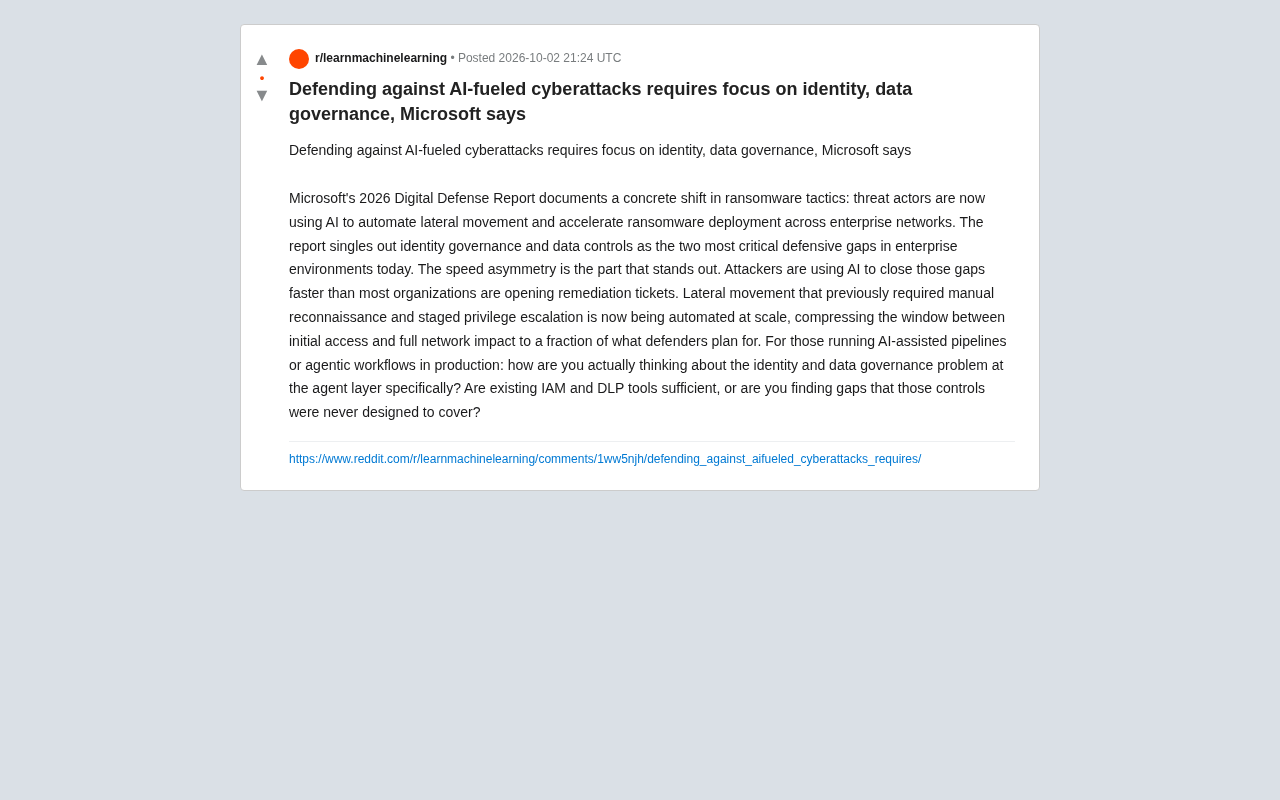
In other words, by the time an organization is still working through its ticketing process and scheduling vulnerability patches, attackers have already exploited those gaps with AI assistance. Defenders planning their responses in days and weeks are now facing an adversary that operates in minutes.
Why Identity and Data Governance
The report's focus on two seemingly familiar domains makes a deeper point: the nature of the problem hasn't changed, only the efficiency of the attack has. Lateral movement fundamentally relies on credentials and permissions — once an attacker establishes a foothold, they pivot across systems by stealing and reusing identity credentials. Weak identity governance means that once the perimeter is breached, there's almost nothing standing in the way internally.
Data governance determines the "payoff" of the attack. Without proper data classification, access controls, and egress monitoring, AI-automated data exfiltration and ransomware encryption can be executed in one seamless operation. These two dimensions also happen to be the areas of traditional security programs most prone to becoming box-checking exercises rather than substantive controls.
It's worth emphasizing: AI hasn't created new attack vectors — it has amplified the exploitability speed of existing weaknesses. Defensive gaps have always existed. The difference is that attackers used to exploit them at roughly the same speed that organizations could patch them. That balance has now been broken.
Lateral movement is a critical stage in the attack chain in which an attacker, having gained an initial foothold, uses internal network trust relationships, stolen credentials, or unpatched vulnerabilities to progressively expand control across systems. Common techniques include Pass-the-Hash, Pass-the-Ticket, and lateral pivoting via remote management protocols such as RDP and WMI. Before AI, this process was highly dependent on manual reconnaissance and operator judgment, often taking hours or even days. AI automation can scan network assets in parallel, analyze permission topologies in real time, and select optimal paths — compressing the same scope of lateral movement to minutes. This fundamentally undermines the premise behind defenders' "detect early, isolate early" strategies.
New Challenges at the Agent Layer
A deeper issue raised by the report concerns teams that are already running AI-assisted pipelines and agentic workflows in production environments. When automated AI agents become components of the system itself, identity and data governance challenges are elevated to an entirely new level.
Are Existing Tools Up to the Task?
Traditional IAM (Identity and Access Management) and DLP (Data Loss Prevention) tools were designed for human users and relatively static service accounts. AI agents introduce a fundamentally different set of challenges:
- How is an agent's identity defined? Does it represent the person who initiated the task, or is it an independent principal?
- How are an agent's permission boundaries dynamically constrained? An agent that can call multiple tools and access data from multiple sources may hold a permission combination far beyond what was originally intended.
- How are inter-agent call chains audited? When one agent triggers another, traditional point-in-time access logs struggle to reconstruct the complete behavioral path.
These are precisely the blind spots that existing IAM and DLP tools were never designed to cover. Mechanically applying the principle of least privilege — designed for humans — to agents capable of autonomously orchestrating tasks tends to result in either dangerous over-provisioning or tools so restricted they can't function.
IAM (Identity and Access Management) defines "who can access what," covering user account lifecycle management, permission assignment, and authentication. DLP (Data Loss Prevention) monitors the movement of sensitive data within and outside systems to prevent unauthorized copying, transmission, or exfiltration. Both tool categories are built on the assumption that principals are relatively stable: human users have clear departmental affiliations and roles, and service accounts are bound to specific applications and remain largely unchanged. AI agents break this assumption — the same agent may play entirely different roles across tasks, its data access scope changes dynamically with each task, and it may read and transmit data in milliseconds that would take a human minutes to accomplish. In this context, DLP's traffic-threshold alerting mechanisms are nearly ineffective.
Practical Considerations for Practitioners
For teams deploying agents in production environments, the core question is no longer "whether to adopt AI" — it's how to design identity and data governance mechanisms specifically for the agent layer. This means potentially establishing separate, traceable identities for each agent, implementing runtime dynamic permission scoping, and building dedicated monitoring for agent data access behavior — rather than simply repurposing tools built for human users.
AI-assisted pipelines refer to workflows embedded in business systems where AI models automatically handle data processing, decision-making, or operations. Agentic workflows go further: they involve AI agents that autonomously decompose goals, call external tools (such as search, code execution, and API interfaces), and collaborate with other agents to complete complex tasks. The key distinction is autonomy — traditional pipelines execute according to predefined logic, while agents can dynamically decide their next action at runtime. This autonomy boosts efficiency but makes permission boundaries and behavioral auditing extraordinarily complex. An agent may traverse multiple systems and invoke multiple credentials within a single task, and the entire process is difficult for traditional security tools to track step by step.
Practical Choices Under Asymmetric Offense and Defense
Microsoft's report sends a clear signal: in the face of AI-augmented attackers, organizations cannot close the speed gap by simply adding headcount. The defensive side equally needs automation and AI to shorten detection and response times — otherwise this asymmetry will only grow.
Identity and data governance keep getting called out because they are the two gates that determine how far an attack can travel. Tightening those gates means that even when attackers breach the perimeter, their lateral movement and data exfiltration are meaningfully slowed. For organizations already embracing agentic workflows, building governance into the agent layer now is far more proactive than trying to retrofit controls after the fact.
Related articles

Understanding DeepSeek in 3 Minutes: The Rise from a Quant Hedge Fund to an Open-Source AI Leader
DeepSeek's history in 3 minutes: from High-Flyer Quant's compute build-up to V2's MLA inference cost cuts, V3's $5.576M training bill, R1's open-source global shock, and V4 with a $7B Series A.

Local Creative Writing Model Showdown: Fine-tuned Qwen3.8 27B Wins, DeepSeek v4.1 Underwhelms
Bilibili creator tests seven local creative writing models: Hemingway and HumanLike Chat based on Qwen3.8 27B perform best, DeepSeek v4.1 is plain, Dongfang Shuo ranks last with confused characters. Includes three test prompts, scores, and usage advice.

Liang Wenfeng's Three Big Bets: Why Did DeepSeek Open-Source Its 82% Gross Margin?
Why did DeepSeek open-source DeepInfer, its 82% gross margin inference framework, and then launch a hundred-billion funding round? An analysis of Liang Wenfeng's three big bets and the open-source strategy.