Microsoft Research India: Transforming from a Software Company to an Infrastructure Company in the AI Era

MSR India's director outlines Microsoft's AI-era shift from software to infrastructure company across four key research directions.
At the MSR India Academic Summit, lab director Venkat Padmanabhan outlined how Microsoft has transformed from a software company into an infrastructure company, backed by $200B in annual investment. He highlighted four research priorities: smoothing out AI's uneven capabilities, deepening high-value vertical domains, advancing small language models for full-stack efficiency, and driving technology diffusion into India and the Global South.
At the opening ceremony of the Microsoft Research (MSR) India Academic Summit, lab director Venkat Padmanabhan delivered a keynote of considerable weight. This two-day summit served not only as a forum for ideas between academic and industry researchers, but also as a window into Microsoft's deeper thinking about its identity, research priorities, and localization strategy in the AI era. Drawing from the opening remarks, this article distills several core judgments worth close attention.
From Software Company to Infrastructure Company
Venkat opened by posing a question to the academic audience in attendance: "When you think of Microsoft, what comes to mind?" The answers were predictable — "PC," "Windows," "software." He acknowledged that Microsoft remains the world's largest software company, and that hasn't changed. But he immediately advanced a key claim: in the AI era, Microsoft and its peers have transformed into infrastructure companies.
This shift is rooted in structural changes in cloud computing and AI compute. Azure has steadily become the core pillar of Microsoft's revenue since the 2010s, but what truly accelerated this transformation was the enormous compute demand of large language models. Training a GPT-4-class model requires tens of thousands of AI accelerator chips (such as NVIDIA H100s) working in concert for months, while inference services require continuous, large-scale compute supply. This demand has driven a wave of hyperscale data center construction, alongside investments in custom AI chips (Microsoft's own Maia series) and supporting network infrastructure.
Behind this transformation lies staggering capital investment. Venkat cited figures widely circulated in the industry: Microsoft's annual infrastructure investment stands at roughly $200 billion, with cumulative spending projected to reach the trillion-dollar range over five years. That $200 billion covers data center construction, server procurement, energy infrastructure, and deep collaborative R&D with OpenAI — marking a shift in the competitive moat of AI companies from "who has better algorithms" to "who can build faster, more energy-efficient compute networks." He noted pointedly that Microsoft's infrastructure investment now exceeds that of oil companies. The analogy is striking — when a company that started with operating systems and office software is outspending traditional energy giants on capital expenditure, the value center of gravity in the entire tech industry is fundamentally shifting.
Such massive investment also raises a new question: how to maximize the value of that infrastructure. Venkat outlined two core directions: first, use the infrastructure as efficiently as possible — extract every bit of value from that $200 billion investment; second, expand use cases — make AI accessible to more people while making it more useful to existing users. These two threads form the basic framework for understanding Microsoft Research's current work.
Four Research Directions: From Core Capabilities to Societal Diffusion
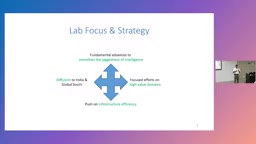
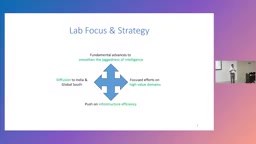
Venkat organized the lab's work into four areas, covering the full chain from technical foundations to societal application with clear logic.
Smoothing Out the "Jaggedness of Intelligence"
The first direction focuses on foundational breakthroughs in AI capabilities. Venkat borrowed the phrase "jaggedness of intelligence" from Andrej Karpathy — co-founder of OpenAI and former AI director at Tesla, widely regarded as one of the most influential practitioners in deep learning. The concept precisely captures the capability profile of current large language models: these models already far exceed average human performance on some tasks (such as mathematical proofs, code generation, and long-form writing), yet make confusingly basic mistakes on tasks that seem simple (such as spatial reasoning, counting, and consistent commonsense judgment). This uneven capability distribution is fundamentally different from the "uniform degradation" pattern of human intelligence, making AI's reliability boundaries difficult to predict.
The lab's work aims to "smooth out" this jaggedness — through verification, higher-quality and lower-cost retrieval, and multimodal reasoning — making AI performance more stable and reliable. Placing emphasis on inference verification (helping models "know what they don't know") and improving the precision of retrieval-augmented generation (RAG) directly affects the deployability of AI systems in enterprise settings. This is a pragmatic stance that confronts head-on the uncertainty of current model capability boundaries, rather than adopting uncritical optimism.
Deep Focus on High-Value Vertical Domains
The second direction focuses on specialized, high-value scenarios — enterprise markets being a prime example. Venkat noted that Microsoft likely serves more companies globally than any other firm, and these enterprises have unique security requirements, database challenges, and coding scenarios. In verticals where the stakes are high enough, targeted professional solutions become irreplaceable.
Full-Stack Efficiency and Small Language Models
The third direction is efficiency improvement — not limited to the infrastructure layer, but spanning the entire technology stack. Venkat specifically highlighted the Small Language Models (SLM) concept pioneered by the keynote speaker and their team.
The rise of small language models represents an important pushback against the "scale is everything" paradigm of large language models. Microsoft's Phi series (Phi-1, Phi-2, Phi-3) is a landmark achievement in this space. The core insight comes from the "textbook quality data" hypothesis: by carefully curating high-quality training data, a small model with only 1 to 7 billion parameters can approach the performance of a model with a hundred times as many parameters on specific tasks. The central proposition is: can we achieve performance and quality close to large models without bearing the same costs?
The significance of SLMs goes beyond lowering inference costs — they open up the possibility of "edge deployment," enabling AI to run locally on phones and PCs without sending user data to the cloud, dramatically improving privacy and reducing latency. SLMs are also especially critical for users in the Global South: in environments with limited bandwidth and low-powered devices, locally-running small models may be the only viable path to inclusive AI. In the context of trillion-dollar investments, efficiency optimization is no longer a bonus — it's a key variable determining return on investment. Microsoft's decision to discuss SLMs alongside its massive infrastructure spending suggests the two form a complementary strategy of "flagship cloud services + lightweight edge deployment."
Technology Diffusion Toward India and the Global South
The fourth direction — and the one Venkat devoted the most attention to — is the diffusion of technology to India and the Global South.
"Global South" is a geopolitical and economic concept referring broadly to developing nations in Asia, Africa, Latin America, and Oceania, in contrast to the "Global North" of developed countries. In the AI domain, the Global South faces multi-dimensional barriers to technology diffusion: at the language level, mainstream large models' training data is heavily skewed toward English, resulting in significantly inferior model performance for languages like Hindi and Swahili compared to English benchmarks; at the infrastructure level, unequal access to compute, bandwidth, and electricity constrains the accessibility of cloud-based AI services; at the use-case level, AI applications defined by the Global North (enterprise SaaS, high-end knowledge work) are structurally misaligned with the core needs of the Global South (agriculture, community healthcare, basic education). As a technology lab rooted in India, local presence is both a distinctive advantage and a source of differentiated value.
Localized Technology Diffusion in Practice
This section showcases the distinctive value of MSR India beyond a purely technical laboratory. Venkat cited a series of concrete examples: in healthcare and education, the lab has collaborated with ASHA (India's community health workers) as well as leading startups like Physicswallah, exploring the boundaries of AI application. The collaboration with ASHA community health workers exemplifies a paradigm shift in how AI research problems are defined — from "technology-driven" to "needs-driven." Research in road safety even attracted the attention of a Nobel laureate at the University of Chicago, leading to a three-way collaboration between the lab, that researcher, and OlaCabs.
In addition, one research outcome was spun off into a company called Karya, which has flourished and was featured on the cover of Time magazine. Researcher Kalika Bali served as an advisor to the India AI Mission and was a key contributor to the "Frontier AI Commitments at New Delhi" — a pledge requiring all major model providers to evaluate their models' multilingual and multicultural capabilities.
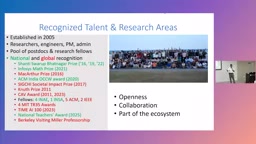
Much of this work is conducted collaboratively. Venkat emphasized three dimensions of the lab's work: openness, collaboration, and ecosystem integration. The lab publishes extensively, open-sources its work, and collaborates deeply with academia. Many researchers hold adjunct professorships at top institutions such as IIT Madras and IIT Delhi, and participate in doctoral supervision. He repeatedly stressed: "We are not an outpost of a global company — we are part of a global company, and at the same time, part of the local ecosystem."
The "Small but Mighty" Lab Model
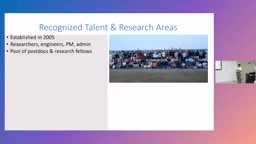
MSR India was founded over twenty years ago and is based in Bangalore. Venkat candidly described it as a small lab, but one with what he considers "amazing talent." The team is made up of researchers, engineers, project managers, and support staff, along with students, research fellows, and postdoctoral researchers.
The Research Fellow Program is one of the lab's signature features — recruiting recent bachelor's or master's graduates for two years of research experience. Unlike the traditional academic path of directly recruiting PhD students, this program bridges the gap between research training at Indian universities and top-tier industrial research. This "talent flywheel" effect gives the lab an influence far beyond its headcount — a team of roughly a hundred people, through successive generations of fellows, has effectively shaped India's entire tech innovation ecosystem. These young researchers go on to diverse paths: some pursue graduate studies abroad, with some entering top PhD programs at MIT, CMU, and elsewhere, bringing an industry-informed problem sensibility into academia; others join Indian research institutions, becoming pillars of the local AI research ecosystem; still others have founded their own companies. Venkat specifically mentioned that OlaCabs founder Bhavish Aggarwal was once a fellow here, and the two even co-authored a paper — "I was still writing papers; he had already moved on to other pursuits."
As the only industrial lab whose employees have received national honors such as the Infosys Prize and the Bhatnagar Prize, this small-but-focused model demonstrates that in the AI race, talent density and ecosystem connectivity may be no less valuable than sheer scale of investment.
Conclusion
Though brief, this opening keynote clearly outlined the strategic orientation of a tech giant's research arm in the AI era: acknowledge the limits of technology, pursue full-stack efficiency, cultivate vertical value, and diffuse technology to a broader population. The self-repositioning from "software company" to "infrastructure company," along with the emphasis on small language models and localized social applications, all reflect an AI industry maturing beyond a pure capability race toward a greater focus on efficiency, use cases, and societal value. For observers tracking the direction of the AI industry, the practice of MSR India offers a deeply instructive reference point.
Related articles

Felix Rieseberg Personal Homepage
Felix Rieseberg's personal homepage sparks attention on Hacker News. This article covers the Slack engineer's technical background, the rise and fall of nativefier, and the value of a developer homepage as a tech calling card.

@ai-sdk/vue 3.0.306 Patch Release Syncs with [email protected] Update
@ai-sdk/vue 3.0.306 released, synced with [email protected]. A routine patch release for the Vercel AI SDK ecosystem with no public API changes; the Vue adapter layer stays version-aligned with the core package.

Gemini 4 Argon API Launches: The Era of Million-Token Output Begins
Google launches Gemini 4 Argon with sparse MoE architecture, up to 1M output tokens, and a 68.90% Vals Index score, available across API, AI Studio, and the Gemini app.