Microsoft Spins Off Four Xbox Studios: Double Fine and Compulsion Games Retain IPs for Independent Operations

Microsoft spins off four Xbox studios, with Double Fine and Compulsion Games keeping their IPs.
Microsoft has announced the spinoff of four Xbox studios — Compulsion Games, Double Fine Productions, Ninja Theory, and Undead Labs — to operate independently. Notably, Double Fine and Compulsion Games will retain their game franchises and catalogs, as confirmed by Xbox CEO Asha Sharma. The move signals a strategic restructuring following Microsoft's massive Activision Blizzard acquisition.
Microsoft Reshapes Its Gaming Portfolio Once Again
Microsoft has announced a restructuring plan for its Xbox gaming business, spinning off four game studios to operate independently. The four studios are Compulsion Games, Double Fine Productions, Ninja Theory, and Undead Labs.
Each studio has a distinct identity: Compulsion Games is a Montreal-based studio known for the darkly stylized We Happy Few and its earlier title Contrast, celebrated for immersive world-building and atmospheric single-player experiences. Double Fine Productions was founded by Tim Schafer in San Francisco in 2000 and stands as an important symbol of the independent game development spirit. Ninja Theory is renowned for its Hellblade: Senua's Sacrifice series, which achieved AAA-quality production values on a modest budget while deeply integrating mental health themes — drawing widespread industry attention. Undead Labs specializes in zombie-themed open-world survival games, with its State of Decay series maintaining a large and loyal long-term player base. All four are mid-sized, creatively driven teams whose operational DNA differs fundamentally from mega-commercial studios like Activision Blizzard.
It's worth noting that Ninja Theory's Hellblade series is widely regarded in the industry as a landmark case for the "AA" production model — a middle ground between indie games and AAA titles, typically involving teams of 20 to 100 people and budgets ranging from $5 million to $30 million, yet still achieving audiovisual quality comparable to major productions through highly focused artistic direction and technical choices. Hellblade: Senua's Sacrifice cost approximately £4 million to produce, yet won BAFTA awards through motion capture, binaural audio technology, and deep collaboration with mental health charities, sparking a global conversation about the intersection of games and mental health — becoming an iconic example of how creative mid-sized studios can break through resource constraints.
This decision marks yet another strategic contraction of Microsoft's gaming footprint. In recent years, Microsoft significantly expanded its gaming assets through large-scale acquisitions such as Activision Blizzard — announced in January 2022 at approximately $68.7 billion, the largest acquisition in gaming history, which cleared global regulatory scrutiny and officially closed in October 2023. That deal gave Microsoft marquee IPs including Call of Duty, World of Warcraft, and Candy Crush, rapidly expanding its studio count to over 30. However, the integration challenges that came with this scale — cultural clashes between studios, added management layers, and duplicated resource allocation — forced Microsoft to reassess its overall portfolio following such aggressive expansion.
Failed post-acquisition integrations are a recurring story in the games industry: EA shut down Westwood Studios after acquiring it, leaving the Command & Conquer series dormant for years; Activision eventually dissolved Neversoft after acquiring the Guitar Hero developer. Research suggests that creative studios acquired by large corporations typically face a triple threat — founders departing, cultural dilution, and rising commercial pressure — with talent attrition peaks occurring on average three to five years post-acquisition. The resulting high integration costs and internal resource allocation pressures make this round of divestitures a clear signal that Microsoft is optimizing its Xbox business structure and refocusing on core assets. Microsoft's choice to spin off rather than shut down these studios is a relatively gentle approach by industry historical standards, preserving the teams' integrity and creative DNA to a meaningful degree.
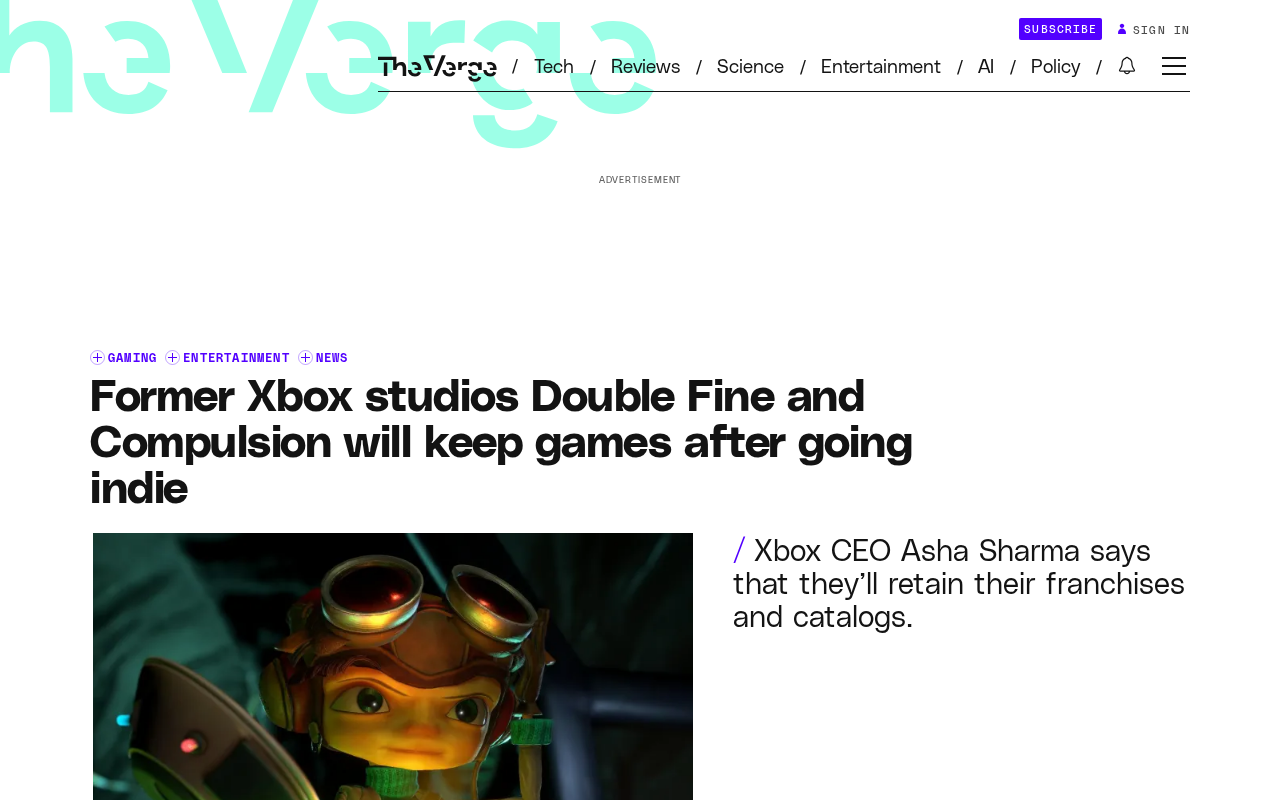
Two Studios Retain Their Own IPs and Game Catalogs
The most closely watched detail in this divestiture is that Double Fine and Compulsion Games will be allowed to retain their respective game franchises and catalogs — a point personally confirmed by Xbox CEO Asha Sharma.
This means both studios can continue to develop and operate the acclaimed titles they built after going independent. Double Fine was founded by industry legend Tim Schafer, who previously led development on classic adventure games like Monkey Island and Grim Fandango and is seen as an iconic figure in narrative gaming. The studio is celebrated worldwide for highly creative works like the Psychonauts series, and is also known for its openness about game development through crowdfunding and documentary filmmaking — its 2012 Broken Age Kickstarter campaign set records on the platform, demonstrating extraordinary community loyalty and willingness to pay, which has built up invaluable commercial goodwill for continuing to rely on community support as an independent. Microsoft's Xbox Game Studios officially acquired Double Fine in 2019, after which its titles were folded into the Xbox Game Pass ecosystem. Compulsion Games has built a stable player base through stylistically distinctive games like We Happy Few. The ability to take these IPs along is critical to the studios' survival as independents — game IPs are often a developer's most essential commercial asset.
The Industry Significance of IP Ownership
In the history of gaming acquisitions and divestitures, whether a studio can take its own work with it when splitting off has often directly determined its post-independence trajectory. This tension is longstanding: Bungie went through fierce IP ownership negotiations when parting ways with Microsoft; the story of Respawn Entertainment's founders leaving Activision without the Call of Duty franchise and going on to create Titanfall is well known across the industry. IP is often the core component of a game company's valuation, and being forced to give it up dramatically undermines a studio's commercial independence.
The legal ownership of game intellectual property spans three dimensions: trademark protection for game titles and character likenesses, copyright protection for code and art assets, and patent protection for specific gameplay mechanics in certain jurisdictions. In M&A practice, IP attribution clauses are among the most critical and contentious points in any negotiation. The 2010 legal dispute between Activision and the former Infinity Ward founders centered in part on the ownership of Call of Duty series bonuses and future IP revenue. Game IP valuation typically employs the income approach (discounted future licensing and sequel revenues), the market comparable approach (referencing similar IP transaction prices), and the cost approach (investment required to rebuild equivalent brand recognition) — with strong IPs often accounting for 60% to 80% of a studio's overall valuation. This explains why IP attribution is so critical to a divested studio's independent survival. In recent years, as awareness of creator rights has grown, more studios have explicitly sought shared IP ownership or retention clauses at the time of signing. Microsoft's decision to allow Double Fine and Compulsion to retain their own IPs lays a more solid foundation for their independent paths and sets a noteworthy precedent for the industry.
Also worth highlighting is the long-standing structural tension between the commercial logic of Xbox Game Pass and the independence aspirations of creative studios. Game Pass, Microsoft's gaming subscription service launched in 2017, operates on a SaaS-style subscription model with a subscriber base that surpassed 34 million by the end of 2024. Its commercial logic borrows from Netflix's content flywheel theory: continuously expanding the content library to attract new subscribers, with subscription revenue reinvested into content acquisition and first-party development, creating a positive feedback loop. However, this model creates a particular structural pressure on first-party studios: Game Pass requires a steady stream of "day-one content" to incentivize subscriber renewals, meaning studios' development cadences must align with the platform's content operations cycle — yet the development timelines of creatively driven games are notoriously difficult to predict precisely. Research indicates that first-party games released on Game Pass typically see retail sales revenue decline by 30% to 50%, though Microsoft offsets this through user retention and subscription income. Once independent, studios will no longer be bound by Game Pass day-one obligations, but they will also lose the natural distribution channel that reaches tens of millions of subscribers — a direct and far-reaching impact on the commercial exposure of future titles.
The Industry Logic Behind the Xbox Studio Restructuring
Microsoft's latest round of Xbox studio adjustments reflects the ongoing rebalancing pressures facing large technology companies in the gaming business. After a period of scale-driven acquisitions, effectively managing a large and stylistically diverse portfolio of studios became an operational challenge Microsoft could no longer ignore.
Spinning off some studios to operate independently both reduces Microsoft's operational and resource allocation burden and grants these creatively driven teams greater autonomy. For relatively lean creative studios like Double Fine and Compulsion, independence may mean breaking free from the hierarchical structures of a large corporation and returning to a more focused state of content creation.
Of course, independence also carries tangible risks. Game studios going independent after separating from a large parent company typically face three paths: seeking new strategic investors or publisher partnerships to secure funding while maintaining creative autonomy; self-publishing through digital platforms like Steam, sustaining themselves on the player bases built around existing IPs; or bringing in venture capital and completing a new funding round as an independent game company.
In recent years, financing channels for game studios have diversified significantly. Over the past decade, dedicated investment funds targeting the games industry have moved from the fringes to the mainstream. Funds such as Bitkraft Ventures, Griffin Gaming Partners, and Makers Fund cover the full gaming value chain, with assets under management ranging from hundreds of millions to billions of dollars. Compared to generalist tech VCs, gaming-focused funds offer key advantages: deeper industry networks (publisher relationships, platform access, talent pipelines), due diligence frameworks better suited to game projects (such as user retention curve analysis and gameplay prototype validation methodologies), and greater tolerance for the development cycles and monetization timelines inherent to game development. Meanwhile, the rise of the "publisher-as-investor" model, exemplified by Annapurna Interactive and Devolver Digital, has given creative studios another avenue: exchanging a share of revenue for publishing support, typically without transferring IP ownership — striking a balance between accessing capital and maintaining creative independence. The rise of Epic Games Store, GOG, and other platforms has also broken Steam's near-monopoly to some degree, giving studios greater negotiating leverage. Successful examples like CD Projekt (developer of The Witcher series) demonstrate the potential of an IP-driven independent path, while many studios lacking strong IP support have fallen into financial difficulty or closed within a few years of going independent. Without Microsoft's financial backing and distribution guarantees, commercial pressure will fall squarely on the studios themselves — and converting the IPs they've retained into sustainable commercial revenue will be their first major test as independents.
Implications for Players and the Gaming Industry
For players, the direct impact of this change remains to be seen. Since Double Fine and Compulsion are retaining their game catalogs, the operation of existing titles is not expected to be severely disrupted. However, changes in development resources following independence may affect the scale and release cadence of future titles to some degree.
From a broader industry perspective, Microsoft's move has once again sparked deeper discussion about the relationship between large platform holders and creative studios. The cycle of acquisition and divestiture is both a norm of capital operations and a reflection of the gaming industry's ongoing struggle to balance the pursuit of scale with the preservation of creative vitality. Finding a genuine equilibrium between commercial expansion and content innovation remains the central challenge the industry will need to work through for years to come.
Key Takeaways
Related articles

Felix Rieseberg Personal Homepage
Felix Rieseberg's personal homepage sparks attention on Hacker News. This article covers the Slack engineer's technical background, the rise and fall of nativefier, and the value of a developer homepage as a tech calling card.

@ai-sdk/vue 3.0.306 Patch Release Syncs with [email protected] Update
@ai-sdk/vue 3.0.306 released, synced with [email protected]. A routine patch release for the Vercel AI SDK ecosystem with no public API changes; the Vue adapter layer stays version-aligned with the core package.

Gemini 4 Argon API Launches: The Era of Million-Token Output Begins
Google launches Gemini 4 Argon with sparse MoE architecture, up to 1M output tokens, and a 68.90% Vals Index score, available across API, AI Studio, and the Gemini app.