Microsoft SQL Major Upgrade: AI Capabilities, Security Enhancements, and Fabric Integration — A Deep Dive

Microsoft SQL gets sweeping AI, security, and Fabric integration upgrades across its entire product lineup.
Microsoft's SQL team has delivered a wave of updates spanning Azure SQL, SQL Server, Fabric, and developer tools. Highlights include AI-generated embeddings for RAG apps, regex-based dynamic data masking, Fabric's new Migration Assistant and Fabric Apps (BaaS), SQL Server CU5 memory and full-text index improvements, SSMS's new SQL Formatter and Agent mode, SQL MCP Server public preview, Apache Arrow driver support, and the new DP-800 SQL AI Developer Certification.
In the latest episode of Data Exposed, Microsoft Data Platform Evangelist Anna Hoffman systematically covered the key updates delivered by the Microsoft SQL team since the SQLCon conference. From SQL Server to Azure SQL, SQL databases in Fabric, and various developer tools, Microsoft once again demonstrated its rhythm of "listening to users and delivering quickly." This article breaks down these key updates by category.
Cloud Engine: Advancing on Two Fronts — Security and AI
One premise worth repeating: whether it's Azure SQL, SQL databases in Fabric, or on-premises SQL Server, they all run on the same Microsoft SQL engine. Azure SQL Database, SQL Managed Instance, and on-premises SQL Server 2022+ share the same core query engine (SQL OS + Query Processor), with highly consistent T-SQL syntax, query optimizer behavior, and storage engine mechanics. Cloud services can deliver new features faster because their release process bypasses the lengthy testing cycles and ISV compatibility validation of traditional boxed releases, using a rolling update model that can move from internal preview to GA within weeks. That's why cloud services often get new features first.
Multiple Security Enhancements
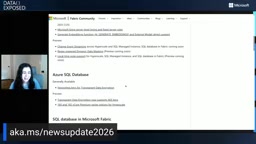
Microsoft is actively pushing users to migrate from SQL authentication to more secure alternatives — in fact, Microsoft has already banned password-based logins internally. On the encryption front, Azure SQL Database has introduced TDE (Transparent Data Encryption) with AES key support to comply with the NSA's CNSA 2.0 recommendations.
TDE (Transparent Data Encryption) is a data-at-rest encryption mechanism introduced in SQL Server 2008 that performs real-time encryption and decryption of data pages via a Database Encryption Key (DEK), completely transparent to the application layer. CNSA 2.0 (Commercial National Security Algorithm Suite 2.0) is a post-quantum cryptography migration roadmap published by the NSA in 2022, requiring federal agencies and defense-related systems to migrate to AES-256, RSA-3072+, ECDH P-384, and other algorithms by the 2030s, with quantum-safe algorithms (such as CRYSTALS-Kyber) incorporated into long-term planning. Azure SQL's introduction of AES-key TDE is precisely to proactively meet this compliance requirement, and it's especially important for customers in finance, healthcare, and government.
Another highlight is regex-based dynamic data masking, currently in preview, enabling more granular and flexible control over masking rules for sensitive fields.
AI Capabilities Arriving Fast
Cloud SQL has added AI-generated embeddings and external model object support, greatly simplifying the development workflow for building RAG (Retrieval-Augmented Generation) applications on Azure SQL.
RAG (Retrieval-Augmented Generation) is one of the most mainstream architectural patterns for enterprise AI deployment today. Its core idea is: convert private knowledge base text into high-dimensional floating-point vectors (embeddings), store them in a data store that supports vector similarity search, retrieve semantically similar document chunks at inference time, and inject them as context into the large language model's prompt — allowing the model to "know" enterprise private data without expensive fine-tuning. The "AI generate embeddings" capability newly added to Azure SQL allows developers to directly call external embedding models (such as Azure OpenAI's text-embedding series) within the SQL layer to generate and store vectors, and perform approximate nearest neighbor (ANN) search with vector indexes, significantly reducing the middleware layers needed to build a RAG pipeline. Additionally, regular expression support for LOB (Large Object Binary) types has also been delivered in SQL Server CU5.
Upcoming Roadmap Features to Watch
Anna also previewed several forthcoming features: Change Event Streaming has entered public preview for Hyperscale and SQL Managed Instance, with the Fabric version coming soon.
Change Event Streaming is the cloud-native evolution of CDC (Change Data Capture) technology. Traditional CDC reads database transaction logs to capture row-level data changes with low latency and publishes them as event streams for downstream systems (such as data warehouses, search engines, and cache layers) to consume in real time. Compared to batch ETL, CDC can compress data latency from hours to seconds. Microsoft's Change Event Streaming in Hyperscale and SQL Managed Instance deeply integrates CDC with Azure Event Hubs or Fabric Eventstream, enabling SQL databases to natively participate in event-driven modern data architectures without relying on third-party connectors like Debezium.
Local timezone support — a long-requested community feature — is gradually rolling out; Hyperscale is also launching extra-large vCore series options to cover everything from small-scale starts to massive scale-out scenarios.
SQL in Fabric: Migration Assistant and Fabric Apps
SQL databases in Fabric have finally delivered two highly anticipated capabilities.
The Migration Assistant is now live: users can click the "Migrate" button directly in the Fabric workspace, select a target database (such as a SQL database in Fabric), complete configuration by importing a DAC package, and then use a copy job to complete the data migration — all without leaving the Fabric interface.
The more significant release is Fabric Apps (formerly codenamed Rafen) — essentially a Backend as a Service (BaaS) platform with a built-in SQL database. Anna specifically recommended this model: it's conceptually similar to GitHub Copilot and VS Code's "shareable sites," but the key advantage is that it runs entirely within the enterprise's governance boundary, with permissions strictly scoped to the corresponding workspace.
The system automatically configures the database at deployment time with no manual intervention needed. Anna shared a sample application she built and open-sourced to GitHub — the app can read workspace data, write back to the database, and support interactive operations like commenting on shared sites, all accessible via a single link that always stays up to date.
SQL Server CU5: Lock Management, Full-Text Index, and Availability Groups
On the on-premises SQL Server side, several cumulative updates (CUs) have landed, with CU5 containing a number of noteworthy practical improvements:
- Lock Manager Cache Memory Percentage Configuration: A new
MaxLockManagerCacheMemoryPercentconfiguration option has been added, with an official recommended setting of 20% and a backward-compatible option to revert to 60%, helping DBAs more precisely control memory consumption by lock management. - CPU Starvation Fix for In-Memory OLTP: In-Memory OLTP (codenamed Hekaton) is the memory-optimized table engine introduced in SQL Server 2014, using optimistic multi-version concurrency control (MVCC) instead of traditional locking for excellent performance in high-concurrency, short-transaction scenarios. However, the Hekaton engine uses an independent XTP scheduler that can compete for resources with the SQL OS standard worker thread pool under extreme concurrency, preventing XTP threads from getting CPU time — the so-called "CPU starvation" problem. CU5 includes a targeted fix for this scheduling contention, offering real production value for customers using memory-optimized tables for core business workloads.
- Full-Text Index V2: Can now be enabled via database-scoped configuration; note that this may be a breaking change when migrating to SQL Server 2025.
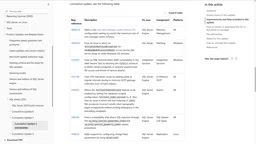
CU1 brought Linux platform enhancements for Contained Availability Groups (Contained AGs): you can now create or restore databases directly through the listener without needing to connect to the physical instance separately, fulfilling a long-standing user request.
Contained Availability Groups are an important architectural improvement introduced in SQL Server 2022, designed to address a long-standing pain point with traditional Always On AGs: AG metadata (logins, SQL Agent jobs, linked servers, etc.) was originally stored at the instance level, requiring manual recreation of these objects on the new primary replica after a failover. Contained AGs "sink" these instance-level objects into a dedicated system database that replicates and fails over with the AG, making the AG a truly self-contained, portable unit. CU1's Linux enhancements further eliminate the operational burden of administrators needing to know physical instance addresses, making management of cross-platform hybrid AG scenarios more consistent.
Developer Tools Fully Upgraded: VS Code, SSMS, and Drivers
Progress on the tools front has been equally intensive, with multiple tracks advancing in parallel.
SSMS and VS Code Extensions
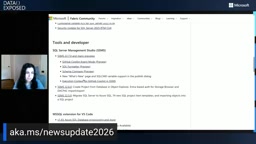
During Build, the MSSQL for VS Code extension saw a significant surge in popularity, gaining the ability to provision a free Azure SQL database directly from within the extension, lowering the barrier to entry further. SSMS received multiple feature updates including Agent mode, as well as the long-requested SQL Formatter and Schema Compare tools.
Other Important Tool Updates
- SQL Notebooks Return: The return of this feature generated enthusiastic community response.
- SQL MCP Server Public Preview: MCP (Model Context Protocol) is an open standard protocol released by Anthropic in late 2024, designed to solve the standardized integration problem between AI agents and external tools and data sources. MCP defines a unified server-client communication spec that allows LLMs to discover and invoke tools and read resources via a standard interface. The public preview of SQL MCP Server means AI agents can interact directly with SQL databases via the MCP protocol — querying data, executing stored procedures, retrieving schema information — without writing a separate database adapter for each AI framework. Microsoft engineer Jerry continues to publish deployment and usage guides on Azure SQL Dev Corner.
- Azure Data Studio Smooth Migration: With ADS officially deprecated earlier this year, SSMS provides smooth import of connection configurations.
- Comprehensive Driver Upgrades: New support for Apache Arrow has been added (the Arrow Fetch API significantly improves batch data export performance). Apache Arrow is a cross-language in-memory data format standard led by the Apache Foundation, using a columnar storage layout designed for analytical workloads and zero-copy cross-process data sharing. Compared to traditional row-by-row ODBC fetching, the Arrow format allows drivers to transfer data in bulk columnar chunks, and combined with SIMD vectorized instructions, can boost batch export throughput by 5-10x. For data scientists using DataFrame libraries like Pandas and Polars, this means significantly reduced memory allocation overhead and data type conversion costs. The Python driver also has improved bulk copy logic, expanded Django support, and PHP support has returned. Notably, the Arrow support also incorporated code contributions from the community.
Database Security in the AI Era and the DP-800 Certification

Anna closed the episode by reiterating database security principles for the AI era. Whether building AI applications via RAG patterns or using Microsoft Foundry, database configurations must adhere to the principle of least privilege to avoid data incidents caused by overly permissive access. This principle is especially critical in scenarios where AI agents can autonomously execute SQL queries — a database account with excessive privileges could expose an entire dataset if the agent is compromised by a prompt injection attack.
To help practitioners keep pace with the AI wave, Microsoft has launched the new SQL AI Developer Certification DP-800, focused on developing AI applications in SQL environments and using the latest database capabilities. It's an important certification path for data engineers and database developers looking to strengthen their AI delivery skills.
Summary
This periodic roundup makes Microsoft SQL's evolution trajectory very clear: using a unified engine as the foundation, rapidly iterating AI and security capabilities in the cloud, connecting the integrated data experience through Fabric, and heavily upgrading the developer toolchain.
For data professionals — whether you're in the SQL Server, Azure SQL, or Fabric ecosystem — it's worth continuously following these updates via the official blog (aka.ms/newsupdate2026). The launch of the DP-800 certification and SQL MCP Server further signals that databases are rapidly becoming a first-class citizen in the AI application stack.
Key Takeaways
Related articles

The Truth Behind Codex 'Build a Website in 5 Minutes': AI Isn't Creating Sites—It's Helping You Copy Them
Exposing the truth behind viral Codex 5-minute website videos: creators aren't building original sites with AI—they're copying shared prompts or scraping others' work. Learn AI coding tools' real limits.

Getting Started with AI Agent Development: A Complete Guide from Concept to Practice
A comprehensive guide to AI Agent architecture and development, covering automated marketing, intelligent customer service, and investment analysis scenarios with single and multi-agent collaboration.

The Truth Behind Codex 'Build a Website in 5 Minutes': AI Isn't Creating Sites — It's Helping You Copy Them
Exposing the truth behind viral Codex 5-minute website videos: creators aren't building original sites with AI — they're copying shared prompts or scraping others' work.