Microsoft Unveils Third-Generation Maia 300 AI Chip: Inference Cost Optimization and Accelerating the Move Away from Nvidia

Microsoft releases third-gen Maia 300 AI chip, targeting AI inference to reduce reliance on Nvidia GPUs.
Microsoft has officially released its third-generation in-house AI chip, Maia 300, positioned as the "workhorse AI inference system" for Microsoft products and services, aiming to reduce reliance on Nvidia GPUs and optimize cloud AI cost and efficiency. The article traces the iteration logic from Maia 100 to Maia 300, noting that inference rather than training is the phase consuming the most compute after AI commercialization. Maia 300 focuses on optimizing inference cost and efficiency and enhancing support for reasoning models and agentic tasks. It also analyzes the calculus behind "de-Nvidia-fication" and notes that in-house chips have become a trend among cloud providers.
Microsoft has officially released its third-generation in-house AI chip, the Maia 300, positioning it as the "workhorse AI inference system" for Microsoft products and services. This marks a key step in Microsoft's in-house chip journey, aimed squarely at reducing reliance on Nvidia GPUs while improving the cost and efficiency of cloud AI workloads.
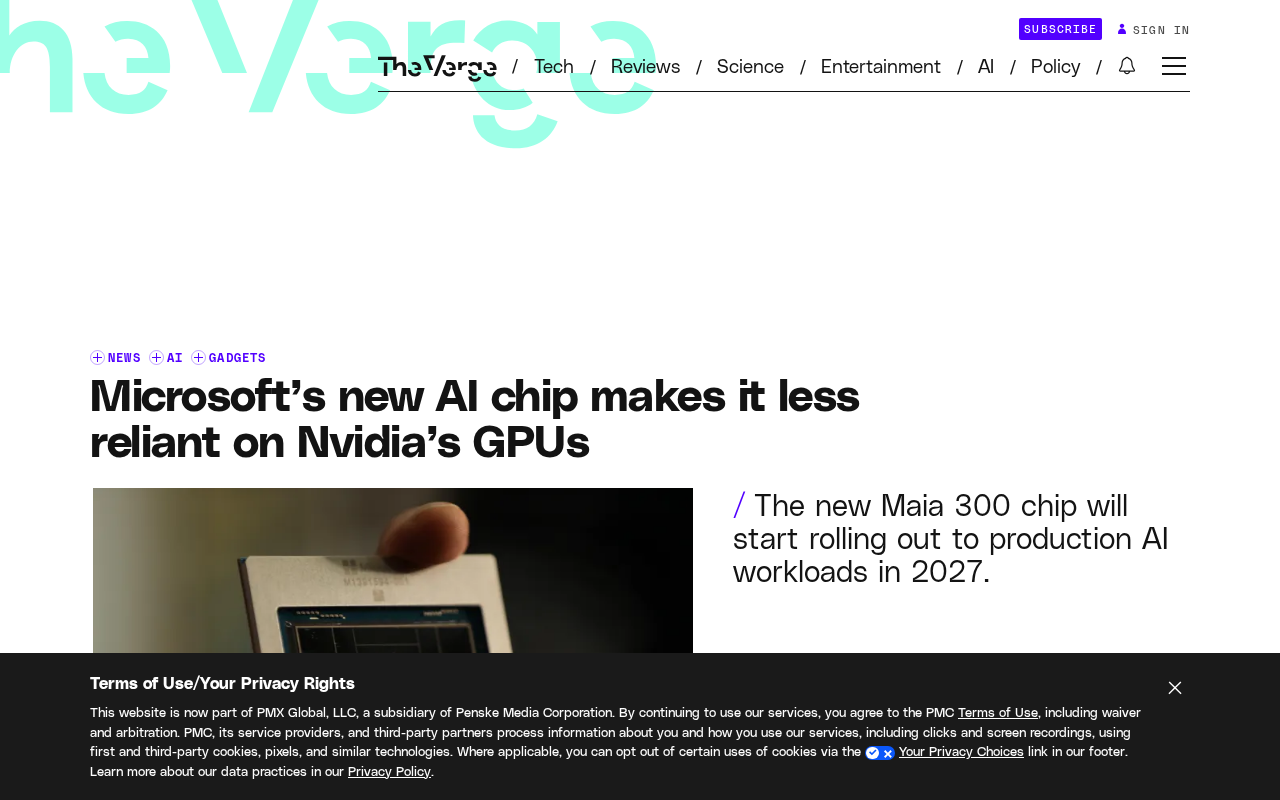
From Maia 100 to Maia 300: The Iteration Logic Behind Microsoft's In-House Chips
Microsoft's AI chip strategy was not a spur-of-the-moment decision. Starting with the first-generation Maia 100, Microsoft has been exploring the use of custom silicon to handle AI inference tasks on its Azure cloud. By the third generation, Maia 300, this positioning has become far more explicit — it is no longer just a "trial run," but is intended to become the "workhorse system" for AI inference across Microsoft's product ecosystem.
The significance of this shift lies in the fact that inference, not training, is the phase that consumes the most compute once AI reaches large-scale commercialization. Every time a user talks to Copilot, every time an Azure AI service responds to a request, inference compute is what powers it behind the scenes. Whoever can drive down inference costs will gain an edge in the scaling competition for AI services. Microsoft's decision to focus on the inference side is logically clear.
The divide between inference and training is key to understanding the AI chip market landscape. Training refers to using massive datasets to teach a model its parameters, typically requiring extremely high floating-point compute and memory bandwidth — a domain where Nvidia GPUs enjoy near-monopoly status thanks to the CUDA ecosystem. Inference, by contrast, is the process by which a trained model actually responds to user requests and generates output. It is characterized by enormous concurrency, relatively small per-request compute, and extreme sensitivity to latency and unit cost. As large models enter the commercialization phase, inference compute's share of total compute continues to rise, and the industry widely expects inference to become the dominant portion of data center compute spending. This is precisely why inference scenarios are more amenable to custom chips — the requirements are clear and can be optimized in a targeted way, without the need to pursue extreme generality as training does. This opens up realistic room for cloud providers to bypass GPUs and build their own dedicated inference chips.
What Exactly Makes Maia 300 Strong?
Dual Optimization of Cost and Efficiency
According to Microsoft's official statements, Maia 300 can simultaneously improve both cost and efficiency when running cloud AI workloads. This means lower compute overhead per inference request — and for a cloud provider of Microsoft's scale, even a small reduction in cost per token, multiplied across massive request volumes, adds up to a significant figure.
Built for Reasoning Models and Agentic Tasks
A key upgrade in Maia 300 is that it is "more capable of handling the latest reasoning models and agentic tasks." This sends two signals:
- Reasoning models refer to those that engage in multi-step thinking before producing an answer. Their compute demand patterns differ from traditional large models, requiring chips to perform better on long sequences and multi-round computation.
- Agentic tasks involve AI autonomously invoking tools and executing multi-step operations, placing higher demands on a chip's scheduling capability and concurrent processing.
By making these two workload types key optimization targets, Maia 300 shows that Microsoft's chip design has kept pace with the evolution of AI application forms.
Agentic tasks refer to AI no longer merely passively answering a single question, but being able to autonomously plan, invoke external tools (such as search, code execution, API interfaces), and adjust strategy based on intermediate results across multiple steps to ultimately accomplish a complex goal. These workloads differ fundamentally from traditional single-turn Q&A: they require chips to maintain context over long periods, frequently make tool calls and feed back results, and demand greater memory capacity, scheduling flexibility, and concurrent processing capability. Correspondingly, reasoning models (such as those built around multi-step chain-of-thought as their core paradigm) generate a large number of intermediate reasoning tokens before producing a final answer, significantly lengthening the computation sequence. What these two workload types share is that they "compute for a long time, compute a lot, and compute in fragments" — precisely the domain where general-purpose GPUs are not at their most efficient and where dedicated chips can leverage their customization advantages.
Moving Away from Nvidia: Microsoft's Real Calculation
Microsoft's official headline states its intent bluntly — "reducing Microsoft's reliance on Nvidia GPUs." Behind this statement lies an anxiety shared across the entire cloud computing industry: Nvidia's dominance in the AI chip market leaves all cloud providers constrained in both cost and supply.
In-house chips are the most direct means of breaking this dynamic. Through the Maia series, Microsoft can replace Nvidia GPUs with its own chips in some inference scenarios, both lowering procurement costs and strengthening its bargaining power in the supply chain. Of course, this does not mean Nvidia will be completely replaced — training and high-end inference scenarios will still depend on GPUs in the near term. But at least in inference, the highest-volume business, Microsoft now has its own card to play.
The CUDA ecosystem is the core of Nvidia's moat. CUDA is Nvidia's parallel computing platform and programming interface. After more than a decade of accumulation, mainstream AI frameworks, operator libraries, and developer tools are almost all built around it. Even if a cloud provider's in-house chip is competitive on hardware metrics, it must still solve software stack compatibility — either rewriting operators or providing a compatibility layer — and the migration cost cannot be ignored. This is also why in-house chips typically land first in a company's own closed scenarios: Microsoft can use Maia for controllable workloads like its own Copilot, use its own teams to absorb the adaptation work, and only open it to external customers once the software ecosystem matures — thereby keeping the risk and pace of "de-Nvidia-fication" in its own hands.
What This Means for the Industry
The release of Microsoft's Maia 300 is another footnote in the wave of cloud providers developing their own AI chips. Amazon has Trainium and Inferentia, Google has TPU, and now Microsoft's Maia has reached its third generation. Leading cloud providers are converging on in-house chips for the same reason: the compute demand for AI inference will remain high for the long term, and buying GPUs externally cannot support a sustainable business model.
For developers, the short-term impact may not be obvious — AI service interfaces on Azure will not change because the underlying chip changes. But in the medium to long term, if in-house chips can truly drive down inference costs, pricing for cloud AI services could become more affordable, which would benefit the entire AI application ecosystem.
Microsoft has not yet disclosed specific performance specifications or a deployment timeline for Maia 300, but given its positioning as a "workhorse inference system," it will most likely be deployed first in Microsoft's own products (such as Copilot and Azure AI services) before gradually opening up to external customers.
The deeper driver behind the wave of cloud providers building their own chips is the transformation of AI compute from a "scarce resource" into a "baseline cost item." When AI inference becomes infrastructure like electricity, procurement cost, supply stability, and bargaining power directly determine cloud service gross margins. Amazon's Trainium/Inferentia, Google's TPU, and Microsoft's Maia are essentially all about trading scale for customization — cloud providers possess massive volumes of real workload data and can design chips that fit their own business distributions better than general-purpose GPUs. In the long run, this trend will reshape the AI chip market: general-purpose GPUs will still dominate training and high-end scenarios, while the inference side may form a landscape where multiple dedicated chips coexist, in turn affecting how cloud services are priced and how quickly AI applications proliferate.
One-line Summary
Microsoft releases its third-generation in-house AI chip, Maia 300, focused on AI inference and aimed at reducing reliance on Nvidia GPUs.
Paragraph Summary
Microsoft has officially released its third-generation in-house AI chip, Maia 300, positioning it as the "workhorse AI inference system" for Microsoft products and services, with the goal of reducing reliance on Nvidia GPUs and optimizing the cost and efficiency of cloud AI. The article traces the iteration logic from Maia 100 to Maia 300, noting that inference rather than training is the phase that consumes the most compute after AI reaches large-scale commercialization, and that Microsoft's decision to focus on inference is logically clear. Maia 300 prioritizes optimizing inference cost and efficiency while enhancing its ability to handle reasoning models and agentic tasks, signaling that its chip design has kept pace with the evolution of AI application forms. The article further analyzes the calculus behind "de-Nvidia-fication": in-house chips can lower procurement costs and strengthen supply chain bargaining power, but training and high-end inference will still depend on GPUs in the near term. Finally, it notes that in-house chips have become a trend among cloud providers, with Amazon, Google, and Microsoft all positioning themselves on the inference side, potentially making cloud AI service pricing more affordable in the medium to long term.
Related articles

Felix Rieseberg Personal Homepage
Felix Rieseberg's personal homepage sparks attention on Hacker News. This article covers the Slack engineer's technical background, the rise and fall of nativefier, and the value of a developer homepage as a tech calling card.

@ai-sdk/vue 3.0.306 Patch Release Syncs with [email protected] Update
@ai-sdk/vue 3.0.306 released, synced with [email protected]. A routine patch release for the Vercel AI SDK ecosystem with no public API changes; the Vue adapter layer stays version-aligned with the core package.

Gemini 4 Argon API Launches: The Era of Million-Token Output Begins
Google launches Gemini 4 Argon with sparse MoE architecture, up to 1M output tokens, and a 68.90% Vals Index score, available across API, AI Studio, and the Gemini app.