Midjourney for Tone-Setting + NB Pro for Consistency: An AI Short Film Workflow Breakdown

A short film creator's workflow using Midjourney for tone-setting and NB Pro/GPT Image for character consistency.
A Reddit short film creator shares a practical AI workflow that assigns distinct roles to different tools: Midjourney excels at early-stage visual exploration and tone-setting thanks to its aesthetic randomness, while Nano Banana Pro and GPT Image handle the execution phase where cross-shot character consistency and precise control matter most. The key insight is that tools should complement each other across creative phases rather than compete.
One Short Film Creator's Philosophy on AI Tool Division of Labor
In an era where AI image generation tools are flourishing, creators no longer face the question of "are there tools available?" but rather "how to combine tools effectively." Recently, an active short film creator on Reddit shared his practical workflow, with a core insight worth considering for all visual creators: Different AI tools should each handle what they do best, rather than trying to replace one another.
His words cut straight to the point: "Every short film I make goes through Midjourney first — no other tool finds a unique visual tone like it does."
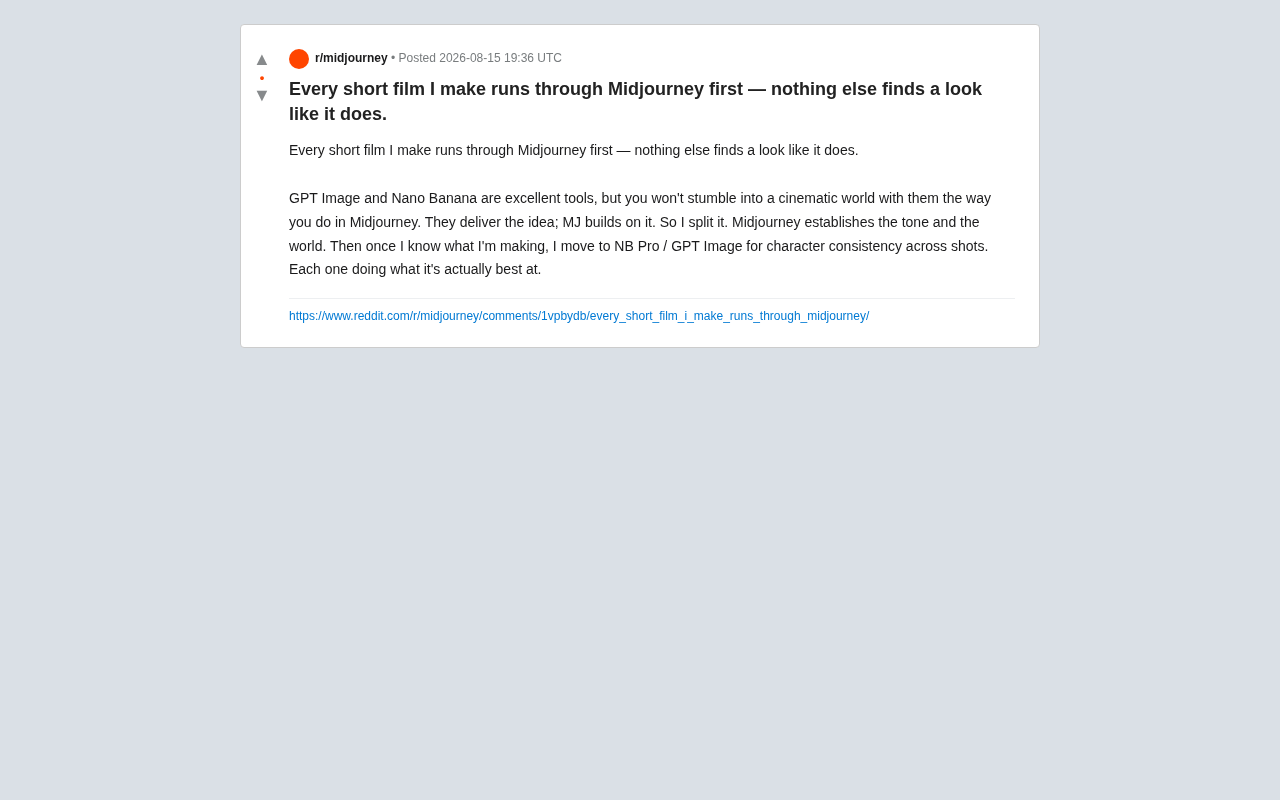
Behind this statement lies a division-of-labor logic tested through practice. It's not a simple tool recommendation, but rather a precise assessment of the capability boundaries of today's mainstream AI image tools (Midjourney, GPT Image, Nano Banana Pro).
Midjourney: The World-Builder That "Finds the Feeling"
In this creator's workflow, Midjourney takes on the role of tone-setting and world-building.
Why Choose Midjourney for Visual Exploration?
He explicitly states: "GPT Image and Nano Banana are both excellent tools, but you can't stumble into a cinematic world the way you can in Midjourney."
The key phrase here is "stumble into." This perfectly captures Midjourney's unique value — its output carries an ineffable aesthetic bias and sense of surprise. When creators haven't fully defined what they want, Midjourney's unique aesthetic tendencies help them discover the "right direction."
Midjourney's ability to produce this distinctive "visual tone" is closely tied to its underlying architecture and training data strategy. As an image generation tool based on Diffusion Models, Midjourney is believed to have been extensively trained on art photography, film stills, and high-end visual design work, giving its output a natural "curatorial-grade" aesthetic tendency. Unlike approaches that pursue photorealism, Midjourney's denoising process incorporates stronger stylistic preferences, allowing even simple prompts to produce images with powerful atmosphere. Its V6 version introduced more refined semantic understanding and composition capabilities, further enhancing this experience of "accidentally discovering beauty."
The Ideal Companion for the Exploration Phase
The early stage of short film creation is often the most chaotic period and the one most in need of inspiration. A creator might have only a vague concept without knowing what the specific visual language should look like. At this point, a tool's "determinism" actually becomes a constraint, while Midjourney's generation approach — with its randomized aesthetics — can spark visual possibilities the creator never expected.
Understanding this from a technical perspective: Within the diffusion model framework, randomness and controllability exist in an inherent tension. A model's "creativity" stems from randomness in the sampling process — higher CFG (Classifier-Free Guidance) values make output hew closer to the prompt but feel "safer," while lower values give the model more creative freedom. Midjourney's parameter tuning strategy tends to preserve more "aesthetic randomness," making each generation potentially surprising; tools that emphasize controllability compress this random space through higher instruction adherence, reference image constraints, and deterministic sampling strategies. Understanding this technical background makes clear why the same tool can rarely excel at both "inspiration exploration" and "precise execution" simultaneously.
In the original poster's words: GPT Image and Nano Banana "deliver the idea," while Midjourney "builds on it." The former are executors; the latter is a co-creator.
GPT Image and Nano Banana Pro: Execution Tools That "Maintain Consistency"
Once the visual tone is established, the creative process enters an entirely different phase. At this point, creators no longer need inspiration and surprise — they need controllability and consistency.
The Core Challenge of Character Consistency
One of the trickiest technical challenges in short film creation is "character consistency" — the same character must look like the same person across different shots, scenes, and lighting conditions. This has long been a persistent challenge in AI image generation.
The technical root of why character consistency is difficult lies in this: each time a diffusion model generates an image, it starts denoising from random noise. Even with identical text prompts, different random seeds cause drift in facial features, body proportions, clothing details, and more. Achieving cross-shot consistency typically requires techniques such as: reference image injection (like IP-Adapter technology), LoRA fine-tuning (training small adapters for specific characters), or leveraging conversational AI's context memory capabilities. Different tools have chosen different technical paths to solve this problem, which explains why certain tools perform notably better in consistency.
This creator's solution: Once the creative direction is clear, switch to NB Pro (Nano Banana Pro) or GPT Image to achieve cross-shot character consistency.
GPT Image's Precision Control Advantage
GPT Image (ChatGPT's image generation feature) is based on OpenAI's native multimodal model, with its core advantage being the deep fusion of image generation with natural language understanding. Unlike standalone image generation tools, GPT Image can maintain semantic coherence throughout a conversation — it "understands" what your previously described character should look like and strives to maintain consistency in subsequent generations. This context-window-based memory mechanism makes it excel in scenarios requiring multiple related images (such as storyboard creation). Additionally, its high adherence to precise text instructions allows creators to precisely control output through detailed natural language descriptions.
Nano Banana Pro's Narrative-Oriented Workflow
Nano Banana Pro (commonly abbreviated as NB Pro) is an image generation tool that has rapidly risen in AI creator communities, particularly favored by short film and animation creators. Its core selling point is dedicated workflow support for narrative creation, including character reference locking, scene style inheritance, and visual consistency assurance during batch generation. In Reddit and Discord creator communities, NB Pro is frequently mentioned as a "production-grade" tool — not for exploring inspiration, but for efficiently producing assets usable in final films. This forms a clear complementary relationship with Midjourney's positioning as an "inspiration generator."
The precision control capabilities of these two tools perfectly compensate for Midjourney's shortcomings in consistency. When you already know what the target is, you need stable, reproducible output rather than random aesthetic exploration.
The Logic of Playing to Each Tool's Strengths
The entire AI short film workflow can be summarized as a clear pipeline:
- Midjourney → Establish overall tone, atmosphere, and world-building
- Define creative objectives → Transition from exploration to execution
- NB Pro / GPT Image → Achieve cross-shot character consistency
In the creator's own summary: "Each one doing what it's actually best at."
What This AI Workflow Teaches Creators
From "Tool Competition" to "Tool Collaboration"
The most valuable aspect of this case is that it breaks free from the common debate of "which AI tool is stronger." In actual production, the question is never either/or, but how to let each tool leverage its unique strengths.
Midjourney's aesthetic randomness is both a weakness and a strength — during exploration it's an advantage, during execution it's an obstacle. Similarly, the controllability of GPT Image and Nano Banana feels "soulless" in early stages but becomes indispensable when consistency is needed.
This approach is actually highly consistent with traditional film and television production logic. In Hollywood workflows, Concept Artists handle early visual exploration and world-building, but once the visual direction is set, work is handed to modelers, texture artists, and other execution teams to ensure consistency and usability of output. The division of labor among AI tools is essentially a mapping of this mature industrial system onto new technological conditions.
The Importance of Phase-Based Thinking
The deeper insight is: An excellent AI creative process needs to match different stages of creation. The exploration phase needs divergence and surprise; the execution phase needs convergence and control. Using the wrong tool for the wrong phase often leads to diminishing returns.
This "phase-based tool selection" approach actually applies to other AI creative fields as well — whether copywriting, music, or video. Understanding each tool's "personality" holds more practical significance than blindly chasing the latest and most powerful single tool. In copywriting, Claude might be better suited for early brainstorming and structural exploration, while GPT-4 might excel at precise output in specific formats; in music, Suno works well for rapid prototype validation of melodic ideas, while Udio might perform better in fine-tuning specific styles. Recognizing tools' "personalities" is becoming a core competency for creators in the AI era.
Conclusion: A Sign of Maturity in AI Creation
This creator's sharing, though brief, reflects that AI visual creation is maturing. When creators begin to precisely orchestrate different AI tools the way professional directors coordinate different departments, AI truly becomes an organic part of the creative process rather than a simple "generate button."
You may not have noticed, but this is merely one individual creator's practical experience and hasn't been validated at scale. However, the underlying methodology of "tool division of labor, each playing to its strengths" undoubtedly provides a highly valuable framework for creators exploring AI short film workflows.
The competitive edge in future AI creation may no longer depend on which single most powerful tool you use, but on whether you know how to orchestrate them to work in concert.
Related articles

Workbuddy for Absolute Beginners: How a Desktop AI Agent Fits Into Real Workflows
A beginner's guide to the Workbuddy desktop AI agent: installation, claiming credits, file management, and building automated workflows—compared with CodeX for fit and cost, helping professionals shift from AI question-askers to AI managers.

OpenAI's New Agent Stack: Computer Use, Decisions API, and Ultra-Fast Workflows
OpenAI Dev Day unveiled a new agent stack: Computer Use outperforms humans, Decisions API delivers ultra-low-latency classification via Luna, Agents API opens the same Computer Use capabilities, and GPT-6.1 Sol costs only one-seventh of Astra. Core updates, benchmark data, and developer insights.

Liang Wenfeng Open-Sources DeepInfo Inference Framework, Takes On U.S. Ban
DeepSeek open-sources its DeepInfo inference framework after its models, featuring GPU/CPU cross-pipelining, small-model prediction with large-model verification, and full Huawei Ascend and NVIDIA chip support—facing the U.S. federal ban head-on. This article analyzes its significance for AI deployment and open-source strategy.