Migrating from Closed-Source to Open-Source Models: A Five-Phase Playbook

A structured five-phase playbook for migrating from closed-source APIs to open-source LLMs in weeks.
Based on Together's migration framework, this article outlines a five-phase path for enterprises moving from closed-source APIs like OpenAI and Anthropic to open-source models like Llama, Qwen, and DeepSeek: discover (inventory use cases), evaluate (benchmark with real business data), adapt (prompt engineering and LoRA fine-tuning), decide (embrace hybrid architectures), and production (monitoring and fallback). The core drivers are cost pressure at scale, compliance risk from sensitive data, and the desire to avoid vendor lock-in. The article emphasizes that open-source models require systematic adaptation to reach their potential, and that a phased, task-by-task hybrid approach is far more practical than an all-at-once cutover.
When enterprises first adopt large language models, they typically reach for closed-source APIs from providers like OpenAI or Anthropic. These services are easy to get started with and highly capable — but as usage scales, concerns around cost, data privacy, and vendor lock-in start to surface. More and more teams are exploring a migration to open-source models, and the process doesn't have to take years. With a clear methodology, the switch can happen in a matter of weeks.
This article breaks down a practical five-phase migration path based on the framework proposed by Together: discover, evaluate, adapt, decide, and production.
Why Consider Migrating to Open-Source Models
Closed-source models offer a great out-of-the-box experience, but come with real trade-offs. Per-token pricing adds up quickly at high volumes; sensitive data must be sent to third-party servers, creating compliance pressure in regulated industries like finance and healthcare; and model versioning, pricing, and availability are entirely in the vendor's hands.
Open-source models — such as the Llama, Qwen, and DeepSeekAd families — have been closing the performance gap rapidly. For certain tasks, they now match or approach closed-source flagship models. More importantly, open-source options give enterprises the ability to self-host, fine-tune for their own use cases, and take full control over latency and cost. At its core, migration is about trading some upfront engineering effort for long-term autonomy and cost efficiency.
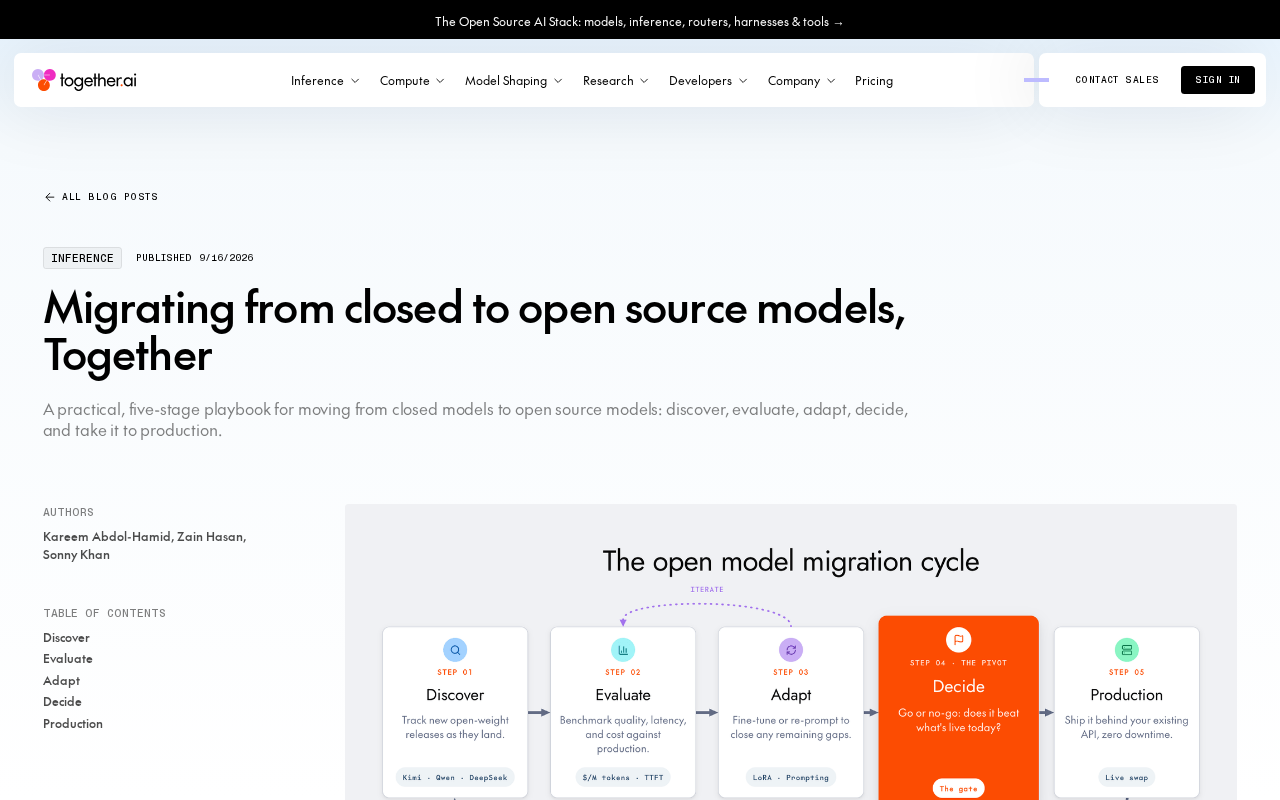
The Five-Phase Migration Playbook
Together's central argument is that this should be measured in weeks, not years. The key is to structure the migration process so that a blind swap doesn't cause a quality regression.
Phase 1: Discover
The first step is to take stock of your existing use cases. Get clear on what tasks your current closed-source model is actually handling — conversational Q&A, text summarization, code generation, complex agent workflows? Different tasks place very different demands on model capabilities. Build a use case inventory that captures call frequency, latency requirements, and minimum quality thresholds for each. This becomes the foundation for every decision that follows.
Phase 2: Evaluate
With your use case inventory in hand, you can shortlist candidate open-source models and run benchmarks. The critical principle here is to evaluate using real business data, not just public leaderboard scores. For each core use case, test the closed-source baseline and open-source candidates with the same prompts. Record output quality, latency, and inference cost to build a side-by-side comparison.
Phase 3: Adapt
Open-source models rarely shine on first contact, but they can often be significantly improved through adaptation. Common techniques include refining prompt structure, adding few-shot examples, adjusting system prompts, and applying lightweight fine-tuning (such as LoRA) on tasks where a clear gap remains. This phase determines whether the open-source option can genuinely close in on closed-source quality.
A note on LoRA: LoRA (Low-Rank Adaptation) is one of the most widely used lightweight fine-tuning methods today. The core idea is to freeze the original model weights and insert a pair of low-rank matrices (typically with a rank of 4–64) alongside the attention layers in each block, training only these small matrices to learn task-specific knowledge. Because the trainable parameter count is only 0.1%–1% of the full model, LoRA requires far less compute than full fine-tuning — you can fine-tune a 7B parameter model on a consumer GPU, and the additional weights can be merged back into the base model after training with no extra inference overhead. In a migration context, when a specific business use case (such as generating reports in a fixed format or understanding industry-specific terminology) still lags significantly behind the closed-source baseline after prompt engineering, collecting a few hundred to a few thousand high-quality samples for LoRA fine-tuning is typically the highest-ROI way to close that gap.
Phase 4: Decide
Based on the results from evaluation and adaptation, make a rational trade-off decision. Not every task is a good migration candidate — some high-complexity reasoning tasks may still warrant a closed-source model, while a large volume of routine tasks can be fully switched over. A hybrid architecture — part closed-source, part open-source — is often the more pragmatic choice in practice.
A note on hybrid architectures: In engineering terms, a hybrid architecture is typically implemented via a routing layer — scheduling logic on the application side that dynamically dispatches requests to either the closed-source or open-source endpoint based on task type, complexity, or confidence level. Simple classification rules (e.g., by keyword or call origin) can be hardcoded directly; more complex scenarios may warrant training a lightweight classifier or using a rules engine. Cost-wise, hybrid architectures can typically reduce overall API spend by 50–80%, since high-frequency, simple requests are handled by self-hosted open-source models while only genuinely demanding inference tasks are routed to closed-source models. This strategy also provides a smooth transition path for gradually expanding the open-source share over time, avoiding the quality risk of an all-at-once cutover.
Phase 5: Production
The final phase is going live. This means standing up a reliable inference service, configuring monitoring and fallback mechanisms, and continuously tracking production quality metrics. Reliability, throughput, and cost performance in the production environment are the ultimate measures of whether the migration succeeded.
Common Pitfalls in Migration
Many teams fail because they treat migration as a one-time "model swap" — skipping evaluation and adaptation, swapping out the model directly, and then abandoning the effort when quality drops. The reality is that open-source models' potential needs to be unlocked through prompt engineering and fine-tuning.
Another common mistake is pursuing a wholesale, all-at-once replacement. A more sensible strategy is to migrate task by task, batch by batch — starting with low-risk, high-frequency use cases to build confidence and experience before gradually expanding into core business workflows.
Summary
Migrating from closed-source to open-source models isn't an all-or-nothing decision — it's an engineering project that can be advanced in a structured way. The five phases of discover, evaluate, adapt, decide, and production provide a clear roadmap, enabling enterprises to weigh cost, performance, and autonomy within a manageable timeframe and arrive at the model mix that best fits their needs.
Related articles

Velocity Ambiguity Profiles: A New Tool for Time-Resolved Bayesian Risk Diagnostics
Velocity Ambiguity Profiles (VAP) is a time-resolved Bayesian risk diagnostic tool for flow matching models that distinguishes intrinsic ambiguity from data-limited loss, validated on CIFAR-100.

Creative Ways to Use Claude to Improve Your Quality of Life: Beyond Hacking TV Ads
Explore creative ways Reddit users use Claude: from automated bill organization and travel planning to smart home control and creative assistance, and how to integrate AI into daily life.

Escaping the "Human Router": A Practical Guide to Multi-Claude Code Agent Orchestration
A developer managing 11 projects with Claude Code manually relayed 257 prompts in a week, taking 11 minutes on average to notice completion. This article analyzes multi-agent orchestration pain points, the trade-offs of single agent + subagents, and three automation approaches—script monitoring, agent communication, and supervisor pattern—to help you go from human router to CEO.