Milepost: An iOS Driving Log with an MCP Server That Lets AI Take Over Your Trip Records

Milepost is an iOS driving log with a built-in MCP server that makes driving data accessible to AI.
Milepost is an iOS driving log app that earned 67 votes on Product Hunt, ranking 20th. Using Roadbook as its core medium, it records routes, photos, notes, and music, supports friend emoji interactions and public link sharing, and upgrades driving records from simple trajectory data to memorable, shareable content. Its biggest differentiator is a built-in MCP server compatible with ChatGPT, Claude, and other AI agents, making driving data queryable and analyzable via natural language—representing a new product approach of "building vertical data first, then connecting to the AI ecosystem via standard protocols." It also incorporates gamification and visual design like garages, city and state stamp collecting, 3D route replay, and monthly recaps. The business model is Freemium, with free logging and Pro unlocking historical data, export, and deep insights.
Article Content
As smart cars and AI assistants rapidly converge, an iOS app called Milepost offers an intriguing product concept: upgrading the act of logging drives from simple trajectory tracking to interactive, shareable digital assets that can be accessed by AI. The product earned 67 votes on Product Hunt, ranking 20th for the day, and is categorized under iOS, Automotive, and Travel.
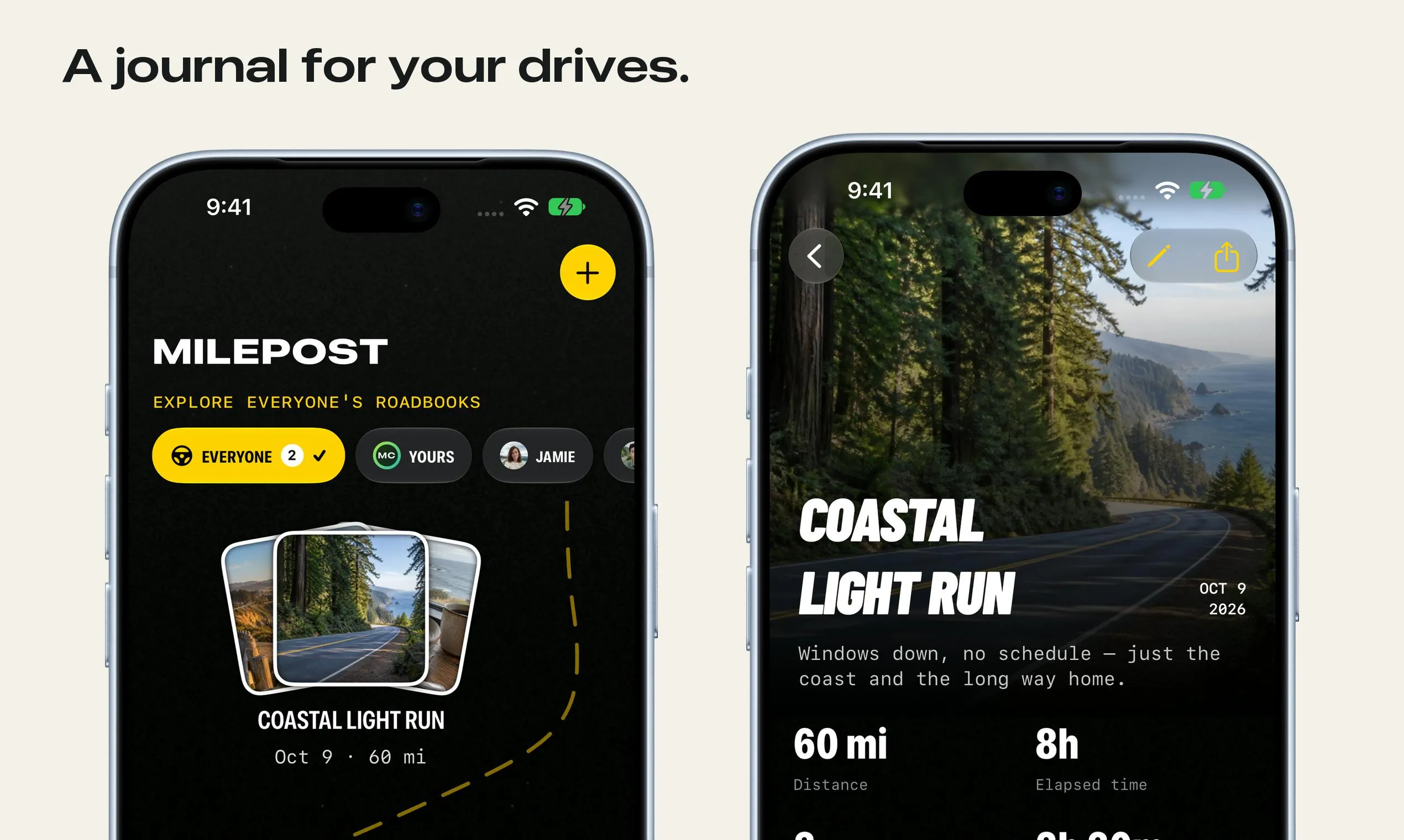
A Driving Log That's More Than Just a Route
Milepost's core concept is the "Roadbook"—a medium for recording driving journeys. Users can log routes, photos, notes, music, and moments from their trips, creating a complete travel journal. This design breaks away from the traditional driving log app focus on mileage and fuel consumption, turning the driving experience itself into content worth remembering and organizing.
What's more interesting is the sharing mechanism. Roadbooks support friend interactions—friends can add emoji reactions and comments, and public web links can be generated for external sharing. This gives the driving log a social media quality, appealing to users who enjoy road trips and highway travel.
MCP Server: Making Your Car Readable to AI Agents
Milepost's true differentiator is its built-in MCP (Model Context Protocol) server, compatible with AI agents like ChatGPT and Claude. This means users' driving data isn't just for their own viewing—it can be accessed and analyzed by AI.
MCP is an open protocol in the current AI tool ecosystem used to connect external data sources with models. By building it into a driving log product, Milepost essentially gives every car a "conversational data interface." Users can ask AI questions like "How many kilometers did I drive on city roads last month?" or "Which route's photos are most worth organizing?" and get answers based on real driving data—no need to manually export spreadsheets and analyze them.
This direction represents a new class of product thinking: first build data accumulation in a vertical scenario, then connect that data to the AI ecosystem using standard protocols like MCP, transforming the app from a "recording tool" into a "data backend for intelligent assistants."
MCP (Model Context Protocol) was open-sourced by Anthropic in November 2024—an open protocol for standardizing communication between AI models and external data sources and tools. Previously, giving AI access to external systems typically required developing separate plugins and interfaces for each model or application, resulting in high compatibility costs and poor reusability. MCP's approach is similar to USB-C: defining a unified format for requests, resources, and tool calls, so that any server following the protocol can be discovered and invoked by MCP-supporting clients. Currently, mainstream AI tools like ChatGPT, Claude, and Cursor all support MCP to varying degrees. For developers, integrating MCP means an app's data and capabilities don't need to be adapted separately for each AI platform; for users, it means being able to query and operate data that was previously locked inside an app using natural language.
Gamification and Visual Design
Milepost incorporates several retention-boosting designs at the experience level. Users can build their own "garage," collecting city and state stamps for each vehicle—similar to a travel check-in Stampbook mechanic. This collection system incentivizes continuous logging and provides a sense of purpose for long-term use.
On the replay side, the product supports 3D route recreation, animated sharing, and monthly recaps. These visual features lower the sharing barrier, turning driving records from dry data into shareable content. For content creators and travel bloggers, these features hold some appeal.
Free and Pro Business Model
Milepost adopts a Freemium model. Basic logging features are free, while the Pro version unlocks longer historical records, data export, and deeper driving insights. This tiered design is relatively restrained—core logging features have no barrier, while advanced analytics are paid, following the common monetization path for utility apps.
It's worth noting that the official description of what specific analytical dimensions Pro's "deeper insights" includes is fairly vague. For users hoping to use AI to dig deep into driving data, actual experience may be needed to determine whether the value matches the cost.
Freemium is one of the most mainstream business models for utility apps: acquiring user scale through free core features, then monetizing through value-added subscriptions or one-time payments. Typical conversion designs include feature gating (such as limiting historical record duration), usage limits (such as monthly export counts), and capability tiering (such as advanced analytics and data export). The advantage of this model is lowering acquisition barriers and relying on word-of-mouth传播, but it also faces the challenge of generally low free-to-paid conversion rates (often between 2% and 5%). For recording-type apps like Milepost, the data users accumulate over time itself constitutes switching costs, making it a key lever for driving subscriptions—the longer you record, the less willing you are to abandon historical data, which happens to be one of the Pro version's core selling points.
Signals Worth Watching
Milepost's emergence reflects a trend: MCP is penetrating from developer tools into consumer-grade applications. When even a personal driving log app starts offering an MCP server, it signals that "data accessible by AI" is becoming a standard product capability rather than something exclusive to geeks.
For driving enthusiasts, this is a tool that balances logging, sharing, and AI interaction; for observers watching the AI application ecosystem, it provides a sample of MCP landing in consumer scenarios. The product is built by developer Sai Kambampati and is currently in its early stages. Whether it can build long-term user stickiness depends on whether the two lines of social sharing and AI analysis can truly gain traction.
Related articles

Cursor Can Now Control Your Computer: AI Agents Can Drive Desktop Apps for Testing
Cursor adds desktop control: AI agents can drive desktop apps like the iOS Simulator to test their own features. We analyze the impact on dev workflows, possible technical approaches, and reliability concerns.

Vibecoding a Custom Inference Engine: High Hopes, Harsh Reality
A Reddit developer shares the real experience of vibecoding a custom inference engine: running GGUF Q4 models in the browser with WebGL2 and GLSL, only to fall into tokenizer debugging hell. This article analyzes the engineering challenges of browser-side LLM inference and why cloning llama.cpp is the more rational choice.

How High Are Anthropic's Early Investor Paper Returns Ahead of IPO?
Anthropic's early investor paper returns draw attention ahead of IPO. This article analyzes sources of book gains, capital structure, pre-IPO games and risks, and implications for the AI startup ecosystem.