MiMo 2.6 Full Benchmark Test: Is the Open-Source #1 Ranking Legit?

MiMo 2.6 tops open-source benchmarks — 6 hard real-world tests reveal whether the scores are legit.
Xiaomi's MiMo 2.6 Pro scored 46 on SWE-bench to top the global open-weight leaderboard, but concerns about 'strong benchmarks, weak real-world use' prompted this full hands-on test. Six tasks — cycling animation, cloth cutting, cube folding, Blender island generation, and two industrial Agent workflows — compared Flash and Pro side by side. Pro led in 3D scene completeness, lighting, and geometric reasoning; both versions showed solid gains in physical simulation. Against DeepSeek and GLM, no model dominated outright. Flash's ultra-low pricing makes it a strong cost-efficient choice — provided quality stays consistent.
After Xiaomi released MiMo 2.6, the community quickly filled up with impressive demos — from fully generated 3D island colony games to cycling visuals with dynamic dashboards. The results are genuinely eye-catching. But these kinds of showcases offer limited value to developers: you have no idea how complex the prompts were, how many iterations and lucky draws it took, or whether the projects were built on pre-existing asset libraries and half-finished templates. Without a controlled comparison, it's hard to judge a model's real capabilities.
This article is based on a comprehensive hands-on test by a Bilibili creator, attempting to cut through the hype and benchmark scores to reveal how MiMo 2.6 actually performs in a real local environment — and whether it's all smoke and mirrors.
Topping the Leaderboard — But What Does It Actually Mean?
On major evaluation benchmarks, MiMo 2.6 Pro scored 46 points, landing it at the top of the global open-weight model leaderboard, with software engineering and tool-calling performance also among the world's top tier. The numbers on paper are genuinely impressive.
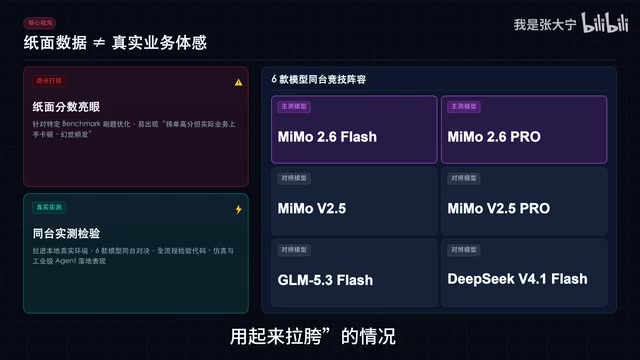
The problem is, we've seen this pattern too many times: "strong on benchmarks, weak in practice." Leaderboards can be gamed through targeted training, but what developers actually care about is performance in real, complex business scenarios. That's why benchmark data alone isn't enough to draw conclusions — there's often a significant gap between ranking #1 and being genuinely useful.
The leaderboard MiMo 2.6 Pro topped is the SWE-bench series, which focuses on software engineering capability. SWE-bench requires models to read real GitHub repository issues, autonomously generate patches, and pass hidden test suites — widely regarded as one of the most realistic code capability benchmarks available. A score of 46 means the model can independently deliver working patches for nearly half of real bug-fix tasks, which is genuinely leading among open-weight models.
However, SWE-bench's limitations have been widely discussed in the community: the questions come from specific historical issues, carrying the risk that the training data has "seen" them before; the evaluation environment is a standardized sandbox that doesn't capture the dependency complexity of production environments; and the "fix rate" metric doesn't reflect engineering quality dimensions like maintainability or security. This is precisely why benchmark scores only become meaningful when validated against real-world scenarios.
Six Hard Tests: Flash vs. Pro Head-to-Head
The test drew from a popular community question bank, using the same set of problems to compare MiMo 2.6 Flash and Pro across spatial geometry, physics simulation, dynamic interaction, and 3D generation.
Cycling Animation: 2.6 Flash used inverse kinematics to link pedal rotation with leg joint movement, producing coherent pedaling motion. 2.6 Pro solved the same leg dynamics while adding richer lighting layers and frame details. Both versions demonstrated solid spatial and mathematical reasoning.
Dynamic Cloth Cutting: This physics problem required the model to build a mass-spring system and cut through the mesh as the mouse passes over it. The key observation is how the cloth deforms under force, and how the two separated sections drift apart after being cut.
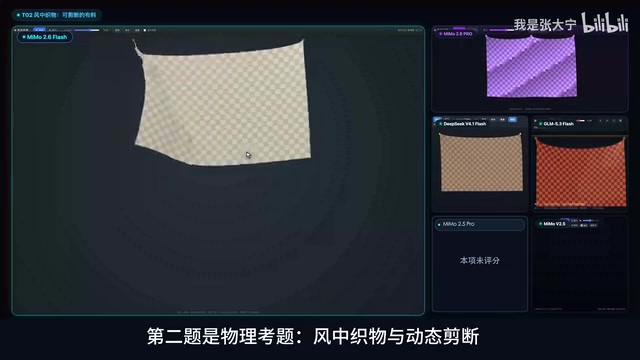
Folding a Cross-Shaped Sheet into a Cube: A 3D spatial geometry test. 2.6 Pro's planning was highly successful — it accurately derived rotation axes and quaternion transforms, with seamless connections at every joint. Flash's folding closure can be compared side by side.
The "Mass-Spring System" mentioned in the cloth simulation is a classic method in computer graphics for simulating flexible objects: the cloth is discretized into mass points, connected by springs between neighboring points, and natural deformation is simulated by solving the spring force, gravity, and damping on each mass point frame by frame. While relatively straightforward to implement, it demands strong spatial math ability and code generation quality — poorly chosen parameters for mass count, spring coefficient, or time step can easily cause oscillation or divergence. Producing a natural falling effect after cloth is cut demonstrates solid understanding of physical constraints and numerical integration. Similarly, "Inverse Kinematics (IK)" used in the cycling animation is a common animation technique: given a target position for the end effector (the foot), it back-calculates joint angles to keep the entire kinematic chain geometrically consistent — an effective dimension for evaluating a model's spatial reasoning.
Into Professional 3D and Agent Testing
The fourth test entered professional 3D territory, requiring a Python script to procedurally generate floating islands in Blender. 2.6 Flash produced islands at varying heights, complete with cottages and vegetation. 2.6 Pro's archipelago featured richer layering, with grass and water surfaces forming a more complete scene.
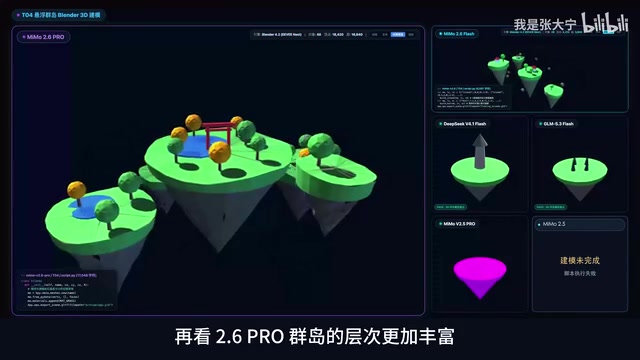
The key here is comparing spatial layout, shape detail, and the overall effect of materials and lighting — and this is where Flash and Pro diverge most clearly. Pro is noticeably stronger in scene completeness.
The test then moved into industrial-grade Agent tasks, including file notification delivery, reconciliation, and paginated order email handling. Both Flash and Pro completed these successfully, demonstrating tool-calling and code repair capabilities. These tasks more closely mirror real workflows and better reflect a model's practical value.
Driving Blender with Python scripts for procedural generation relies on Blender's built-in
bpyAPI. This requires the model not only to write syntactically correct Python, but also to understand Blender's scene graph structure (the hierarchy of Object, Mesh, Material, Light, etc.) and how to call various Modifiers and Shader Nodes. Because thebpyAPI is extensive and varies significantly across versions, the model must generate a working script in a single pass without real-time execution feedback — leaving very little margin for error. This is why Blender script generation is generally considered a more demanding test than general-purpose code generation: reliably producing executable complex scene scripts is a high bar for both domain knowledge depth and code consistency.
Overall Performance: Back at the Frontier
Looking at all six visual tasks and two Agent tasks together, the MiMo 2.6 series delivers a convincing showing. Compared to the previous generation, 2.6 shows clear improvement in spatial geometry, physics simulation, and dynamic interaction.
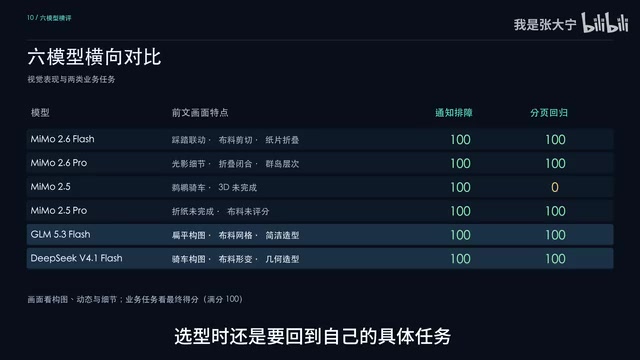
In head-to-head comparisons with DeepSeekAd and GLM, each model has its own strengths in compositional detail and scene rendering — there's no clear blowout. Model selection still comes down to your specific task. From this comprehensive test, MiMo 2.6 demonstrates the credentials of a serious contender among domestic flagship models, and has genuinely returned to the competitive table among frontier large models.
One important caveat: these test results only apply to these specific scenarios and should serve as a rough reference. The feel of a large model varies significantly by use case. For real conclusions, you must validate it against your own business code and workflows.
Pricing: Flash Continues the Ultra-Low-Price Strategy
MiMo 2.6 carries forward the previous generation's aggressive pricing strategy. The Flash version in particular is priced lower than comparable Flash offerings from competitors like DeepSeek and GLM. If quality holds up going forward, it could easily become many developers' go-to model.
For teams chasing cost-efficiency, the positioning of "capability close to the top tier, price significantly lower" may be more compelling than any leaderboard ranking alone. How would you rate this MiMo 2.6 release?
Related articles

Chain of Thought Isn't Just for AI: How Humans Can Use CoT to Improve Thinking Quality
Chain of Thought isn't just a prompt trick for large models. Starting from a Hacker News discussion, this article analyzes why CoT works for human thinking too, breaks down actionable ways to transfer it, and highlights the key differences between human CoT and machine CoT.
Cloudflare Teams Up with OpenAI: Closi…
Cloudflare Teams Up with OpenAI: Closing the Loop from Vulnerability Discovery to Defense with AI
Cloudflare uses OpenAI Daybreak to investigate security vulnerabilities and generate reviewable remediation plans, while developers use Codex to boost coding efficiency and quality.

Orca Multi-Agent Orchestration in Practice: A Guide to Parallel Collaboration with Claude and Codex
Orca is Stable AI's free open-source agent workbench supporting 34 agents like Claude Code and Codex in parallel. Learn its Git worktree isolation, multi-model orchestration, and mobile management.