Mindcase: An API Tool for Extracting Structured Data from Any Webpage in Minutes
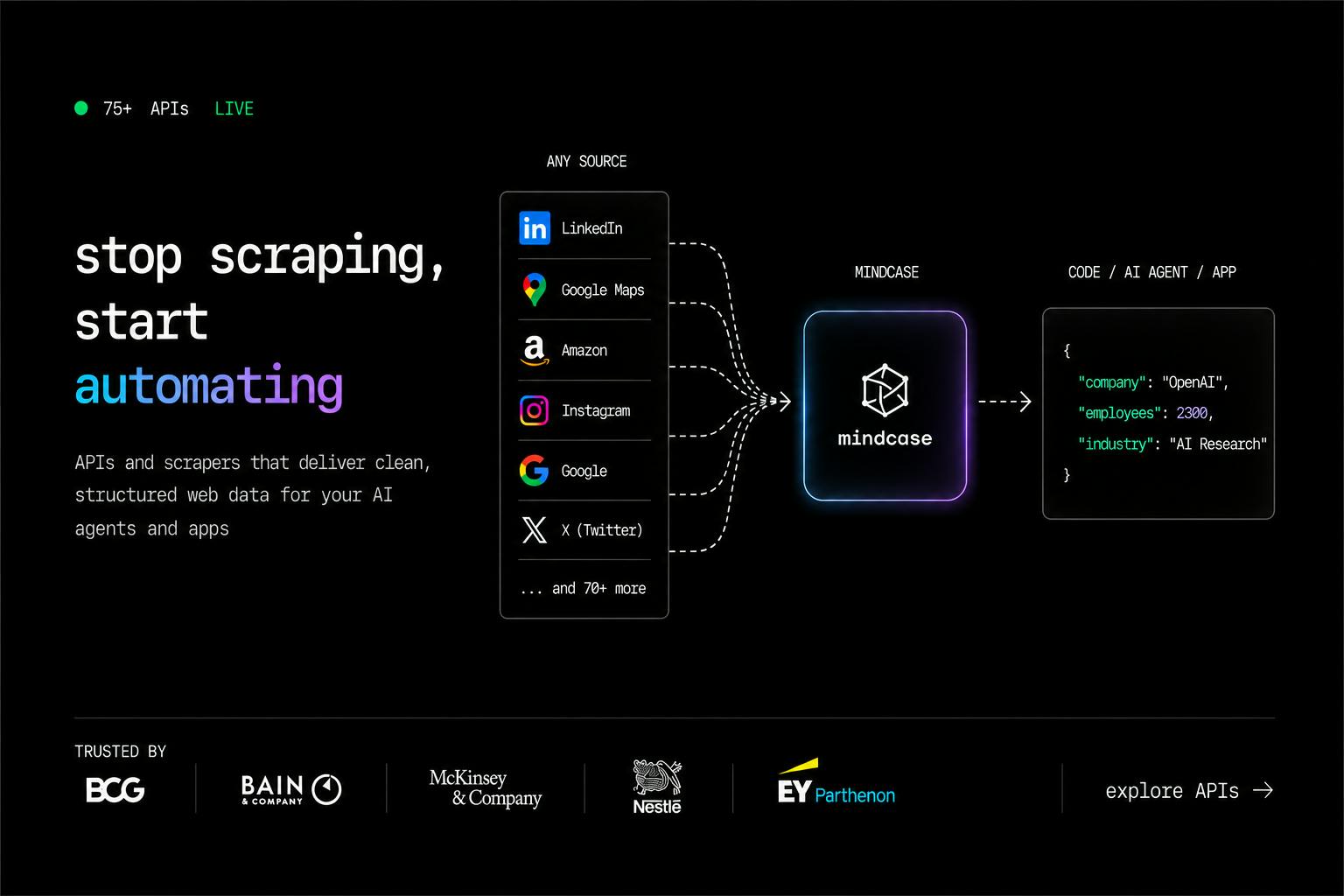
Mindcase turns complex web scraping into simple API calls for structured data extraction.
Mindcase is a new developer tool that abstracts away the complexity of web scraping by offering an infrastructure layer for extracting structured data from any webpage. It provides both ready-made APIs for popular data sources and a custom API builder for long-tail use cases. Targeting developers and AI teams who need reliable web data for LLM training, RAG systems, and AI applications, Mindcase delivers clean, structured output ready for downstream use.
The Persistent Challenge of Web Data Extraction
For developers and AI teams, obtaining usable data from the internet has always been a persistent pain point. Traditional web scraping solutions typically require maintaining an entire infrastructure stack: proxy pools, anti-bot countermeasures, page parsing, and data cleaning. A failure in any single component can bring the entire data pipeline to a halt.
The complexity of this tech stack runs far deeper than it appears on the surface. A proxy pool requires maintaining a large cluster of servers with different IP addresses to distribute request origins and avoid being blocked by target websites. Anti-bot countermeasures involve multiple mechanisms including CAPTCHA solving, browser fingerprint detection, and JavaScript rendering. Page parsing typically relies on XPath or CSS selectors to locate target elements in HTML, but modern websites heavily use frontend frameworks like React and Vue for dynamic rendering, which frequently breaks traditional static HTML parsing approaches. This often necessitates headless browsers like Puppeteer or Playwright to simulate real browser behavior. By industry estimates, a mid-scale scraping system can easily cost thousands of dollars per month in proxy and server expenses alone.
To make matters worse, webpage structures can change at any time — a scraper that worked perfectly yesterday might return empty data today.
Mindcase, a new product that ranked #3 on Product Hunt with 130 upvotes and 23 comments, targets exactly this scenario. Its positioning is straightforward — "extract data from anywhere on the web in minutes" — abstracting away complex scraping engineering into a callable data infrastructure layer.
Core Features and How Mindcase Works
According to its official description, Mindcase positions itself as an "infrastructure layer for extracting web data," outputting structured, ready-to-use data formats. It primarily targets two types of users: developers and AI teams who need reliable web data but don't want to manage scraping infrastructure themselves.
Positioning itself as an "infrastructure layer" draws from the layered architecture philosophy of cloud computing. Similar to how AWS S3 serves storage or Twilio serves communications, the core logic of an infrastructure layer product is to encapsulate a highly specialized, expensive-to-maintain technical capability into a standardized API service, allowing upstream developers to use it without understanding the underlying implementation details. The business advantage of this model is clear: the platform absorbs costs through economies of scale, while users pay on demand, avoiding upfront infrastructure investment and ongoing operational burden. Stripe for payments and SendGrid for email are classic examples of this pattern.
From a product capability standpoint, Mindcase offers two usage paths:
Ready-Made Data Source APIs
For popular, high-frequency data sources, Mindcase provides out-of-the-box API endpoints. Developers don't need to write scrapers from scratch — they can simply call the API and receive structured data. This is akin to a "pre-made meal" model — common web data extraction needs have already been packaged and are ready to use.
Custom API Builder
More noteworthy is its customization capability. For long-tail scenarios where no ready-made endpoint exists, Mindcase allows users to turn "any content on the web" into a custom API built for their specific use case. This means that no matter how obscure the target website or how unusual its structure, it can be transformed into a stable, structured data endpoint through Mindcase.
This combination of "universal scraping + structured output + API-based delivery" essentially outsources scraping engineering to the platform, letting developers focus solely on the data itself rather than getting bogged down in infrastructure.
Why Web Data Extraction Tools Are Perfectly Timed
Mindcase is categorized on Product Hunt under API, Developer Tools, and Data & Analytics — a combination that precisely highlights its relevance to the current moment.
With the explosion of large language models and AI agents, "data to feed models" has become more important than ever. Whether it's building training datasets, updating knowledge bases for RAG (Retrieval-Augmented Generation), or enabling real-time information retrieval for AI applications, all of these depend heavily on high-quality, structured web data.
RAG (Retrieval-Augmented Generation) is one of the most mainstream architectural patterns in current LLM applications. Its core idea is: before a large language model generates a response, it first retrieves the most relevant document fragments from an external knowledge base based on the user's query, then injects those fragments as context into the model's prompt, enabling the model to generate answers based on the most current and accurate information. This architecture addresses core issues such as training data cutoff dates and the tendency to produce "hallucinations." RAG system knowledge bases need continuous updates, and a significant portion of their data comes from publicly available web content — meaning RAG systems don't need web data as a one-time input, but rather require high-frequency, continuous, and stable data input pipelines.
Traditional scrapers typically output messy HTML that requires extensive post-processing before it can be used by models. Mindcase's emphasis on "structured, ready-to-use formats" directly addresses a critical need for AI teams — data arrives clean and parseable, ready to seamlessly plug into downstream model training or analysis workflows. This is precisely why "for developers and AI teams" is front and center in its core value proposition.
Key Questions Worth Considering Before Using Mindcase
As a product that just debuted on Product Hunt, Mindcase demonstrates a clear direction, but several key questions need to be validated through real-world usage:
- Scraping Reliability and Stability: The biggest enemies of web scraping are page changes and anti-bot mechanisms. Mindcase claims to provide "reliable web data," but how its custom APIs handle maintenance costs and response times after target websites undergo redesigns will be the core determinant of its long-term value.
- Data Collection Compliance Boundaries: Extracting data from "anywhere on the web" inevitably raises questions about copyright, robots protocol compliance, and data regulations. The robots.txt protocol (also known as the Robots Exclusion Protocol) is an industry convention where websites use a standard text file to inform crawlers which pages can and cannot be scraped. While this protocol isn't legally binding, it's considered a basic ethical guideline in industry practice. Since 2024, as AI companies have engaged in large-scale web scraping for model training, data compliance issues have intensified dramatically — The New York Times suing OpenAI, Reddit revising its data licensing terms, and multiple European countries invoking GDPR to investigate AI data collection all signal that this space is moving from a gray area toward strict regulation. For platforms like Mindcase, how they build compliance mechanisms into the product (such as automatically identifying and respecting robots.txt, providing data source traceability, and supporting user-configurable compliance policies) will directly impact their credibility with enterprise customers and long-term viability.
- Pricing and Feasibility at Scale: As an infrastructure layer, whether the cost structure supports large-scale, high-frequency API calls directly affects its ability to become a long-term foundational component that teams can rely on.
Summary: Which Teams Is Mindcase Best Suited For?
Mindcase represents a rapidly emerging product category — abstracting complex web data scraping into simple API calls, freeing developers and AI teams from tedious infrastructure maintenance. At a time when AI applications have an exploding demand for structured data, the promise of "connecting to any web data in minutes" is highly compelling. Whether it can truly deliver on the word "reliable" will depend on the robustness and long-term maintenance capability of its scraping engine. For development teams currently struggling with their data pipelines, this is at the very least a new option worth watching and trying out.
Related articles

WaseiGo: The Ultimate Japanese Learning Tool for Mastering 1,000+ Wasei-Eigo Words
WaseiGo is a Japanese learning app focused on 1,000+ wasei-eigo words—English-looking terms with different meanings in Japanese. Features two-voice dialogues, native audio, and picture quizzes. One-time purchase, no subscription.
Impractical: Using AI Agents to Generate After Effects-Level Motion Videos
Impractical is an AI motion design tool that connects to AI Agents via MCP protocol, enabling users to generate After Effects-level product launch and demo videos using natural language.
Cosmic Agent Plugins: Connecting AI Agents with Developer Tools via the MCP Protocol
Cosmic Agent Plugins uses the MCP protocol to connect AI agents with GitHub, Stripe, Render & more, enabling cross-system automation with real vendor tools.