Ming Image Prompt Builder in Action: Using JSON for Precise AI Image Generation Control

A creator built a JSON Prompt Builder for Ming Image enabling layer-level precision in AI image composition.
A creator developed a Prompt Builder for Ming Image that uses structured JSON prompts to achieve high-precision compositional control — defining canvas settings, layer coordinates, hierarchy, and hex color values for every element. Using a fictional papercut-style movie poster as an example, the post demonstrates how each layer, from background starfield to foreground moths and title text, can be explicitly specified. This structured prompting trend is especially powerful for typography-heavy designs like posters and covers. Ming Image remains under-discussed in the community with few public examples, but tools like this prompt builder help lower the barrier to entry.
In the world of AI image generation, getting models to accurately understand complex compositions has always been a major challenge for creators. Recently, a user in Reddit's StableDiffusion community shared a Prompt Builder they built for Ming Image, inspired by KJ's Ideogram 4.0 node — and reported impressive results. The core idea behind this tool is to use structured JSON prompts to achieve a high degree of control over image composition.
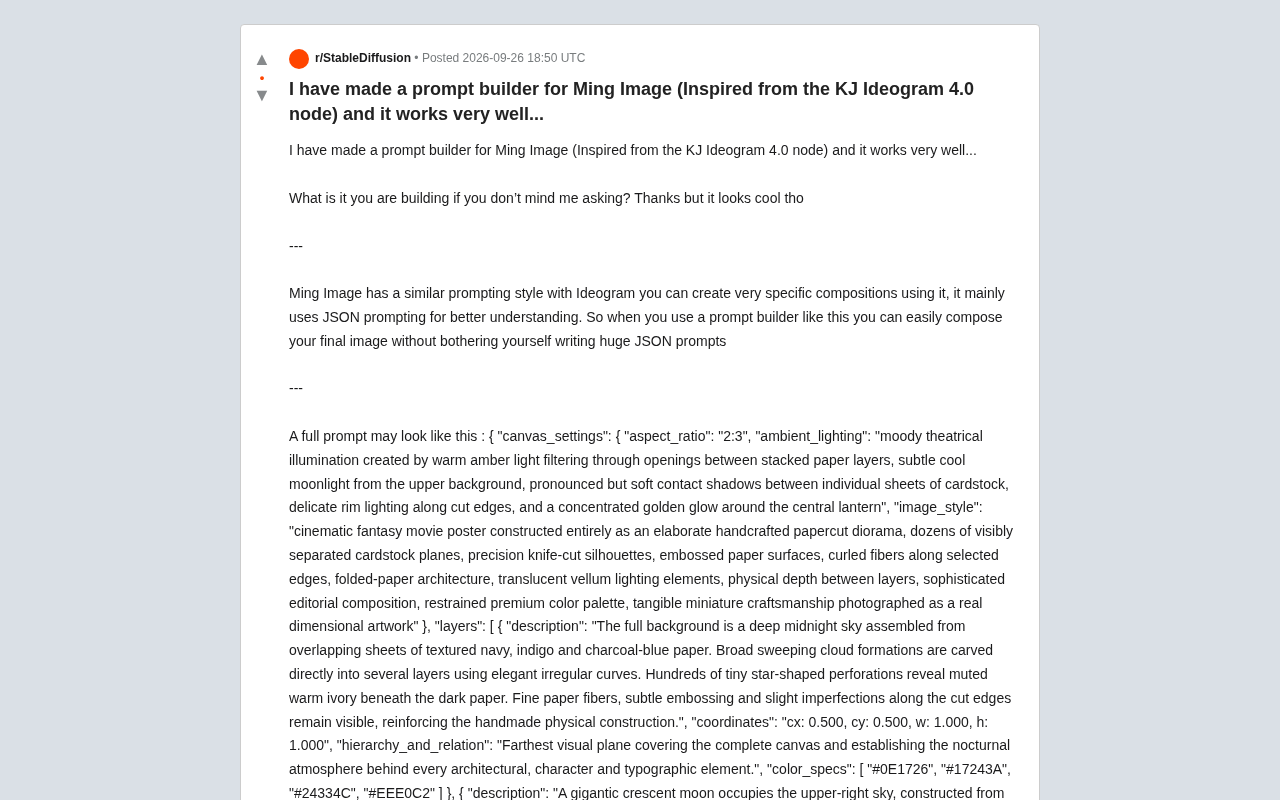
Ming Image's JSON Prompting Style
Ming Image adopts a prompting style similar to Ideogram, but relies more heavily on JSON-structured prompting to achieve deeper model understanding. According to the original poster, this approach allows users to create highly specific compositions — from canvas settings and lighting atmosphere to the position, layering, and color scheme of each individual element.
The problem is that manually writing these massive JSON prompts is both tedious and error-prone. A complete composition prompt can include canvas parameters, multiple layer descriptions, coordinate positioning, and color specifications — easily running hundreds of lines. This is exactly where the prompt builder comes in: users can easily assemble a final image without having to handwrite enormous JSON from scratch.
JSON (JavaScript Object Notation) structured prompting is a way of expressing creative intent through key-value pairs and nested data structures, as opposed to traditional natural language prompts (like "a nighttime cityscape painting"). With conventional text prompts, models rely on statistical patterns from training data to "guess" the creator's intent, making it difficult to reliably reproduce specific compositions, colors, or element placement. JSON prompts transform these vague descriptions into machine-parseable structured data — each field carries explicit semantics, allowing the model to more directly map field values to corresponding dimensions of the generation process. This approach draws from "structured output" practices in the large language model space: once a model is trained or fine-tuned to understand structured inputs, JSON becomes a high-precision interface between human intent and the model's internal representations. Ideogram is one of the leading commercial image generation models for text rendering and typography, and Ming Image's adoption of a similar prompting style signals that the industry is increasingly recognizing the advantages of structured prompting for fine-grained generation tasks.
What a Complete Prompt Looks Like
The original poster shared a highly representative example that illustrates just how complex Ming Image prompts can get. It describes a fictional movie poster titled THE LAST LANTERN, with the overall style defined as "a cinematic fantasy movie poster constructed entirely from handcrafted papercut diorama."
Canvas and Global Settings
The prompt begins with canvas_settings defining global parameters:
- Aspect ratio: 2:3 (a classic poster format)
- Ambient lighting: Warm amber light filtering through layered paper gaps to create a dramatic atmosphere, with cool moonlight in the upper background and focused golden radiance around the central lantern
- Image style: Dozens of visibly separated cardstock planes, precision knife-cut silhouettes, embossed paper surfaces, and translucent parchment light-source elements — conveying the authentic three-dimensional feel of physical craft
Fine-Grained Control Through Layered Composition
The real power of JSON prompting shows up in the layers array. Each layer contains four key fields:
- description: Detailed visual description
- coordinates: Center-point coordinates and dimensions (e.g.,
cx: 0.500, cy: 0.500, w: 1.000, h: 1.000) - hierarchy_and_relation: The layer's position and relationship within the overall composition
- color_specs: A precise list of hex color values
In this poster example, layers build from the furthest midnight starfield background, to a large crescent moon in the upper right, a fantasy city skyline in the lower half, an arching bridge spanning the canvas, a lone traveler at the center of the bridge holding a hexagonal lantern, and finally a swarm of glowing paper moths flying from the lantern toward the moon. Even the title layer — "THE LAST LANTERN" — gets an entire paragraph describing the origami-sculpture quality of the letterforms, the knife-cut serifs, the deep crescent-shaped counters, and the three-dimensional effect of the text rising above a deep burgundy shadow layer.
This level of descriptive precision means creators can maintain clear, intentional control over every element, every light and shadow, every color — rather than hoping the model will "guess" the desired result.
In the layer coordinate system, cx and cy represent the normalized coordinates of an element's center point on the canvas, ranging from 0 to 1, where (0,0) is the top-left corner and (1,1) is the bottom-right. w and h are similarly normalized width and height ratios. So cx: 0.500, cy: 0.500, w: 1.000, h: 1.000 means the layer is centered exactly in the middle of the canvas and covers the entire image — typically used for background layers. The advantage of this normalized coordinate system is that it decouples from actual pixel resolution: the same JSON prompt maintains consistent compositional proportions across different output sizes, making it highly reusable. The hierarchy_and_relation field works similarly to layer ordering and masking logic in graphic design software like Photoshop or Figma — explicitly telling the model which elements are visually in the foreground and which are occluded by others. This helps the generated output better match the creator's intended sense of spatial depth, rather than leaving the model to infer stacking relationships on its own.
Why Structured Prompting Deserves Attention
Both Ming Image and Ideogram point toward the same trend: upgrading natural language prompts to structured descriptions. Compared to freeform single-sentence prompts, JSON prompting offers several advantages:
- Controllability: Coordinate systems move element placement from vague to precise
- Clear hierarchy: The
hierarchy_and_relationfield helps the model understand occlusion and depth - Color consistency: Hex color values eliminate ambiguity like "roughly blue"
- Reusability: Templated structure makes batch modifications and iteration straightforward
This approach is especially valuable for layouts that require precise typography — movie posters, cover designs, text-integrated compositions — because it can simultaneously handle graphics, text, and spatial relationships.
Community Reception and Current Limitations
It's worth noting that the original post also highlighted a significant information gap around Ming Image. One community member bluntly noted: "There's almost zero information and content about this model on this sub," and hoped the author would share more generation results showcasing the model's different capabilities. Another user referenced a related post titled Ming Image is really good in the comments, suggesting the model is gradually entering some creators' awareness — but overall discussion remains limited.
In short, Ming Image appears to have considerable potential — particularly in handling complex compositions and text typography — but publicly available test samples and usage documentation are still quite scarce. For creators who want to try it early, that's both an opportunity and a barrier: the tool is powerful, but the learning resources require a lot of self-guided exploration.
Final Thoughts
The prompt builder shared by this creator fundamentally addresses the pain point of "structured prompting being too high a barrier to entry." As AI image models place increasing emphasis on precise compositional control, auxiliary tools that reduce the burden of writing JSON are becoming a critical part of professional creative workflows. If Ming Image can accumulate more community examples and documentation going forward, it may find significant room to grow in the niche of fine-grained image generation.
Related articles

JobRunner MCP Server: AI Agents Can Now Fix Failed Java Jobs
JobRunner launches an open-source MCP server enabling AI agents to view cluster status, diagnose failures, and recover Java jobs—incident response from any cloud coding environment or existing agent.

MLAI Digital Launches 9 Security Agents: MCP Server Safeguards the Full Lifecycle of Agentic AI
MLAI Digital launches Security MCP Server with nine built-in specialized security agents covering vulnerability discovery, attack simulation, prompt injection detection, API and infrastructure assessment, and accelerated remediation—embedding security validation across the full Agentic AI lifecycle from development to production.

Running Isaac Lab on H100 GPUs: Exploring Better Approaches
Exploring optimization methods for running Isaac Lab on NVIDIA H100 GPUs, including MIG configuration, mixed precision, TensorRT acceleration, and community experience to improve robotics simulation and reinforcement learning efficiency.