Mini-AGI: A Dynamic Continual Learning Model Trained from Scratch on 8GB VRAM

Mini-AGI trains a continual learning model from scratch on 8GB VRAM consumer GPUs, lowering the barrier to entry.
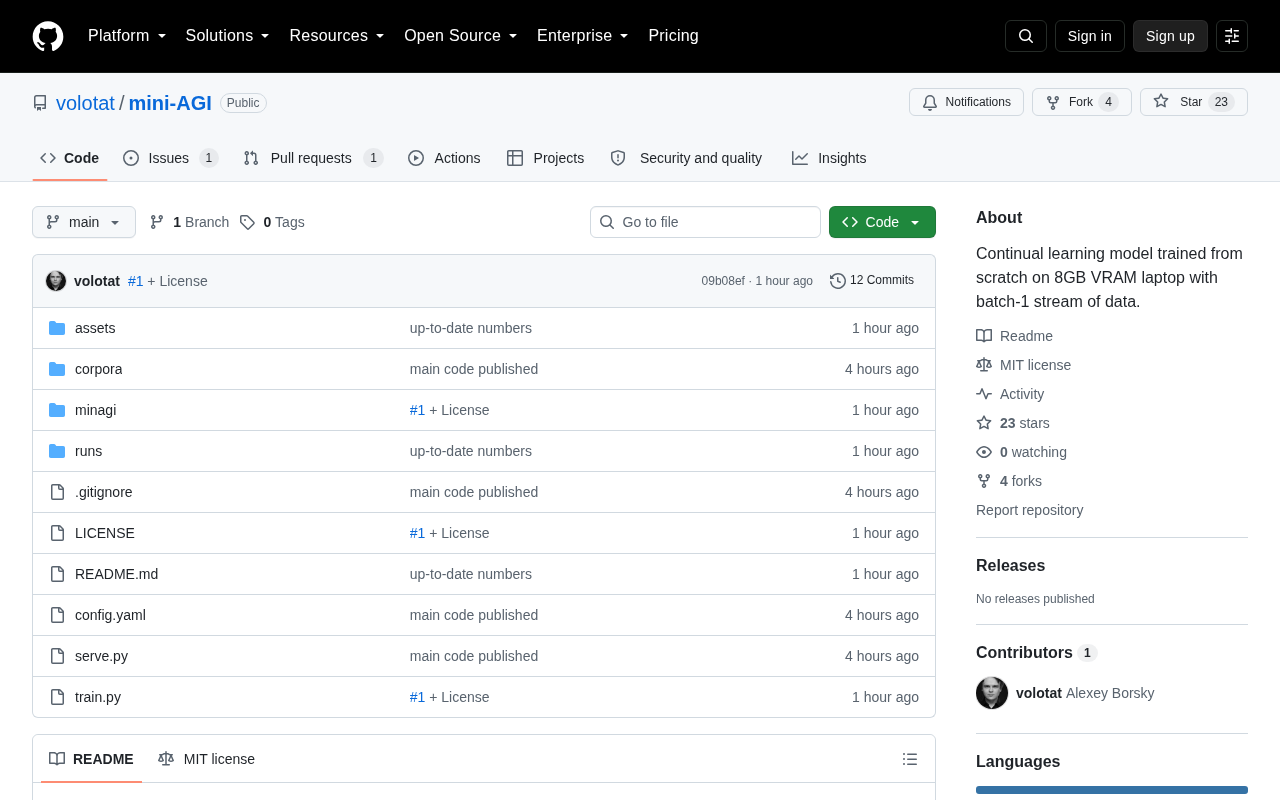
Mini-AGI is a focused open-source experiment aiming to train a model with dynamic continual learning capabilities from scratch on a consumer GPU with just 8GB of VRAM. It targets two major pain points in the LLM ecosystem: high training barriers and the lack of post-deployment learning. The key challenge is combating catastrophic forgetting — a neural network's tendency to overwrite old knowledge when learning new tasks. The "AGI" in the name is largely aspirational; it signals a directional interest in a key AGI trait rather than a claim of achieving general intelligence. With limited community discussion and no public benchmarks yet, treat it as a promising but early-stage experimental project.
A Continual Learning Experiment for Consumer-Grade Hardware
Recently, an open-source project called Mini-AGI sparked a small but notable discussion on Hacker News. Its positioning is clear: train a model with dynamic continual learning capabilities entirely from scratch on a consumer-grade GPU with just 8GB of VRAM.
This direction deserves attention because it addresses two long-standing pain points in the current large model ecosystem — prohibitively high training requirements, and the inability of deployed models to keep learning. Most mainstream models require anywhere from dozens to hundreds of high-end GPUs to train, while 8GB of VRAM is a common configuration for gaming laptops and entry-level discrete GPUs. Successfully training a model from scratch on such hardware carries genuine exploratory value.
What Is Dynamic Continual Learning
Continual Learning — also commonly referred to as Lifelong Learning — refers to a model's ability to keep updating as it receives new data, without needing to retrain from scratch each time. The core challenge it aims to solve is Catastrophic Forgetting: the tendency of neural networks to largely forget previously learned knowledge when trained on new tasks.
How It Differs from Traditional Training Paradigms
Today's mainstream large models follow a static "pre-train + fine-tune" paradigm: once a model is trained on a fixed large-scale dataset, its parameters are essentially frozen, and subsequent updates require reorganizing data and running a new round of training. "Dynamic continual learning," by contrast, emphasizes a model's ability to continuously absorb new information and dynamically adjust itself during operation — much closer to how humans learn.
The word "dynamic" in the project's name suggests that Mini-AGI attempts to introduce some form of dynamic update capability at the architecture or training mechanism level, freeing the model from being locked into the result of a single training run. This is also the key differentiator from typical small-model projects.
Catastrophic forgetting is a long-standing problem in neural networks. Its root cause lies in how gradient descent works: gradients from a new task directly overwrite the weight distributions formed by previous tasks, effectively "washing away" older knowledge. The research community has developed three main approaches to address this: parameter isolation (assigning different network subsets to different tasks, e.g., Progressive Neural Networks); regularization-based methods (penalizing updates to important parameters, e.g., the EWC elastic weight consolidation algorithm); and experience replay (maintaining a small buffer of historical data and mixing it in during new task training). Each approach makes a different trade-off between "stability" and "plasticity" — too conservative and the model can't effectively learn new information; too aggressive and old knowledge rapidly degrades. This trade-off is the core technical dimension for evaluating whether Mini-AGI's continual learning approach is viable.
Why 8GB VRAM Matters
Pushing the training threshold down to 8GB of VRAM means this project is aimed primarily at researchers, students, and independent developers — not industrial-scale applications chasing state-of-the-art performance. Its value lies not in benchmark scores, but in being reproducible, experimentable, and teachable.
For anyone wanting to understand the full model training pipeline, being able to run a complete "train from scratch" process on their own machine offers far more learning value than calling a pre-built API. Projects like this typically make trade-offs around model size, context length, and batch size to fit within tight VRAM budgets.
It's worth tempering expectations: the name "Mini-AGI" carries a certain marketing flair. AGI (Artificial General Intelligence) is a grand and as-yet-unrealized goal, and a small model trained on 8GB of VRAM is clearly far from AGI in any meaningful sense. The name is better understood as an expression of the project's directional interest in exploring continual learning — one of the key characteristics associated with AGI.
When training a language model from scratch under extremely tight VRAM constraints, several engineering techniques are typically used to reduce memory footprint. Common approaches include: mixed-precision training (using FP16 or BF16 instead of FP32, halving memory usage); gradient checkpointing (trading recomputation for memory, reducing activation memory by roughly 60–70%); gradient accumulation (simulating large-batch training with multiple small steps to stabilize convergence); and choosing smaller model architectures (typically in the 100M–500M parameter range). In this context, 8GB of VRAM imposes strict constraints on both model scale and context length — but that's sufficient for validating the feasibility of continual learning algorithms, since algorithmic correctness doesn't require the model to hit a specific performance baseline.
Current Information Limitations and What to Watch
As of now, the project has only 5 upvotes and 1 comment on Hacker News. Community discussion is still sparse, and there are no publicly available performance benchmarks, technical papers, or detailed architectural descriptions. Reliable assessment of its actual effectiveness and technical depth is therefore not yet possible.
For interested developers, here are a few angles worth watching carefully:
- Continual learning implementation: Does it use parameter isolation, regularization constraints, or a replay mechanism to combat catastrophic forgetting?
- Reproducibility: Are the training scripts, data recipes, and dependency environment fully open-sourced?
- Real-world validation: After continuously receiving new data, how well does the model retain previously learned knowledge?
- Scale and capability ceiling: What is the practical upper bound of model capability under the 8GB constraint?
Summary
Mini-AGI represents a type of exploration worth encouraging — lowering the barrier to training and making continual learning experimentable on personal hardware. Its core appeal lies in the combination of "dynamic continual learning" and "training from scratch on consumer-grade VRAM," not in its somewhat grandiose name. Until more technical details and community validation are available, it's best treated as a promising experimental project: worth following, but with measured expectations.
Related articles

Python 3.15 New Feature: Is the sentinel Type Better Than None?
Python 3.15 adds the sentinel type, using named unique sentinel objects to replace None and bare object(), resolving confusion among missing values, explicit emptiness, and invalid input while avoiding type hint failures.

Deep Learning's Three Architectures and the Universal Approximation Theorem: A Complete Guide to MLPs, CNNs, and Transformers
Explaining the inductive bias differences among MLP, CNN, and Transformer, the existence meaning of the Universal Approximation Theorem (UAT), and the role of Taylor expansion in approximation analysis, while clearing up common misconceptions.

GitLab Emergency Patch Release: Analysis of Critical Security Fixes
GitLab releases critical patch 19.5.1, sparking 355 points of discussion on Hacker News. This article analyzes the background, upgrade steps for self-hosted instances, and verification points to help DevOps teams respond quickly to security updates.