Mini Brain Organoids "Read" Braille, a Key Step Toward Biohybrid Computing

The brain organoid "reading Braille" experiment verified distinguishable neural responses to structured stimuli, but reliable computing remains far off.
The article discusses a Hacker News thread about brain organoids "reading" Braille, outlining the technical background and practical significance of the experiment. Brain organoids are three-dimensional neural tissues cultured from stem cells, and the Braille experiment essentially tests whether living neural tissue can produce distinguishable electrical responses to structured tactile encoding. The article notes that the core motivation for biohybrid computing lies in the energy efficiency and synaptic plasticity of the nervous system, but "having a response" does not equal "being able to compute"; stability, signal interfaces, and semantic mapping of responses form three thresholds. Ethically, current organoids lack a basis for consciousness, but a review framework will need to be established as complexity increases. The short-term landing point is more likely neural encoding research and low-power sensing validation rather than replacing existing computing hardware.
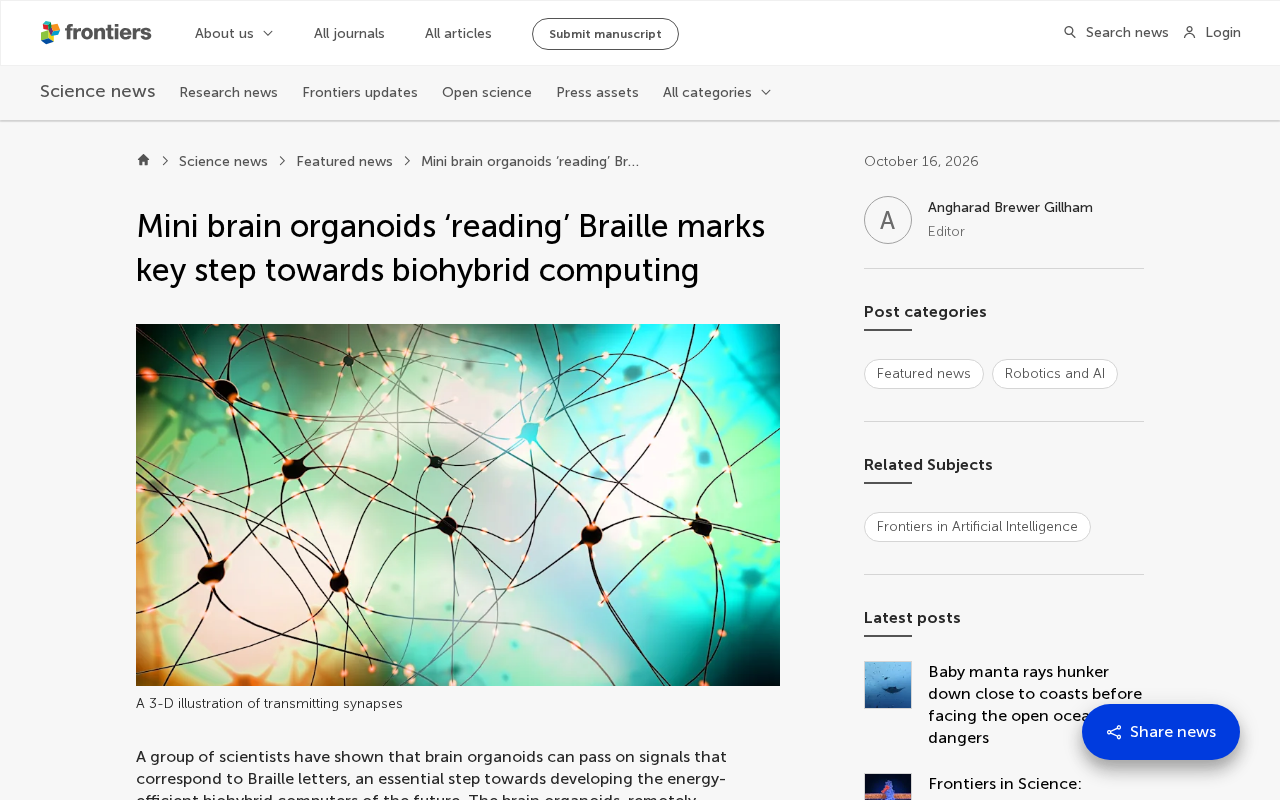
A rather eye-catching discussion has appeared on Hacker News: scientists have enabled mini brain organoids to "read" Braille, and are treating this as a key step toward biohybrid computing. The topic initially had only 3 points and 0 comments, but the direction it points to is intriguing enough—when living neural tissue begins to take on information-processing tasks, the boundaries of computing are being redefined.
What Brain Organoids Are and Why They Can "Read" Braille
Brain organoids are three-dimensional neural tissues cultured in vitro from stem cells, typically on the millimeter scale, possessing partial neural networks and electrical activity characteristics, and are therefore often called "mini brains." They are not brains in the true sense, have no consciousness, and do not possess complete organ structures, but they can form observable, stimulable neural connections in a culture dish.
The key to the phrase "reading Braille" lies not in "reading" but in "tactile encoding." Braille conveys information through the arrangement of raised dots, which is essentially a spatial tactile stimulus. If these raised-dot patterns are converted into regular electrical or mechanical stimulation of neural tissue, and the neural response patterns of the organoids are then observed, it amounts to testing whether living neural tissue can produce distinguishable responses to structured input. This is precisely the core question of interest in neuromorphic computing and biohybrid systems—whether biological tissue can become part of an information pathway.
Organoid refers to a miniature tissue model formed by the self-organization of pluripotent stem cells or adult stem cells under three-dimensional in vitro culture conditions, capable of partially reproducing the cellular composition, spatial structure, and some functional characteristics of the source organ. Compared with traditional two-dimensional cell culture, organoids are closer to real tissue in cell-cell interactions, nutrient gradient distribution, and differentiation lineages. Common types include intestinal organoids, liver organoids, and brain organoids. Brain organoids are usually derived from induced pluripotent stem cells (iPSCs) through neural induction and differentiation, and can form neural networks containing multiple neuron subtypes and some glial cells, exhibiting spontaneous calcium oscillations and electrophysiological activity. Their limitations are also obvious: the lack of a vascular system makes the central region prone to necrosis, size is limited, maturity is insufficient, and batch-to-batch consistency is poor. These characteristics determine that organoids are both valuable neurobiological models and far from being engineerable, stable devices.
Biohybrid Computing: Treating Neurons as Computing Units
Traditional computing relies on silicon-based transistors, whereas biohybrid computing attempts to combine living neurons or neural tissue with electronic systems to form hybrid architectures. There are several motivations behind this approach.
First, energy efficiency. The human brain consumes about 20 watts yet can perform a large number of parallel recognition tasks, while silicon-based systems consume several orders of magnitude more energy on equivalent tasks. Second, plasticity. Neural tissue naturally possesses synaptic plasticity and can adjust connection strength during stimulation; this learning mechanism may be more natural than explicit programming for certain pattern recognition tasks. Third, interface value. If neural tissue can stably receive and output signals, it may be embedded into electronic systems as sensors, pattern recognizers, or novel computing substrates.
The significance of the Braille experiment lies in providing a structured, repeatable input paradigm. Compared with random electrical stimulation, Braille patterns have clear encoding rules and can test whether neural responses have discriminability and stability—a prerequisite for whether any computing substrate can be practical.
Neuromorphic computing is a computing paradigm that draws on the structure and information-processing methods of the nervous system, with typical features including spike encoding, event-driven operation, and in-memory computing. In the traditional von Neumann architecture, computation and storage are separated, and data movement brings substantial energy consumption; neuromorphic hardware attempts to use synapse-like devices to perform weight updates and signal transmission locally, thereby gaining energy-efficiency advantages on sparse, temporal tasks. Biohybrid computing can be seen as a radical branch of neuromorphic computing: it does not simulate neurons but directly uses living neurons as a physical computing medium. The common assumption of both is that the energy efficiency and adaptability of the nervous system stem from its architecture itself rather than from algorithms alone. The difference is that silicon-based neuromorphic chips are controllable and reproducible, whereas living neural tissue possesses genuine synaptic plasticity but is difficult to standardize—this is precisely the fundamental tension facing the biohybrid approach.
Key Difficulties: From "Having a Response" to "Reliable Computing"
Such progress must be viewed with restraint. Neural tissue responding to stimulation does not mean it can reliably perform computation. Judging from existing research paths, the real thresholds are at least threefold.
The first is stability. The neural activity of organoids has spontaneous fluctuations, and differences between batches are obvious; a stimulus pattern that can be distinguished today may not be reproducible tomorrow. The second is the interface. How to achieve long-term, multichannel signal readout and writing without damaging the tissue is a hard problem at the hardware level. The third is semantics. How neural response patterns map to meaningful output requires an interpretable encoding scheme; otherwise the system merely "has a response" and cannot "give an answer."
According to the positioning of this entry on Hacker News, the work is regarded as a "key step" rather than a delivered outcome, and this wording itself is accurate. It is more like verifying the feasibility of a direction than delivering a usable biological computing chip.
Multi-electrode array (MEA) is the most commonly used interface technology in electrophysiological research on organoids: dozens to thousands of microelectrodes are integrated at the bottom of a culture dish, capable of both recording the field potentials of neural tissue and applying local electrical stimulation. The key metrics of MEA include electrode density, signal-to-noise ratio, and long-term biocompatibility. The current bottleneck is that shrinking electrode size improves spatial resolution but reduces signal-to-noise ratio, while long-term implantation also triggers glial encapsulation and signal attenuation. In addition, the three-dimensional structure of neural tissue means that planar MEAs can only sample a layer of neurons near the substrate, and a large amount of deep activity cannot be observed. Three-dimensional flexible electrodes and optogenetic methods developed in recent years have partially alleviated these problems, but achieving long-term, high-channel-count bidirectional readout and writing without damaging tissue remains a core challenge at the hardware level.
Ethics and Boundaries: A "Brain" Without Consciousness
Brain organoid research has always been accompanied by ethical discussion. Currently cultured organoids are limited in scale and do not possess the neural basis for consciousness or pain; the consensus in mainstream scientific circles is that such tissue does not constitute a moral subject. However, as culture time lengthens and complexity increases, boundary questions will be raised repeatedly: how complex must neural tissue be to require additional review? Should neural tissue used for computing and organoids used for disease modeling be subject to different norms?
There are no unified answers to these questions for the time being, but if biohybrid computing is to move toward application, the ethical framework needs to advance in step with technological progress rather than be addressed after the fact.
Realistic Expectations for This Path
In the short term, brain organoids will not replace any existing computing hardware. A more realistic landing point is a validation platform for specific scenarios: using neural tissue for basic research on pattern recognition, studying neural encoding mechanisms, and exploring low-power sensing front ends. The value of the Braille experiment is that it adds a discussable experimental sample to the question of whether biological tissue can become an information-processing unit.
From the low discussion volume on Hacker News, it is also clear that this direction is still at the stage of niche attention. It is worth recording, but there is still a long way to go before it changes the computing industry. What truly determines its trajectory is not the headline of any single experiment, but whether the three barriers of stability, interface, and interpretability can be crossed one by one.
One-line Summary
The brain organoid "reading Braille" experiment verified that neural tissue can produce distinguishable responses to structured stimuli, but it is still far from reliable computing.
Paragraph Summary
The article centers on a Hacker News discussion about brain organoids "reading" Braille, outlining the technical background and practical significance of this experiment. Brain organoids are three-dimensional neural tissues cultured from stem cells, and the essence of the Braille experiment is to test whether living neural tissue can produce distinguishable electrical responses to structured tactile encoding. The article points out that the core motivation for biohybrid computing lies in the energy efficiency and synaptic plasticity of the nervous system, but "having a response" does not equal "being able to compute"; stability, signal interfaces, and semantic mapping of responses constitute three thresholds. At the ethical level, current organoids do not have a basis for consciousness, but as complexity increases, a review framework needs to be established in parallel. The short-term landing point is more likely to be neural encoding research and low-power sensing validation rather than replacing existing computing hardware.
Related articles

Understanding DeepSeek in 3 Minutes: The Rise from a Quant Hedge Fund to an Open-Source AI Leader
DeepSeek's history in 3 minutes: from High-Flyer Quant's compute build-up to V2's MLA inference cost cuts, V3's $5.576M training bill, R1's open-source global shock, and V4 with a $7B Series A.

Local Creative Writing Model Showdown: Fine-tuned Qwen3.8 27B Wins, DeepSeek v4.1 Underwhelms
Bilibili creator tests seven local creative writing models: Hemingway and HumanLike Chat based on Qwen3.8 27B perform best, DeepSeek v4.1 is plain, Dongfang Shuo ranks last with confused characters. Includes three test prompts, scores, and usage advice.

Liang Wenfeng's Three Big Bets: Why Did DeepSeek Open-Source Its 82% Gross Margin?
Why did DeepSeek open-source DeepInfer, its 82% gross margin inference framework, and then launch a hundred-billion funding round? An analysis of Liang Wenfeng's three big bets and the open-source strategy.