Minicart: An AI Team to Handle E-Commerce Chores, Run Your Online Store Through Chat

Minicart lets small sellers manage their online store through chat with three personified AI teammates.
Minicart is an AI e-commerce tool for handmade creators, content creators, and resellers, built around replacing traditional software UIs with natural language conversation. It features three AI characters—Sloane for the storefront, Milo for marketing, and Logan for logistics and support—consolidating listings, promotions, and fulfillment into a single chat interface. The workflow retains a human review step, with AI producing drafts for seller approval. The product ranked second on Product Hunt, but real user feedback is still limited, and AI output quality and bulk-operation efficiency remain key tests.
Replace Backend Operations with Conversation
For e-commerce entrepreneurs, the biggest headache usually isn't product selection or marketing creativity — it's getting buried under tedious operational tasks: listing products, updating inventory, creating promotions, handling shipments, and responding to customer inquiries. Minicart tries to solve this problem with a fresh approach: give you an online store, pair it with an AI-powered operations team, and let you tell them what to do in plain, everyday language.
The product launched on Product Hunt with 125 upvotes, finishing second for the day, and is categorized under both Artificial Intelligence and E-Commerce. Its positioning is clear: it targets handmade creators, content creators, and resellers — people who don't want to spend time learning complex e-commerce software.
Three AI Characters, Each with a Role
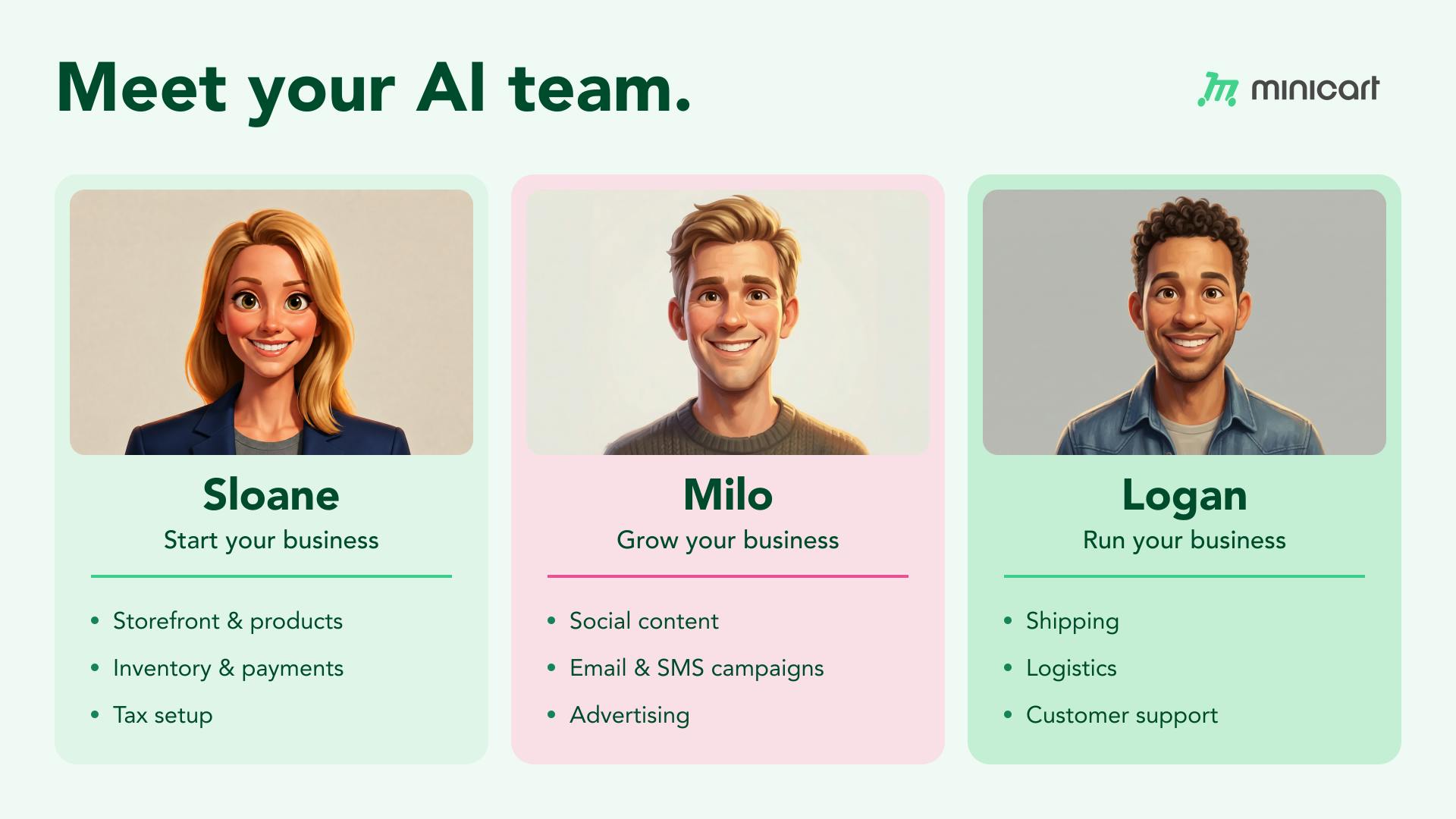
Minicart's most distinctive design choice is splitting operational work across three personified AI characters, each with their own responsibilities:
- Sloane manages the storefront — handling product listings, inventory, and how the shop looks to customers.
- Milo focuses on marketing content — generating promotional materials and planning campaigns.
- Logan handles logistics and customer communication — order fulfillment and customer service replies.
This character-based design isn't just a marketing gimmick. It transforms an abstract "AI assistant" into a team you can actually talk to, lowering the psychological barrier for users. You don't need to understand how many feature modules exist in the backend — you just need to know "go to Milo for marketing, go to Logan for shipping." For small-scale sellers who have never touched e-commerce software, this interaction metaphor feels closer to a real employment relationship.
The Core Workflow: Say, Review, Continue
According to the official description, Minicart's logic can be summed up in three steps: tell the team what you need in plain language, review what they've completed, and then carry on with your business.
Adding products, updating inventory, creating promotions, fulfilling orders — tasks that normally require jumping between different menus are all funneled into a single chat interface. At its core, this replaces the graphical UI of traditional e-commerce SaaS with natural language instructions plus human review.
The value of this design lies in keeping the "review" step. The AI doesn't take over automatically — it produces a draft and hands it back to the seller for confirmation, striking a balance between efficiency and control while reducing the risk of the AI acting unilaterally.
This "Human-in-the-Loop" design philosophy is becoming increasingly common in AI products. Fully automated execution carries high risks in e-commerce scenarios — an incorrect price change, a misfulfilled order, or an inappropriate auto-reply to a customer can all cause real damage. By keeping a human review checkpoint, the AI is positioned as a "drafter" rather than a "decision-maker," leaving ultimate control with the human. The hidden cost of this design is that it increases conversation turns, and for high-frequency, bulk operations (like updating inventory across dozens of SKUs at once), it may actually be less efficient than a traditional spreadsheet interface. This model works best for sellers with low operation frequency and clearly defined single tasks — it holds limited appeal for sellers with large SKU catalogs.
Who It's For, and What Challenges It Faces
Minicart is targeting a real and sizable long-tail market: individual sellers who have products and creativity but are blocked by the complexity of the tools. For them, reducing the learning curve may matter more than having a rich feature set.
That said, based on publicly available information, a few questions are worth watching. First, the actual quality of AI-generated marketing content and customer service responses directly determines how much work the "review" step requires — if every output needs heavy editing, the conversational advantage quickly erodes. Second, the product currently has only 5 reviews on Product Hunt, meaning real user feedback is limited and the actual experience needs further validation. Third, whether chat-based interaction is more efficient than a traditional table interface for bulk, precision operations remains an open question.
Looking at the competitive landscape, the "conversational e-commerce management" space already has multiple players. Major platforms like Shopify are embedding AI assistants directly into their backends (e.g., Shopify Magic), allowing merchants to generate product descriptions and marketing copy through natural language. On the independent tools side, vertical products focused on customer service automation are competing for the same audience. Minicart's differentiation lies in consolidating multiple operational workflows into a single conversational interface, rather than enhancing a single feature. The advantage of this integration strategy is a consistent experience; the downside is that each individual function may lack the depth of a dedicated specialist tool, and the thickness of its ecosystem moat depends on how deeply it's integrated with platforms for user data, payments, and logistics.
Summary
Minicart represents a rising product philosophy: rather than bolting an AI plugin onto traditional software, it reconstructs the entire interaction paradigm from the ground up. Replacing "feature menus + manual operations" with "AI team + natural language" is genuinely appealing for creators and resellers who are unfamiliar with e-commerce tools. Whether it can truly succeed depends on the stability and output quality of the AI in real-world operational scenarios — a question every conversational AI application has to answer.
Related articles

Workbuddy for Absolute Beginners: How a Desktop AI Agent Fits Into Real Workflows
A beginner's guide to the Workbuddy desktop AI agent: installation, claiming credits, file management, and building automated workflows—compared with CodeX for fit and cost, helping professionals shift from AI question-askers to AI managers.

OpenAI's New Agent Stack: Computer Use, Decisions API, and Ultra-Fast Workflows
OpenAI Dev Day unveiled a new agent stack: Computer Use outperforms humans, Decisions API delivers ultra-low-latency classification via Luna, Agents API opens the same Computer Use capabilities, and GPT-6.1 Sol costs only one-seventh of Astra. Core updates, benchmark data, and developer insights.

Liang Wenfeng Open-Sources DeepInfo Inference Framework, Takes On U.S. Ban
DeepSeek open-sources its DeepInfo inference framework after its models, featuring GPU/CPU cross-pipelining, small-model prediction with large-model verification, and full Huawei Ascend and NVIDIA chip support—facing the U.S. federal ban head-on. This article analyzes its significance for AI deployment and open-source strategy.