MiniCPM5-2B In-Depth Analysis: The Strongest Open-Source Model Under 4B Parameters
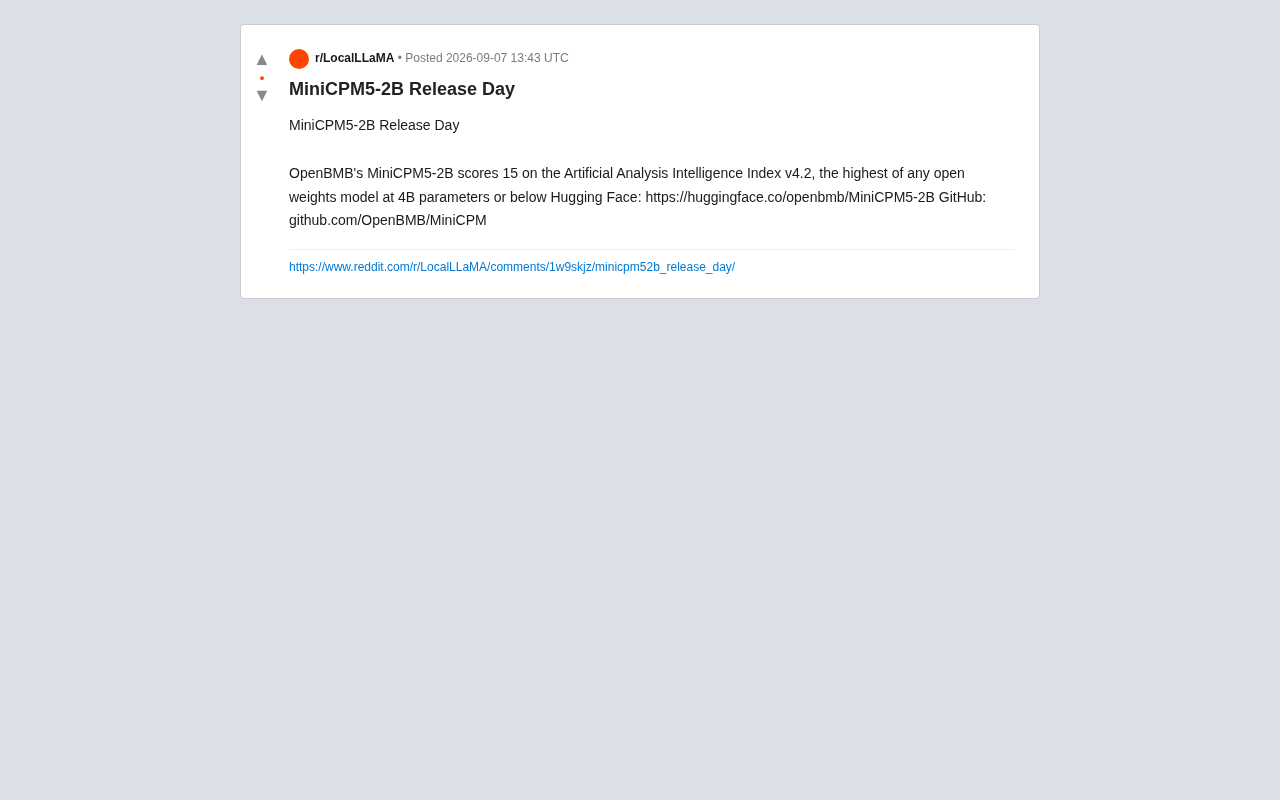
MiniCPM5-2B: 2B parameter model tops 4B-and-under rankings with score of 15, redefining small model capabilities
OpenBMB's MiniCPM5-2B achieves breakthrough performance as a 2B parameter language model, scoring 15 on Artificial Analysis Intelligence Index v4.2 to lead all open-source models under 4B parameters. The model demonstrates that parameter efficiency and performance can be optimally balanced through architectural optimization and training strategies, offering low-cost inference, fast response times, and edge device deployment capabilities—making it ideal for resource-constrained scenarios.
MiniCPM5-2B In-Depth Analysis: The Strongest Open-Source Model Under 4B Parameters
The OpenBMB team recently released MiniCPM5-2B, a compact language model with just 2B parameters that has achieved remarkable performance breakthroughs across multiple benchmark tests. According to the Artificial Analysis Intelligence Index v4.2 evaluation, MiniCPM5-2B topped the performance rankings for open-source models under 4B parameters with a comprehensive score of 15.
OpenBMB (Open Lab for Big Model Base) is an open-source large model research organization initiated by Tsinghua University's Natural Language Processing Lab, dedicated to advancing open research on efficient large models. The MiniCPM series is its flagship project line focused on small, efficient language models. Previously released MiniCPM versions have already garnered widespread attention in academia and industry, with the MiniCPM-V series in particular demonstrating the surprising potential of small models in multimodal understanding. As the latest iteration of the series, MiniCPM5-2B has undergone systematic upgrades in architecture optimization and training data engineering.
MiniCPM5-2B Core Performance
MiniCPM5-2B achieved a score of 15 on the Artificial Analysis Intelligence Index v4.2 benchmark test, significantly leading among open-source models of comparable parameter scale.
The Artificial Analysis Intelligence Index is a comprehensive model capability scoring system developed by the independent AI evaluation agency Artificial Analysis. This index integrates results from multiple mainstream benchmark tests (such as MMLU, HumanEval, GSM8K, etc.) and calculates a unified composite score through weighted computation, aiming to provide the industry with cross-model horizontal comparison standards. Specifically, MMLU (Massive Multitask Language Understanding) tests a model's breadth of knowledge across 57 disciplines, HumanEval evaluates code generation capabilities, and GSM8K examines mathematical reasoning ability. Version 4.2 is its latest iteration, further optimizing scoring weights and test coverage, and is widely used to measure the actual capability levels of models across different parameter scales.
For a model with only 2B parameters, such performance is quite rare. Generally speaking, larger parameter counts tend to correspond to stronger model capabilities—a recognition rooted in the famous Scaling Law in the large language model field. This law, proposed by OpenAI's Kaplan et al. in 2020, indicates that model performance has power-law relationships with parameter count, training data volume, and compute amount, with increases in any of these factors typically bringing predictable performance improvements. However, DeepMind's Chinchilla paper further revealed that there exists an optimal ratio between parameter count and training data volume, and simply stacking parameters is not the most efficient path. MiniCPM5-2B represents an extension of this understanding—through carefully designed model architecture, optimized data quality, and training strategies, small-parameter models can also find performance sweet spots on the efficiency curve and deliver outstanding results.
Practical Application Value of 2B Parameter Small Models
Against the current industry backdrop where large models often have hundreds of billions of parameters, models like MiniCPM5-2B at the 2B parameter level demonstrate irreplaceable application advantages:
Low Cost and Low Latency
Smaller parameter scales directly translate to lower inference costs and faster response speeds. To reference specific data, the computational cost per inference (FLOPs) of a 2B parameter model is approximately one thirty-fifth that of a 70B model, which directly reflects in substantial reductions in GPU occupancy time and power consumption. For application scenarios requiring real-time interaction—such as intelligent customer service, real-time translation, conversational assistants—MiniCPM5-2B can provide smooth user experiences under resource-constrained conditions. In high-concurrency scenarios, the same GPU card can serve far more 2B model requests simultaneously than large models, with per-request costs potentially dropping by one to two orders of magnitude.
Edge Device Deployment
The 2B parameter model size makes it possible to run directly on edge hardware such as mobile devices and IoT devices. Edge Computing refers to the computing paradigm of migrating data processing and AI inference from cloud servers to execution on terminal devices closer to the data source. Core challenges faced by on-device deployment include: limited memory capacity (smartphones typically have only 8-16GB RAM), constrained computational power (mobile GPU/NPU performance is far below data center GPUs), and strict power budgets. A 2B parameter model typically requires only about 1-2GB memory after INT4 quantization, enabling it to run smoothly on mainstream smartphones, embedded development boards (such as NVIDIA Jetson series), and even some high-end IoT devices. In contrast, 70B-level large models require dozens of GB of memory even after quantization, making deployment on consumer-grade terminal devices essentially impossible.
This means AI capabilities can truly descend to terminal devices, breaking free from strong dependence on cloud computing power and functioning normally in offline scenarios. This holds critical significance for scenarios with limited network conditions such as industrial sites, in-vehicle systems, and medical devices.
The release of MiniCPM5-2B provides developers with a pragmatic choice that balances high performance with low cost. Especially in projects with limited computing budgets or strict inference latency requirements, such small yet powerful models are becoming increasingly mainstream solutions.
Open-Source Resource Access and Quick Start
The OpenBMB team has fully open-sourced MiniCPM5-2B on Hugging Face and GitHub, and developers can quickly access and use it through the following channels:
- Hugging Face Model Hub: Directly download pre-trained weights and integrate them into existing projects with just a few lines of code
- GitHub Repository: Contains complete training code, evaluation scripts, and technical documentation, facilitating researchers' in-depth understanding of model internals
Hugging Face is currently the world's largest AI model open-source community and distribution platform, dubbed the "GitHub of AI." Its core products include the Model Hub (hosting over 800,000 pre-trained models), Transformers library (unified model loading and inference framework), Datasets library (standardized dataset management tools), and Spaces (online model demonstration platform). Through Hugging Face, developers can complete model download, loading, and inference with just a few lines of Python code, greatly lowering the barrier to AI model usage. Publishing models on Hugging Face also means the community can spontaneously perform conversions to various deployment formats such as GGUF and ONNX, further expanding the model's application scenarios across different hardware platforms.
This thoroughly open strategy aligns with the current development direction of the AI open-source community. Researchers can fine-tune, distill, or conduct secondary development based on MiniCPM5-2B, further expanding the capability boundaries of small, efficient models. Continuous community feedback also helps the OpenBMB team iteratively optimize subsequent versions.
Insights for the AI Industry and Future Directions
The release of MiniCPM5-2B marks a new milestone in small language model research. It has proven with actual data that better balance points exist between parameter efficiency and model performance, which holds important reference significance for the entire AI industry.
Several foreseeable trends:
- Scenario-specific small models will continue to emerge: Small models deeply optimized for specific tasks will form differentiated complementarity with large general-purpose models. In actual enterprise applications, over 80% of business scenarios do not require models to possess general capabilities across all domains, and small models with targeted optimization can often achieve or even exceed large model performance on specific tasks at lower cost.
- Enterprise deployment strategies will become more flexible: Not all business needs require models at the tens-of-billions parameter level; selecting appropriately sized models based on needs can dramatically reduce costs while ensuring effectiveness. More and more enterprises are adopting "large-small model collaboration" hybrid deployment architectures—where large models handle complex reasoning tasks while small models handle high-frequency simple requests, achieving optimal overall cost-performance balance.
- Efficient training methods will accelerate iteration: The successful experience of MiniCPM5-2B will motivate more research teams to invest in exploring efficient training techniques such as model compression and knowledge distillation. Mainstream model compression methods include: knowledge distillation—where small models (student models) learn the output distributions of large models (teacher models), "compressing" the knowledge of large models into small models; quantization—reducing model weights from 32-bit floating-point to 8-bit or even 4-bit integer representation, significantly reducing memory footprint; pruning—removing weight connections or attention heads in the model that contribute less to final outputs. Additionally, neural architecture search (NAS) and mixture-of-experts (MoE) architectures are also important directions for improving parameter efficiency. The combined application of these technologies is the key technical support for small models to achieve "punching above their weight."
For developers and enterprise decision-makers evaluating AI solutions, MiniCPM5-2B is worth in-depth investigation and testing as a preferred solution for lightweight deployment scenarios. As the recognition that "not all scenarios need the largest models" gradually becomes industry consensus, the strategic value of efficient small models will only become increasingly prominent.
Key Takeaways
- MiniCPM5-2B achieved a score of 15 on the Artificial Analysis Intelligence Index v4.2, becoming the strongest open-source model under 4B parameters
- 2B parameter scale brings significant advantages: substantially reduced inference costs, faster response speeds, and edge device deployment capabilities
- Fully open-sourced on Hugging Face and GitHub with complete resources, enabling developers to quickly integrate and customize
- Represents important industry trends: scenario-specific optimization, flexible deployment strategies, and efficient training method innovation
- Provides a pragmatic high-performance, low-cost solution for resource-constrained and latency-sensitive application scenarios
Related articles

GPT-6 Astra vs. Claude Fable 5.1: A Full Comparison Across Four Real-World Tests
GPT-6 Astra vs. Claude Fable 5.1: benchmarks, cost, Fortnite clone, UI design, motion graphics, and 3D dashboard — four real-world tests compared.

GPT-6 Astra vs Claude Fable 5.1: Head-to-Head Comparison Across 15 Real-World Work Scenarios
A creator spent thousands testing GPT-6 Astra vs Claude Fable 5.1 across 15 real work scenarios. Astra won 10 rounds and saved $186; Fable excelled in creative copy and visual design.

Claude Code Team Interview: How Engineers Shift from Writing Code to Managing AI Goals
Anthropic Claude Code team deep dive: reveals how software engineers shift from line-by-line coding to AI goal management, covering Slack-native Agents, cloud-hosted Loops, workflow fan-out reviews, and AI's profound restructuring of development paradigms.