Minimalist RAG Memory System BRIDGE: When Is It Enough, and When Is It Not?

Minimalist RAG memory system BRIDGE challenges complex architectures and reveals memory evaluation should shift to an "enablement" perspective.
A new study proposes the minimalist RAG memory system BRIDGE, which matches or outperforms complex SOTA on multiple standard benchmarks at lower cost. The researchers note that standard memory benchmarks only measure retrieved content, not how memory supports agent action. Five adversarial probes reveal no universally optimal architecture: atomic fact extractors excel at rule application, chunk-summary memory at pattern induction. The study calls for an "enablement" perspective in agent memory evaluation.
In the design of AI agent memory systems, the industry has stacked far too many complex mechanisms: entity extraction, fact supersession, reflection, graph synthesis... But a new study finds that these "advanced primitives" can hardly justify their costs in standard memory benchmarks. The researchers propose a minimalist RAG memory system called BRIDGE and use a series of adversarial tests to reveal what really matters in memory design—not what is retrieved, but what the agent is enabled to do.
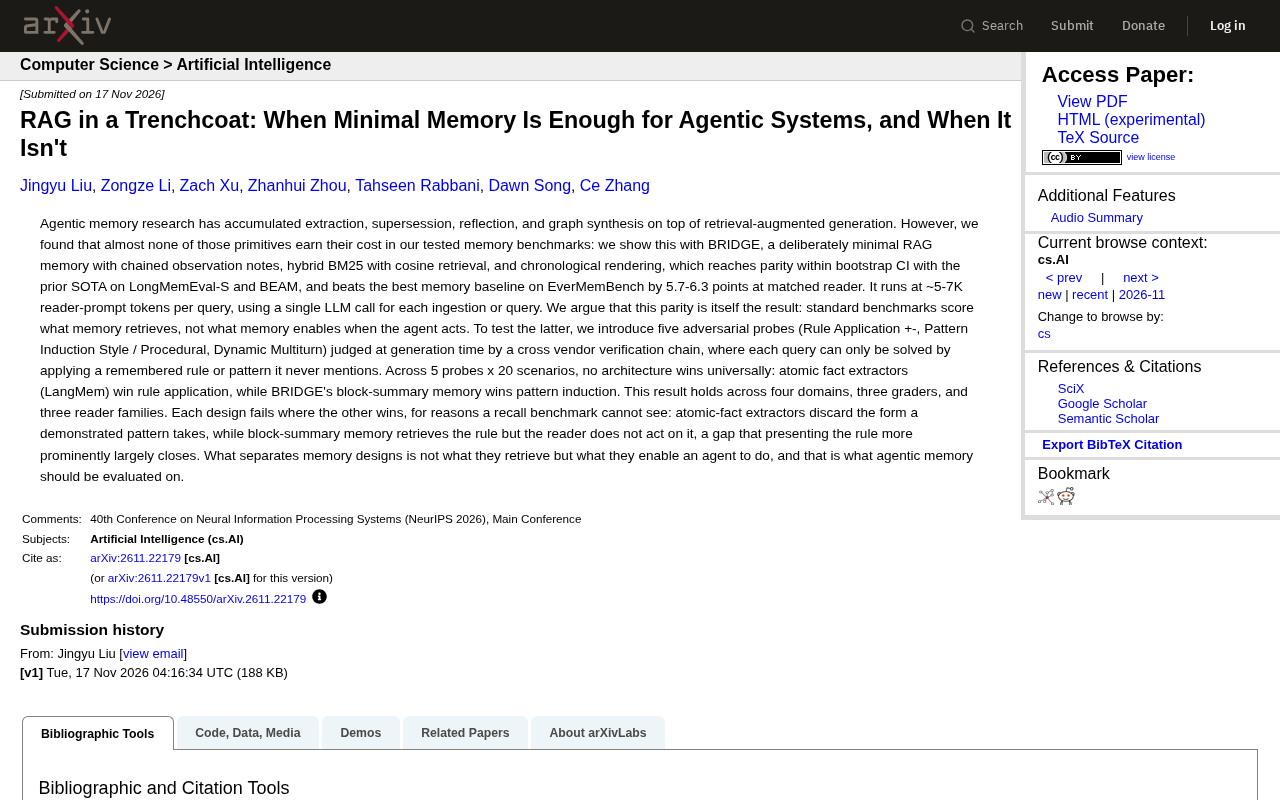
BRIDGE: Minimalism Under a "Trenchcoat"
BRIDGE is deliberately minimalist in design: chained observation notes, hybrid retrieval combining BM25 and cosine similarity, and chronological rendering. It consumes only about 5-7K reader prompt tokens per query and requires just one LLM call per ingestion or query. There is no complex extraction pipeline and no graph structure synthesis.
According to the research team's tests on multiple benchmarks, BRIDGE's performance is surprising: on LongMemEval-S and BEAM, it reaches parity with previous state-of-the-art (SOTA) methods within bootstrap confidence intervals; on EverMemBench, when matched with the same reader model, it outperforms the best memory baseline by 5.7-6.3 percentage points. This result directly challenges the intuition that "the more complex the memory system, the better."
The Blind Spot of Standard Benchmarks
The researchers point out that this "parity" is itself the result: standard benchmarks measure what memory retrieves, not what memory enables when the agent acts. In other words, existing benchmarks cannot distinguish the capability differences of different memory architectures in real tasks, because they focus only on recall and ignore how memory is used by the agent.
BM25 is a classic sparse retrieval algorithm that computes the relevance between a query and a document based on term frequency (TF) and inverse document frequency (IDF), and excels at exact keyword matching. Cosine similarity is commonly used in dense vector retrieval, measuring semantic similarity by computing the cosine of the angle between the query vector and the document vector. BRIDGE combines the two, balancing the precision of keyword matching with the generalization ability of semantic retrieval while keeping the system lightweight.
LongMemEval-S, BEAM, and EverMemBench are recently proposed benchmarks for evaluating agent memory. They typically construct multi-turn dialogue or long-document scenarios, require systems to answer queries based on historical information, and measure retrieval effectiveness with metrics such as recall and accuracy. However, these benchmarks mainly focus on "whether the correct information is retrieved" rather than "whether the retrieved information is effectively used by the agent for decision-making or action," making it difficult to distinguish the capability differences of different memory architectures in real tasks.
Adversarial Probes: The True Touchstone of Memory Design
To test the value of memory in agent action, the research team introduced five adversarial probes (Rule Application +-, Pattern Induction Style / Procedural, Dynamic Multiturn), judged at generation time by a cross-vendor verification chain. Each query can only be solved by applying a memory rule or pattern that was never explicitly mentioned.
In tests of 5 probes × 20 scenarios, no single architecture wins across all scenarios: atomic fact extractors (such as LangMem) win on rule application, while BRIDGE's chunk-summary memory performs better on pattern induction. This result holds across four domains, three graders, and three reader model families.
The Root of Failure Modes
The two designs each fail in the other's area of strength, for reasons that recall benchmarks cannot capture: atomic fact extractors discard the form presented by demonstration patterns, leading to failure in pattern induction; while chunk-summary memory retrieves the rule, but the reader model does not act on it—a gap that can be substantially narrowed by presenting the rule more prominently.
Atomic fact extractors (such as LangMem) decompose memory into independent fact triples or short sentences, facilitating precise retrieval and rule application, but may lose sequential patterns and formal structures in events or demonstrations. Chunk-summary memory retains larger-grained text chunks (such as dialogue fragments or document paragraphs), better capturing patterns and context, but may introduce noise and requires the reader model to have stronger reasoning ability to extract rules. The two form a trade-off in memory granularity.
The reader model refers to the LLM in a RAG system responsible for reading retrieved memory and generating the final answer or action. The effectiveness of a memory system depends not only on retrieval quality but also on whether the reader model can correctly understand and utilize the retrieved content. In BRIDGE's experiments, although chunk-summary memory retrieved the rule, the reader model did not follow it, indicating that the presentation of memory (such as highlighting rules) significantly affects the reader model's behavior—a key factor to consider when evaluating memory systems.
Multi-Source Validation and Consensus
According to the study and community analyses (such as discussions of related work by Bilibili creators and YouTube channels), several points of consensus are worth noting: first, standard memory benchmarks are insensitive to architectural differences and cannot guide design decisions; second, minimalist RAG can achieve performance comparable to complex systems on multiple benchmarks at lower cost; third, the evaluation of agent memory should shift to an "enablement" perspective, i.e., whether memory helps the agent act correctly.
Regarding points of divergence, the study also presents them honestly: atomic fact extractors have a clear advantage in rule application, while chunk-summary memory is stronger in pattern induction. Each has its applicable scenarios, and there is no universally optimal architecture.
Implications for Agent Memory Design
This study sends a clear signal: the value of a memory system should not be measured solely by retrieval metrics, but by whether it enables the agent to apply rules or patterns from memory when needed. Designers need to choose memory granularity based on task type—if the task involves explicit rule application, atomic fact extraction may be more suitable; if the task requires inducing patterns from examples, chunk-summary memory has an advantage.
BRIDGE does not aim to negate complex memory systems, but to remind us: before adding complexity, first confirm whether it actually improves agent behavior. After all, a "trenchcoat" is sometimes enough—as long as you know where it falls short.
One-line Summary
Minimalist RAG memory system BRIDGE challenges complex architectures and reveals that memory evaluation should shift to an "enablement" perspective.
Paragraph Summary
A new study proposes a minimalist RAG memory system, BRIDGE, which matches or even outperforms complex SOTA on multiple standard benchmarks at lower cost. The researchers point out that standard memory benchmarks only measure retrieved content and cannot reflect memory's ability to support agent action. Through five adversarial probe tests, they find no universally optimal architecture: atomic fact extractors excel at rule application, while chunk-summary memory excels at pattern induction, with failure modes stemming from design trade-offs. The study calls for agent memory evaluation to shift to an "enablement" perspective—whether memory helps the agent act correctly.
Related articles

Bambu P3C Five-Nozzle 3D Printer: Flagship Features at Half Price, But Not Quite What You'd Expect
Bambu P3C five-nozzle 3D printer costs $1,149, inheriting the flagship H3C's real-time multi-material switching and color mixing at less than half the price. We analyze its key highlights, gaps versus expectations, and market positioning.

Jensen Huang Reportedly Admitted Multiple Extramarital Affairs to Nvidia Board
According to The Wall Street Journal, Nvidia CEO Jensen Huang admitted to the board before his reinstatement that there were more extramarital affairs beyond the two already reported. This article covers the core of the incident, its potential impact on Nvidia's governance, and cross-verification of information from multiple sources.

AI Data Centers Build Their Own Gas Power Plants as Grid Bottlenecks Reshape the Energy Landscape
AI data centers turn to self-built gas power plants as grid interconnection delays mount. MIT Technology Review's The Download reveals the energy bottleneck behind compute expansion and urges conceptual restraint on consciousness debates.