MiniMax H3 in Action: 3 Pages of Comics, 28 Seconds of Animation
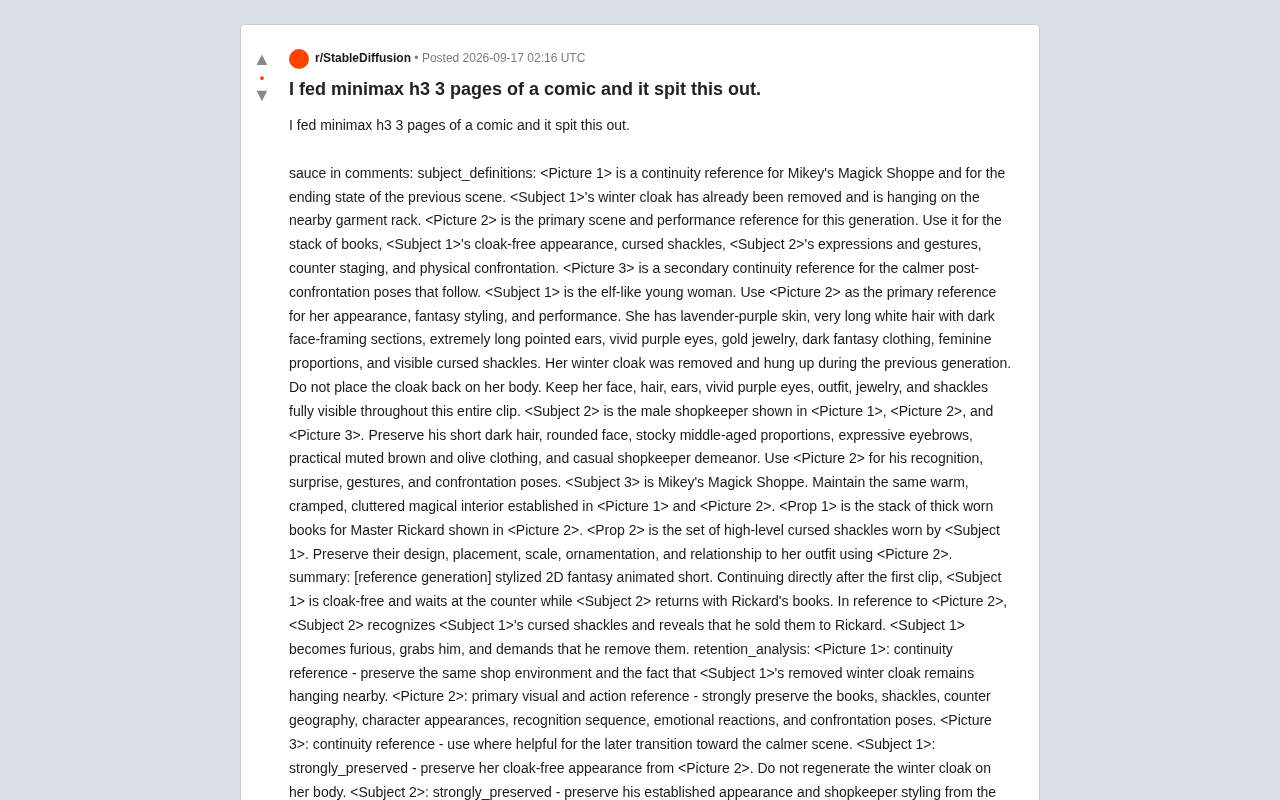
MiniMax H3 turns 3 comic pages into a 28-second animation, powered by director-grade structured prompting.
A Reddit user fed 3 pages of comics into MiniMax H3 and got back a 28-second 2D fantasy animated short. The real story isn't the result — it's the director-script-level prompt behind it: pre-defined character appearances, cross-shot retention rules, precise timecoded shot breakdowns, speaker mapping to prevent lip-sync errors, and even an emotional arc for the score. The case shows that the floor of AI video generation quality depends far more on how precisely you write your prompt than on model capability alone.
From Comics to Animation: An AI Generation Experiment Worth Paying Attention To
A Reddit user shared an interesting experiment using the MiniMax H3 model: feeding it just 3 pages of comics and getting back a coherent animated short. What sparked discussion wasn't how impressive the result was, but what it revealed about how AI video generation actually works — specifically, how current video models understand "continuity," "character consistency," and "performance direction."
Looking at the complete prompt the user made public, this was no one-liner. It was an extraordinarily detailed "director's script." Understanding that distinction is key to grasping the true capability limits of these tools.
The Prompt Is the Core: A Structured "Director's Script"
What's genuinely surprising is the complexity of the prompt engineering behind this generation. Rather than simply typing "turn these comics into animation," the user built a complete structured reference system, including:
- subject_definitions: Explicit definitions for every character, scene, and prop — for example, the elf woman (Subject 1) with her purple skin, extremely long pointed ears, purple eyes, gold jewelry, and cursed shackles; the shopkeeper (Subject 2) with short hair, a round face, and a middle-aged build.
- retention_analysis: Item-by-item annotations marking which elements need to be
strongly_preserved— such as the pile of old books, the cursed shackles, and most critically, a note that the character's winter cloak was removed in the previous scene and must not be regenerated on her. - detailed_description: Shot-by-shot breakdowns with precise timecodes divided into three shots (Shot 1/2/3), from 00:00.000 to 00:28.000, with every line of dialogue, every change in expression, and every action spelled out explicitly.
This approach essentially treats AI as an "executor" requiring precise instructions rather than a "creator" free to improvise. The lower bound of generation quality is largely determined by the precision of the prompt.
This kind of structured prompting has precedent in AI image generation, but it's considerably more complex for video because of the added temporal dimension. "Prompt Engineering" as a practical discipline centers on translating human intent into formalized language that a model can reliably interpret. Structured reference systems — like numbering characters as Subject 1 and Subject 2 — exist fundamentally to eliminate ambiguity, preventing the model from confusing pronoun references like "she" or "he" in multi-character scenes. The logic mirrors variable declaration in software development: define the entity first, then reference it in subsequent descriptions. MiniMax H3 is a video generation model from MiniMax, belonging to the current class of so-called "native video large models," in the same technical category as Runway Gen series, Sora, and Kling. Its core capability is synthesizing continuous-frame video directly from text or image input, rather than stitching together individual frames.
The Consistency Problem: The Hardest Part of AI Video
The character consistency the prompt hammers on repeatedly points to the biggest pain point in current AI video generation.
The user goes out of their way to repeat: "maintain full visibility of her face, hair, ears, purple eyes, clothing, jewelry, and shackles throughout the clip," dedicating an entire paragraph to preventing the cloak from being erroneously regenerated. This kind of "defensive prompting" reveals that even newer models still tend to slip up when it comes to maintaining consistent character appearance across shots.
Even more granular is the handling of speaker mapping. The prompt explicitly states that (s1) maps only to the elf woman and (s2) maps only to the shopkeeper, with a special note that "the listening character must not lip-sync the other character's lines." These constraints reflect a common failure point in dialogue animation — lip-sync mismatches. The author was clearly well-prepared.
The root cause of character consistency issues lies in how current video generation models work. Mainstream video generation models typically use a Diffusion Model architecture, re-sampling from noise with each generated frame. This means the model doesn't logically "remember" the precise appearance of the previous frame — it relies on attention mechanisms to maintain temporal coherence. When scene cuts occur, this coherence constraint weakens further, making appearance drift an acknowledged challenge in the field. "Defensive prompting" is a strategy that emerged from the creator community to compensate: using redundant, repeatedly emphasized language to explicitly tell the model what not to do, offsetting the model's inherent limitations in tracking cross-shot state. This phenomenon also illustrates that current models' "understanding" is fundamentally statistical correlation, not logical reasoning based on scene state.
Rejecting the Comics Look: Turning Static Panels Into Continuous Performance
One interesting design choice is that the author explicitly instructed the model not to generate any comics elements: no speech bubbles, thought bubbles, caption boxes, subtitles, sound effect text, panel borders, or comic frames. All dialogue is delivered purely through audio.
The prompt reads: "transform comic panel compositions into continuous cinematic action rather than static panels." This means the goal isn't the cheap effect of "making comics move," but genuinely using the comics as a reference to re-interpret the story as animation with actual performance and camera work.
The animation style is defined as "stylized 2D fantasy animation," emphasizing clean expressive linework, saturated colors, lively facial animation, and secondary motion in the ears and hair. These detailed requirements reflect a genuinely professional understanding of the language of animated performance.
"Secondary motion" is a professional animation term rooted in Disney's Twelve Principles of Animation. It refers to the delayed follow-through motion of attached objects or body parts due to inertia, gravity, or air resistance — hair flowing while running, earrings swaying, the trailing edge of a cape lagging behind the main movement. Secondary motion is a key marker distinguishing "cheap animation" from "animation with weight and texture": without it, characters look stiff and lifeless; with it properly executed, characters gain a sense of physical weight and vitality. In the context of AI video generation, explicitly requesting secondary motion in a prompt is essentially communicating to the model that the target output is animated performance with genuine physical presence, not simple keyframe interpolation. This detail suggests the user has a fairly professional background in animation.
Sound Design Was Carefully Planned Too
Easy to overlook: this prompt planned out the audio layer in detail as well.
The soundscape includes a warm shop atmosphere, creaking floorboards and shelves, the sound of books landing on the counter, rustling from fabric and jewelry, bottles clinking, and an emphasis on keeping dialogue "clear and prominent."
The non-diegetic music is designed with even more emotional precision: a light, whimsical fantasy score for the opening; a "recognition motif" when the shopkeeper notices the shackles; a "comedic dramatic accent" when the elf woman lunges toward the shopkeeper; and the music pulled back when the shopkeeper explains himself. This level of emotional arc design for the score is close to the standard of a professional storyboard script.
The distinction between diegetic and non-diegetic music comes from film sound theory. Diegetic music exists within the story world and can be heard by characters — like a song playing on a gramophone in the scene. Non-diegetic music exists only at the audience's perceptual level; characters "can't hear it" — it's a tool directors use to guide viewer emotion. Using the term "non-diegetic music" in the prompt, and designing corresponding emotional motifs for each narrative beat, means the author is planning AI output through a professional filmmaking framework rather than simply describing "background music." This transfer of professional cross-media language is also a key reason structured prompting works: the model's training data includes large amounts of film production text, so using industry terminology more precisely activates the corresponding generation patterns in the model.
What This Case Tells Us
Setting aside the quality of the generated result itself, the most valuable insight from this experiment is: AI video generation is moving from "hoping for the best" toward "deliberate control."
Whether a model can understand such complex structured input and produce coherent multi-shot, multi-character narrative with dialogue and emotional turns within 28 seconds directly determines how close it is to being a genuinely practical tool. Judging by the fact that the user was happy enough to post and share it, the result at least met their expectations.
For creators, this case also serves as a reference prompt template: stable, controllable AI animation doesn't come from luck. It comes from writing like a director — spelling out every continuity constraint, every line of dialogue, every emotional beat. The model sets the ceiling, but the floor of the result usually comes down to how clearly you've stated what you want.
Related articles
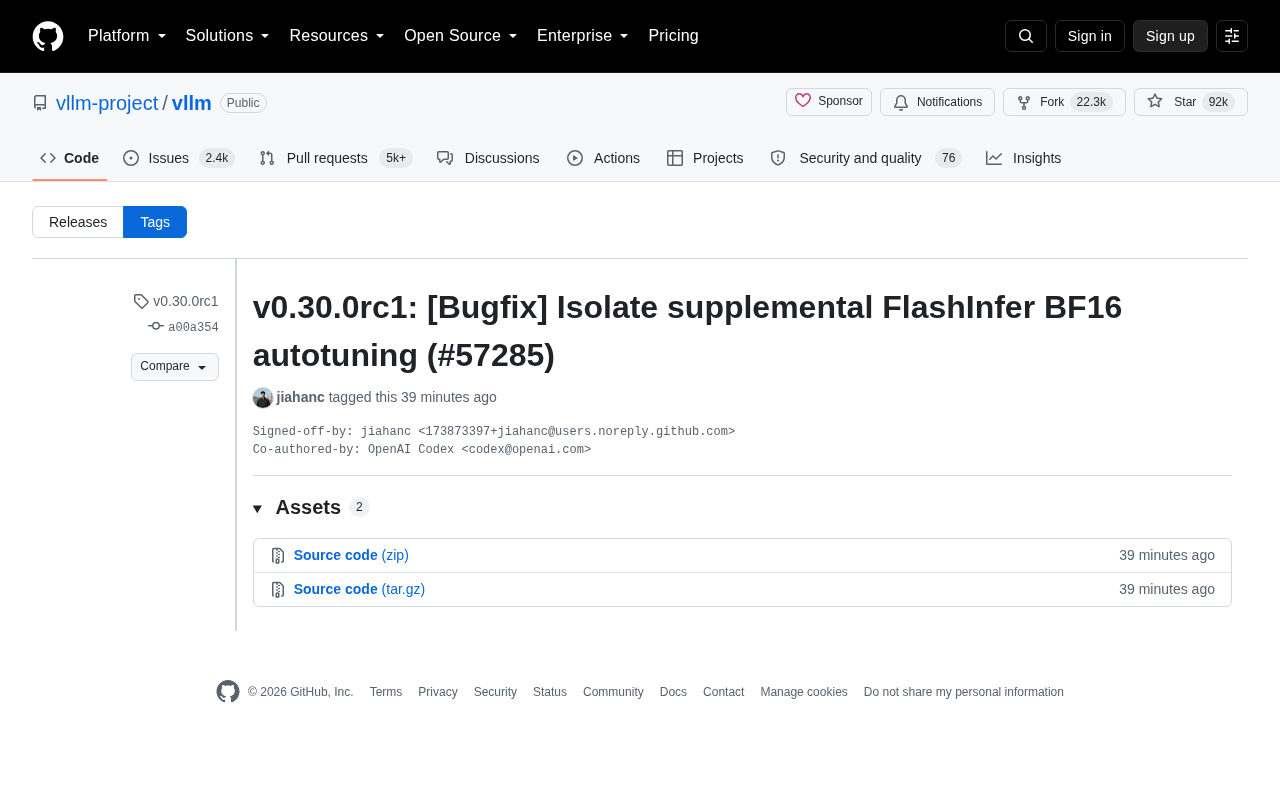
vLLM v0.30.0rc1 Released: Isolates FlashInfer BF16 Autotuning Logic
vLLM v0.30.0rc1 release candidate fixes FlashInfer BF16 autotuning isolation (PR #57285). Learn the technical background and its impact on inference deployment.

Comp AI Raises $34M Series A, Bets on Agentic Security Compliance
Comp AI raises $34M Series A led by Roo Capital and Grand Ventures, betting on "continuously agentic" AI to transform compliance from periodic audits into real-time monitoring.

MIT Technology Review's 35 Innovators Under 35: A Climate Tech Edition Explained
MIT Technology Review's latest 35 Innovators Under 35 list focuses on climate tech, spotlighting nine young global innovators. Here's what the list means and why it matters.