MiniMax H3 in Practice: Recreating the "Desktop Girl" Video with Ultra-Long Prompts
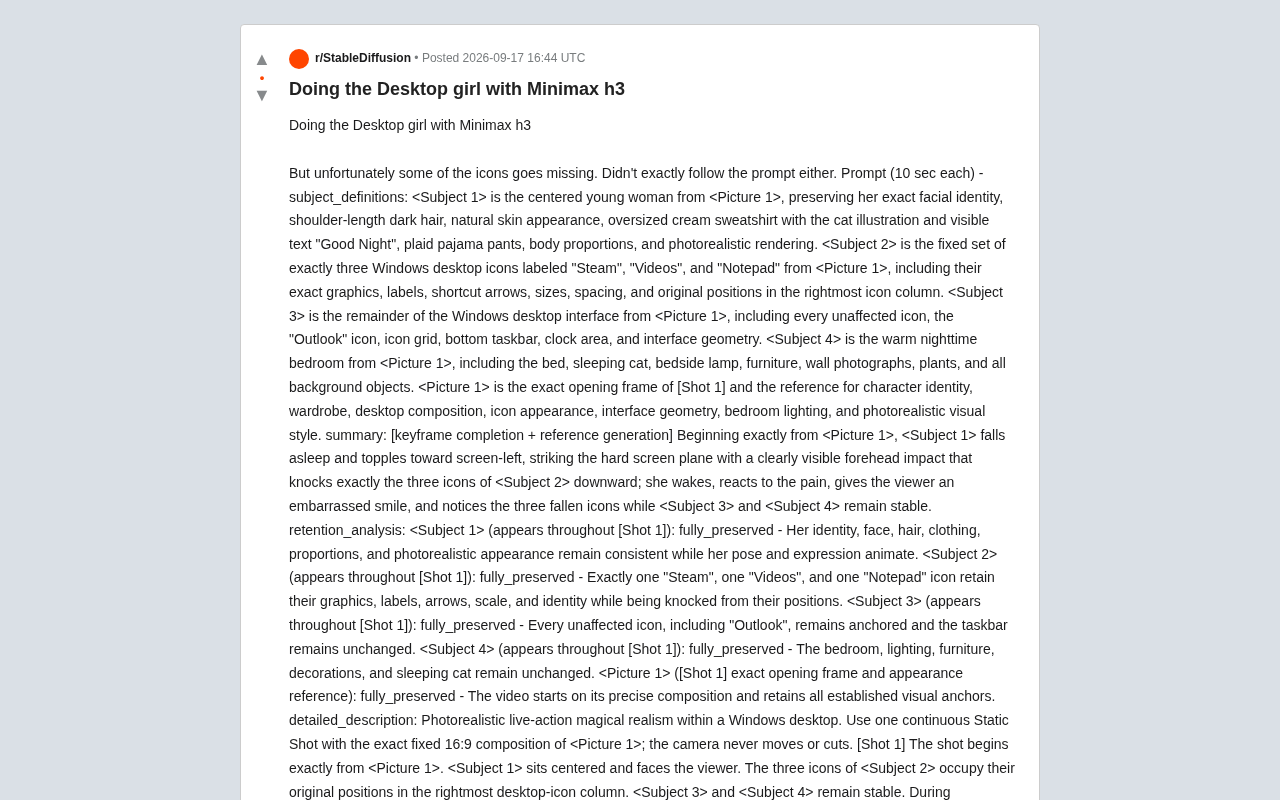
A Reddit user recreates "Desktop Girl" with MiniMax H3, exposing the real limits of AI video fine-grained control.
A Reddit user attempted to recreate the "Desktop Girl" short clip using MiniMax H3 — a woman dozes off, bumps the screen, scattering icons, then picks them up one by one. The standout feature was the prompt design: four layered subjects with retention checklists, millisecond-level action timelines, and sound design descriptions rivaling a professional storyboard. Due to the 10-second per-segment limit, the creator stitched two clips via segment continuation. Results were mixed: character consistency held up reasonably well, but desktop icons disappeared or distorted, and long prompts suffered from instruction decay — revealing two core weaknesses in today's AI video models.
An Ambitious AI Video Generation Experiment
Recently, a Reddit user shared the results of an experiment using the MiniMax H3 video model to recreate the "Desktop Girl" concept. The original idea is clever and charming: a young woman in a cream-colored hoodie printed with "Good Night" dozes off at her computer, tips forward, and bumps her head into the screen — knocking a few desktop icons loose. She then rubs her forehead, gives an embarrassed smile, and picks the icons back up one by one, returning them to their places. It's a miniature piece of "magical realism" playing out on a Windows desktop.
According to the creator's own assessment, the results were a mixed bag: the overall effect captured the spirit of the concept, but "some icons disappeared midway, and it didn't fully follow the prompt." This honestly illustrates the real limits of fine-grained control in today's AI video generation.
Prompt Engineering: An Input That Reads Like a Film Storyboard
What makes this experiment most worth examining is the prompt itself. Rather than a simple one-sentence description, it's a structured, near-professional storyboard — an ultra-long prompt for a video that's only 10 seconds per segment. The prompt is broken into multiple modules:
Subject Definitions
The creator broke the scene into four distinct "subjects" and locked each one down:
- Subject 1: The young woman centered in frame, with requirements to "preserve her exact facial identity, shoulder-length dark hair, cream-colored cat-print hoodie, plaid sleep pants, body proportions, and photorealistic rendering."
- Subject 2: Exactly three desktop icons — "Steam," "Videos," and "Notepad" — with explicit instructions to retain their graphics, labels, shortcut arrows, size, and spacing.
- Subject 3: The remaining unaffected desktop elements, including the "Outlook" icon, the icon grid, the taskbar, and the clock area.
- Subject 4: A warm nighttime bedroom background with a bed, sleeping cat, bedside lamp, wall photos, and plants.
This approach of "layered subjects + retention checklists (retention_analysis)" is essentially telling the model: what must change and what must never change. The author repeatedly emphasizes "fully_preserved," attempting to nail down every visual anchor point through language alone.
This "subject layering" approach borrows from the "layer separation" mindset used in professional visual effects (VFX) production. In traditional post-production, compositors handle foreground characters, interactive objects, and background environments separately, allowing precise control over each layer without disturbing the others. Applying this logic to prompt design is essentially simulating the concepts of "masking" and "locking layers" in natural language — forcing the model to distinguish between elements that "need to move" and elements that "must stay still." This is a genuine challenge for text-driven diffusion models, which have no explicit concept of object layering from training. They can only infer which tokens correspond to which pixels through the attention mechanism. Highly structured prompts are, in effect, indirectly steering the distribution of attention — not truly "locking" any visual region.
Frame-Level Timeline Control
Even more ambitious is the millisecond-precision action timeline embedded in the prompt. For example:
00:00.000–00:01.800: Blinking slows, eyelids close, jaw drops, enters sleep;00:01.800–00:03.350: Upper body tilts left in frame, forehead leading;00:03.350: Forehead strikes the screen, the interface shakes for two or three frames, knocking exactly three icons loose;00:03.600–00:12.000: Eyes open, rubs forehead, gives an embarrassed smile, looks down at the icons.
The creator even wrote sound design into the overall_soundscape: the low-frequency thud of a forehead hitting glass, three crisp click sounds as icons detach, digital static noise during the fall, and a startled inhale from the woman.
Segment Continuation: Seamlessly Joining Two 10-Second Clips
Because each generation is capped at 10 seconds, the creator used a segment continuation strategy. The integrated_multimodal_description in the second prompt explicitly states: "Seamlessly continue from the automatically inherited final second of the previous video clip — do not reset the scene, do not repeat the fall, do not replay the forehead impact, do not introduce a camera cut."
The core action in the second segment is the woman picking up each fallen icon and returning it to its spot — moving only one icon at a time, with "Outlook," "Notepad," "Videos," and "Steam" going back in sequence, followed by two fine-tuning adjustments with her fingertip, and finally a smile of relief tinged with lingering embarrassment. This sequence of "pick up — place back — align" places extremely high demands on the model's object consistency tracking.
Segment continuation (also called "video extrapolation" or "rolling generation") is a common engineering workaround for the single-generation time limit. The core idea is to use the last few frames of the previous clip as conditioning frames for the next, so the model treats the existing footage as an "anchor" and maintains character appearance, scene lighting, and motion continuity. However, this approach carries the risk of "error accumulation": if the end of the first segment already contains minor character distortion or scene drift, the second segment treats those errors as the "correct" baseline and continues from there, causing problems to compound across segments. Additionally, since each segment requires the model to re-interpret the prompt, it may sometimes interpret "do not reset the scene" as permission to make subtle resets. This is why the author explicitly listed prohibited behaviors in the second prompt — a form of defensive prompting.
Why Do Icons "Disappear"? Revealing the Model's Weaknesses
The two problems the creator mentioned — icons disappearing and the prompt not being fully followed — are classic pain points for current video models:
First, maintaining consistency for small objects. Desktop icons are small elements within the frame, and the model struggles to reliably "remember" their exact shapes, label text, and positions across multiple rendered frames. When dynamic events occur — like the woman's head moving or icons falling — the model tends to merge, distort, or simply drop icons from existence. The author's repeated instructions to "do not duplicate, merge, morph, disappear" in the prompt reveal exactly where the model most commonly fails.
Second, instruction decay with long prompts. When a prompt contains dozens of precise constraints, the model typically cannot deliver on all of them. The more details specified — the exact timing of a physical impact, the number of frames the interface shakes, the synchronization of sound effects — the greater the gap between actual output and text description. In short, writing a more detailed prompt does not mean the model executes it more accurately.
From a technical standpoint, both problems are rooted in the underlying architectural characteristics of current video generation models. Leading AI video models (including those based on diffusion Transformer architectures) do not maintain an explicit "scene state graph" when generating consecutive frames — they cannot track "icon A is currently at coordinates (x, y)" the way a game engine would with an object list. Each frame's generation relies on an implicit understanding of preceding frames. As frame count increases, fine details of small objects from early frames tend to be gradually "smoothed out" in latent space, causing icons to visually dissolve or disappear. Researchers refer to this as "temporal consistency degradation" — one of the core challenges in video generation today, and an area that techniques like ControlNet and object-tracking guidance are actively working to address.
What This Experiment Teaches Us
Despite its imperfections, this experiment offers substantial reference value. It demonstrates a "write the prompt like a screenplay" approach: through subject layering, retention checklists, millisecond-level timelines, and sound design descriptions, the creator worked to minimize the model's room for improvisation. For creators who demand precise control, this structured writing style is worth studying.
At the same time, the experiment serves as a reminder: today's AI video models are already quite capable when it comes to photorealistic character consistency (the woman's face, clothing, and movements), but they still fall notably short when handling precise physical interactions between multiple small objects (icons being knocked down and then painstakingly returned one by one). The full realization of a creative vision is often constrained by these seemingly small but critically important details.
For users looking to try similar ideas, a practical suggestion: break down complex physical interactions, simplify them, or lower your expectations for icon-level precision. Stabilize the main subject and scene first, then gradually layer in more detail.
Related articles

Waymo Restarts San Antonio Operations: Back on the Road Five Months After Flood Incident
Waymo resumes San Antonio Robotaxi service ~5 months after a vehicle was swept away in flooding. A look at what happened, why it took so long, and what it means for AV safety in extreme weather.
What Is AIOps? How AI Is Reshaping IT Operations
AIOps applies AI and machine learning to IT operations for anomaly detection, alert noise reduction, and root cause analysis — shifting teams from reactive to proactive.

CCC Sends Its Invitation: 40C3 Hacker Congress Themed "Model Citizens"
CCC announces its 40th Chaos Communication Congress (40C3) under the theme "Model Citizens," inviting hackers worldwide to examine surveillance and algorithmic governance.