MiniMax H3 Real-World Test: 3-Step Sampling for a Full-Song Lip-Sync Music Video
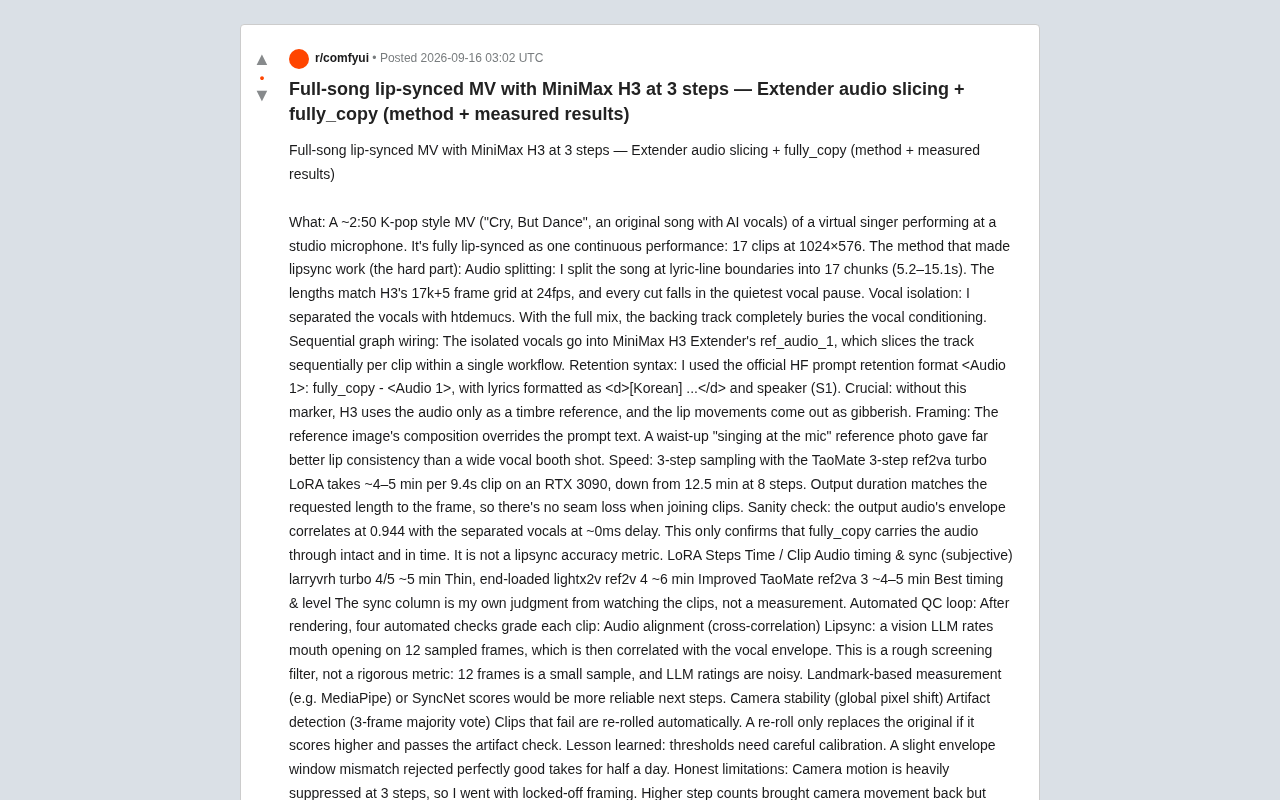
Complete MiniMax H3 Extender workflow for a lip-synced K-pop AI music video, from audio slicing to automated QC.
A Reddit creator documented their full pipeline for generating a 2:50 K-pop style AI music video with MiniMax H3 Extender. The core lip sync challenge was solved through three key steps: isolating vocals with htdemucs, slicing audio at lyric boundaries, and using the official fully_copy retention syntax. TaoMate's 3-step turbo LoRA delivered the best timing at ~4–5 min per clip on an RTX 3090, though at the cost of suppressed camera motion. The author found reference image composition more effective than text prompts for locking in framing, and built an automated QC loop covering audio alignment, lip scoring, stability, and artifact detection — while honestly documenting all trade-offs.
A Reddit creator shared a complete workflow for producing a full K-pop style AI music video using MiniMax H3 Extender. The roughly 2-minute-50-second piece, Cry, But Dance, follows a virtual singer performing at a studio microphone — lip-synced throughout, with continuous performance — stitched together from 17 clips at 1024×576. The author doesn't just show the finished product; they break down lip sync — "the hardest part" — in considerable depth, with reproducible methodology and real benchmark data.
The Core of Lip Sync: Audio Slicing and Retention Syntax
Getting the lips to actually match the audio is the trickiest part of the whole project. The author's first step was splitting the audio at lyric sentence boundaries, cutting the full song into 17 segments ranging from 5.2 to 15.1 seconds. These lengths precisely match H3's "17k+5 frame" grid at 24fps, and every cut point falls on the quietest vocal pause, avoiding any seams during splicing.
Vocal isolation is equally critical. The author used htdemucs to separate vocals from the mix — using the full mix directly would have the backing track completely drowning out the vocal conditioning signal, causing lip sync to fail. The isolated clean vocals are fed into MiniMax H3 Extender's ref_audio_1 interface and sliced sequentially by segment within a single workflow.
The most easily overlooked yet decisive element is retention syntax. The author uses the official HuggingFace prompt retention format <Audio 1>: fully_copy - <Audio 1>, with lyrics written as <d>[Korean] ...</d> and speaker labeled (S1). He emphasizes: without this tag, H3 treats the audio only as a timbre reference and lip movements become "gibberish." This is the prerequisite that makes the entire approach work.
htdemucs is Meta's open-source source separation model (Hybrid Transformer Demucs), based on a hybrid frequency-time domain architecture that splits a mixed track into four signals: vocals, drums, bass, and other instruments. Compared to earlier tools like Spleeter, it offers higher fidelity on vocal edge details (such as breath sounds and trailing notes), making it the go-to tool for precise lip-driving scenarios. In this workflow, the separated clean vocals retain full phoneme timing information, allowing H3 Extender to accurately identify the mouth-opening motion for each syllable. Skipping this step and using the full mix directly contaminates the conditioning signal with drum hits, synthesizers, and other frequencies — the attention mechanism in lip prediction can no longer accurately locate the vocal energy envelope, resulting in severe misalignment between mouth movements and lyrics.
Reference Image Composition Overrides Text Prompts
A counterintuitive finding: the composition of a reference image overrides text prompt descriptions. After comparing approaches, the author notes that a waist-up reference photo of someone "singing in front of a microphone" delivers far better lip consistency than a wide studio shot. In other words, rather than describing the shot in words, using a reference image with the right composition directly locks in the performance framing.
This insight has direct value for creators working on digital humans or virtual singers: shot language should be determined at generation time through a reference image, not relied upon through post-processing or prompt tweaking.
Speed Benchmarks: 3-Step Sampling and LoRA Comparison
Speed is another key factor for scaling this workflow. Using TaoMate's 3-step ref2va turbo LoRA on an RTX 3090, generating a 9.4-second clip takes only about 4–5 minutes — a major speedup compared to 12.5 minutes with 8 steps. More importantly, output duration aligns precisely to the frame with the requested length, so there's no seam loss during splicing.
The author also provides a side-by-side comparison of three LoRAs:
| LoRA | Steps | Time per Clip | Audio Timing & Sync (Subjective) |
|---|---|---|---|
| larryvrh turbo | 4/5 | ~5 min | Thin, energy concentrated at the end |
| lightx2v ref2v | 4 | ~6 min | Improved |
| TaoMate ref2va | 3 | ~4–5 min | Best timing and volume balance |
He notes that the sync column reflects his personal subjective judgment after watching the clips, not measured results. On objective metrics, the cross-correlation between the output audio envelope and the separated vocals reached 0.944 with ~0ms delay — but the author honestly clarifies this only proves that fully_copy passed the audio through completely and in sync; it is not a measure of lip sync accuracy.
LoRA (Low-Rank Adaptation) is a lightweight fine-tuning technique for large diffusion models: by injecting small low-rank decomposition matrices alongside the original weight matrices, it alters the model's generative behavior by training only a tiny fraction of parameters, without degrading the base model's capabilities. In video generation, ref2v-type LoRAs are specifically optimized for "reference image to video" tasks, while TaoMate's ref2va goes further by incorporating audio signals as a condition — a variant of joint visual-audio guidance. "Turbo" versions compress inference to 3–5 steps through distillation or consistency training, at the cost of reduced stochastic exploration space, which manifests as suppressed camera motion — which is precisely why the author chose a fixed camera angle. Different LoRAs vary in how they weight audio timing signals, which directly determines whether lip movement energy is distributed evenly across the timeline or concentrated toward the end.
Automated Quality Control Loop
After rendering, the author built four automated checks to score each clip: audio alignment (cross-correlation), lip sync (scoring mouth openness across 12 sampled frames using a visual LLM, then correlating with the vocal envelope), camera stability (global pixel displacement), and artifact detection (3-frame majority vote). Clips that fail are automatically regenerated, and the replacement only sticks if the new clip scores higher and passes the artifact check.
The author is clear-eyed about the limitations of this loop: the lip sync score is only a "rough filter" — 12 frames is too small a sample and LLM scoring is inherently noisy. More reliable approaches would use landmark-based measurement like MediaPipe or SyncNet scores. He also mentions a hard-learned lesson: thresholds need careful calibration; a minor envelope window mismatch once caused perfectly good clips to be falsely rejected for half a day.
SyncNet is a deep learning model specifically designed to evaluate lip sync quality in video, outputting a sync score by comparing the visual features of mouth regions in video frames against the corresponding audio's MFCC (Mel-frequency cepstral coefficient) features. It is widely used in academic lip sync benchmarking. MediaPipe is Google's open-source real-time computer vision framework; its FaceMesh module can precisely track 468 facial landmarks per frame — including fine upper and lower lip movements — to compute a time series of mouth opening and closing. Compared to the visual LLM scoring approach used here, both tools offer advantages in being quantifiable, reproducible, and free from linguistic ambiguity. However, they have their own limitations: SyncNet was primarily trained on English data and its generalization to Korean phonemes hasn't been thoroughly validated; MediaPipe's landmark accuracy degrades noticeably at low resolutions or side-profile angles, and the 1024×576 clips used in this workflow sit right at the boundary.
Honest Limitations
To the author's credit, they don't shy away from the drawbacks. With 3-step sampling, camera motion is heavily suppressed — hence the choice of a fixed camera; increasing steps recovers camera movement but damages vocal fidelity. Secondary latent 3D upscaling significantly improves skin texture but slows generation by roughly 12×, so it was abandoned. Lip sync is workable overall but not perfect — phonemes occasionally drift on fast syllables.
This candid documentation of trade-offs is more useful than simply showcasing the finished product. It reveals the real tensions in current AI video generation between speed, camera dynamics, and lip sync accuracy, and gives creators looking to attempt similar workflows a clear picture of the boundaries. The author hasn't shared workflow files but has offered to answer questions about the setup. The full method credits MiniMax H3 Extender (tritant), TaoMate-H3 3-step turbo (TaoLiveAIGC, converted by Kijai), and lightx2v turbo LoRA.
Related articles

Letting AI Build AI Tools: A 7-Day, 31-Commit Bootstrapping Post-Mortem
An engineer ran a fully autonomous AI-builds-AI pipeline for 7 days, 31 commits, with a 1-in-6 success rate. This post-mortem covers 5 failure types, 11 structural rules, and how every mistake became a permanent immunity gate.

Building an AI-Powered E-Commerce Business from Scratch: A Real-World Account of Multi-Agent Architecture for Print-on-Demand
A blogger builds a print-on-demand e-commerce company from scratch using AI agents — documenting specialized Agent profiles, GPT-5.6 vs Claude Fable multi-model orchestration, and reusable skill accumulation.

AI Agent Earns $10K in One Week: 3 Key Upgrades Explained
A blogger shares how he earned $10K in a week with an AI Agent — not by adding more skills, but through verification, approval gates, and subagents to raise trust and enable true automation.