MiniMax H3 Team AMA Full Breakdown: What's Coming Next and What's Still Broken

MiniMax H3 AMA reveals upcoming 2K regeneration, sparse attention, image model, and acknowledged model flaws.
The MiniMax H3 team held a Reddit AMA confirming several upcoming features: a 2K regeneration model that semantically redraws video at higher resolution, sparse attention code for faster generation on existing hardware, a dedicated image model with a new decoder, and a full technical report. They also candidly acknowledged model defects including distant object blurring, detail graininess, softer reference-to-video output, and visible clip stitching seams.
Recently, the MiniMax H3 video generation model team held an AMA (Ask Me Anything) on Reddit's r/StableDiffusion community, responding to over 400 comments one by one. r/StableDiffusion is one of the largest open-source image/video generation communities on Reddit, filled with developers and creators who actually deploy models — their questions tend to cut straight to engineering pain points rather than surface-level spec comparisons. AMA is Reddit's signature interactive format where a party opens a thread to accept unrestricted community questions. Due to its unscripted, unfiltered nature, AMAs often reveal more real information than official blogs or launch events. Compared to press-release-style announcements, these Q&As tend to expose a model's true state — what's vaporware, what's actually shipping, and what flaws the team themselves acknowledge. This article systematically distills the key information from that AMA.
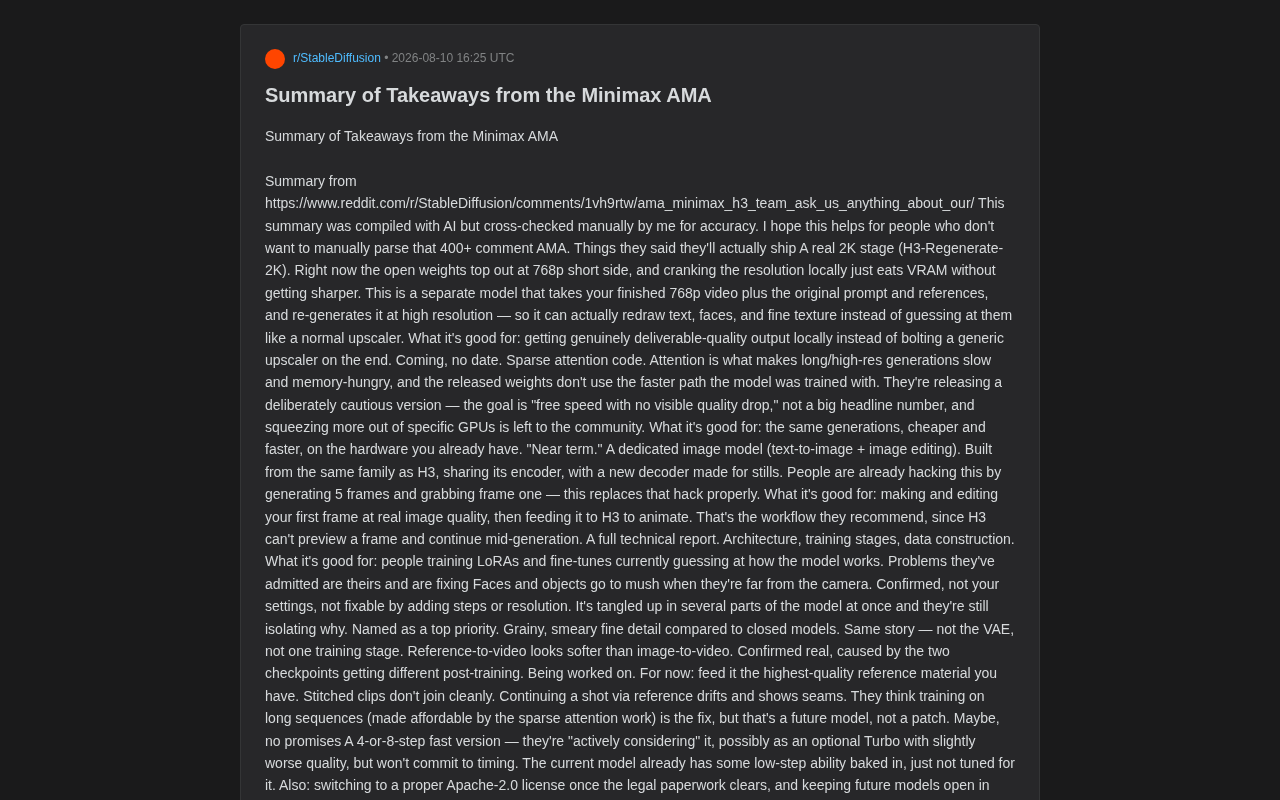
Features Confirmed for Shipping
This is the highest-value section of the AMA, as the team explicitly stated these features will land — not remain at the conceptual stage.
H3-Regenerate-2K: True 2K Video Regeneration
Currently, H3's open-source weights cap out at 768p on the short side. Forcing higher resolution locally only eats VRAM without producing sharper output. To address this, the team plans to release a standalone model called H3-Regenerate-2K. Its approach is fundamentally different from conventional upscaling tools: it takes your already-generated 768p video along with the original prompt and reference materials, then regenerates the footage at high resolution.
Traditional super-resolution tools like Real-ESRGAN or Topaz Video AI essentially perform interpolation and texture completion on existing pixels — they cannot create semantic information that doesn't exist in the original image. H3-Regenerate-2K follows a "conditional regeneration" paradigm: it uses the low-resolution video as structural guidance and, combined with the original text prompt and reference images, re-executes the diffusion process in high-resolution space. This means the model can redraw text strokes, facial proportions, and material textures based on semantic understanding rather than mechanically upscaling existing pixels. Academically, this approach is similar to ControlNet-guided inpainting but specifically optimized for video temporal consistency.
In other words, it doesn't simply interpolate and enlarge pixels — it can genuinely redraw text, faces, and fine textures instead of guessing details like a generic upscaler. For creators, this means producing truly deliverable-quality final output locally without needing to bolt a generic upscaler onto the end of the pipeline. The model is described as "coming soon" with no specific date.
Sparse Attention Code: Faster Generation on Same Hardware
Attention mechanisms are precisely why long-duration, high-resolution generation is slow and VRAM-hungry. Standard Transformer full attention requires every token in every frame to compute association weights with all tokens across all other frames, yielding O(n²) computational complexity where n is the total token count. As frame count increases or resolution rises, n explodes, causing quadratic growth in both memory usage and computation time.
Sparse Attention limits each token to attending only a subset of other tokens (such as adjacent frames, keyframes, or similar tokens selected via hash bucketing), reducing complexity to approximately O(n log n) or even O(n). Common implementations include Sliding Window Attention, Dilated Attention, and Ring Attention.
The currently released weights don't enable the faster paths used during model training. The team stated they will release a deliberately conservative version targeting "free speed gains without visible quality loss" rather than chasing impressive performance numbers — leaving GPU-specific optimizations to the community. The team's "deliberately conservative version" means they'll select a sparsity pattern where quality loss is virtually imperceptible, avoiding quality controversies from aggressive compression.
Simply put: the same generation task will run faster and cheaper on your existing hardware. This feature is slated for "near-term" release.
Dedicated Image Model and Technical Report
Standalone Text-to-Image + Image Editing Model
This may have the biggest workflow impact. The team will release a dedicated image model from the same H3 family, sharing H3's encoder but equipped with an entirely new decoder designed for static images.
Modern generative models typically use an encoder-decoder architecture where the encoder maps inputs (text, images) to latent space representations and the decoder restores them from latent space to visible pixels. H3's video model encoder has already learned powerful visual semantic understanding, while its decoder is specifically optimized for video temporal coherence. The new image model shares the same encoder (reusing semantic understanding capabilities) but features a new decoder optimized for single-frame static images — meaning it can dedicate all decoding capacity to spatial detail rather than temporal coherence, surpassing the "generate video and grab first frame" hack in single-frame quality. This architecture reuse strategy also ensures the image model and video model have consistent semantic understanding of the same prompt, making the "image first, then video" workflow semantically seamless.
Why does this matter? The community is currently using a hack: generating a 5-frame video and grabbing the first frame as an image. The new image model will properly replace this workaround. The team's recommended standard workflow is: first use the image model to create and edit the first frame to true image-level quality, then feed it to H3 for animation. Since H3 itself cannot preview a single frame and then continue generating from there, "lock the frame first, then animate" is the officially endorsed path.
Full Technical Report Coming
The team has committed to publishing a complete technical report covering architecture, training stages, and data construction. For developers currently guessing their way through LoRA training and model fine-tuning, this will drastically reduce the cost of experimentation.
Officially Acknowledged Model Defects: It's Not Your Settings
The rare candor in this AMA was the team directly confirming several issues inherent to the model itself, explicitly telling users "this isn't a parameter tuning problem on your end."
Distant Faces and Objects Blur Together
When faces or objects are far from the camera, they blur out. The team confirmed this is a model defect — adding more steps or increasing resolution won't fix it. The problem is entangled across multiple parts of the model. The team is still identifying root causes but has listed it as one of their highest priorities.
Detail Graininess and Smearing
Compared to closed-source models, H3's fine details tend toward graininess and smearing. The team has ruled out the VAE and any single training stage as the cause, acknowledging this as a systemic defect that needs solving.
The VAE (Variational Autoencoder) plays a critical role in current mainstream video generation models by compressing pixel space into latent space. The diffusion process actually operates in the low-dimensional latent space after VAE encoding, then the VAE decoder restores it to full-resolution video frames. If the VAE itself introduces information loss (such as high-frequency texture loss or color quantization errors), the final output will be limited regardless of how good the diffusion model is. The team ruled out the VAE as the root cause of graininess and smearing in the AMA, meaning the problem likely lies in the diffusion model's training data distribution or noise scheduling strategy — a deeper systemic issue.
Reference-to-Video Looks "Softer" Than Image-to-Video
This is a specific technical detail: reference-to-video output looks softer than image-to-video. In the video generation stack, Image-to-Video (I2V) takes an image as a deterministic first frame and generates continuous motion forward from it; Reference-to-Video (Ref2V) uses the reference image as style/content guidance but doesn't require pixel-level consistency between the output video's first frame and the reference image. The latter gives the model more freedom but also means it must balance "faithfulness to reference" against "creative liberty."
The reason is that the two checkpoints underwent different post-training — specialized fine-tuning stages performed after base model training, where training data quality standards and objective function design directly affect output sharpness. The team is working on it; the current recommendation is — feed the highest quality reference materials possible.
Visible Seams When Stitching Clips
Using reference images to extend shots produces drift and visible seams. Most current video generation models are limited by VRAM and compute costs, with training clip lengths typically at 2-5 seconds. When users need longer videos, they can only stitch multiple clips via "last frame to first frame" connections. But since each generation is an independent diffusion process, clips inevitably exhibit brightness drift, color shifts, and motion discontinuity.
The team believes training on longer sequences is the solution (this depends on the aforementioned sparse attention work making training costs bearable), but this belongs to future model iterations rather than something a patch can fix. The true solution is using longer video sequences (30+ seconds) during training so the model learns long-range temporal dependencies — this is precisely where sparse attention shines, which explains why the team discusses these two issues together.
Features Under Consideration but Not Promised
The team gave vague "actively considering" responses to several highly requested features:
- 4-step or 8-step fast versions: May be released as an optional Turbo mode with slight quality tradeoffs, but no timeline commitment. Such fast generation is typically achieved through Consistency Distillation or Progressive Distillation, where the core idea is training a "student" model to reproduce the "teacher" model's multi-step sampling results in very few steps. The typical cost is reduced detail diversity and occasional artifacts. Stable Diffusion XL Turbo and SDXL Lightning are successful examples in the image domain, but video distillation is significantly harder due to the additional complexity of the temporal dimension. The team indicated the model already has "built-in low-step capability," suggesting its noise scheduling may already be partially optimized for few-step sampling but hasn't undergone dedicated distillation training.
- Switching to Apache-2.0 license: Will switch once the legal process is complete, and stated they intend to keep future models open-source overall.
Things Not Happening Anytime Soon
Finally, the team directly rejected two common requests:
A smaller, lighter H3. The team has no plans for a lite version, instead suggesting the community prune the existing weights themselves.
Low-resolution draft + same-seed high-resolution re-run. This path simply doesn't work — noise changes with frame dimensions, and the model's low-resolution quality actually degraded during the process of training toward higher resolution, so the two don't correspond at all. Specifically, in diffusion models, the initial noise shape must strictly match the target output's spatial dimensions — a 512×512 noise tensor and a 1024×1024 noise tensor have completely different spatial frequency distributions even with the same random seed. The deeper issue is that the model learns different denoising strategies at different resolutions: high-resolution training teaches the model to handle finer spatial frequency components, and in this process the low-resolution generation path effectively gets "forgotten." Therefore, no deterministic correspondence exists between low-resolution previews and high-resolution final generation.
Conclusion
This AMA presented a relatively pragmatic open-source team stance: clear roadmap items (2K regeneration, sparse attention, image model, technical report) alongside unflinching acknowledgment of current hard problems (distant blurring, detail graininess, soft reference output, stitching seams). For creators and developers evaluating H3, the three most practical takeaways are — use the highest quality reference materials, follow the "lock the frame first, then animate" workflow, and wait for the upcoming 2K regeneration model for truly deliverable-quality output.
Related articles

Felix Rieseberg Personal Homepage
Felix Rieseberg's personal homepage sparks attention on Hacker News. This article covers the Slack engineer's technical background, the rise and fall of nativefier, and the value of a developer homepage as a tech calling card.

@ai-sdk/vue 3.0.306 Patch Release Syncs with [email protected] Update
@ai-sdk/vue 3.0.306 released, synced with [email protected]. A routine patch release for the Vercel AI SDK ecosystem with no public API changes; the Vue adapter layer stays version-aligned with the core package.

Gemini 4 Argon API Launches: The Era of Million-Token Output Begins
Google launches Gemini 4 Argon with sparse MoE architecture, up to 1M output tokens, and a 68.90% Vals Index score, available across API, AI Studio, and the Gemini app.