MiniMax M2.7 Hands-On Review: Coding Ability Rivals Claude Opus at 50x Lower Cost

MiniMax M2.7 achieves Claude Opus-level coding at 1/50th the cost after 100 rounds of autonomous evolution.
MiniMax released M2.7, a next-gen agentic model scoring over 56% on SWE-bench Pro and other benchmarks, rivaling Claude Opus 4.6 in coding and agent capabilities—but at just 1/50th the input cost ($0.30 per million tokens). The model underwent 100+ rounds of autonomous self-evolution without human intervention, achieving 30% performance gains. Hands-on tests show it outperforming Opus 4.6 in complex scenarios including MacOS system generation, slot machine games, and Gold Miner games, making it one of the best cost-performance AI coding models available today.
The MiniMax team recently released M2.7, their next-generation agentic AI model. This model delivers impressive results across multiple benchmarks, with coding and agent capabilities rivaling top-tier model Claude Opus 4.6—at just 1/50th the cost. What's even more noteworthy is that M2.7 underwent over 100 rounds of autonomous self-evolution without any human intervention, achieving a 30% performance improvement. This article provides an in-depth breakdown of the model's real-world capabilities through multiple practical test cases.
Benchmark Results: M2.7 Goes Head-to-Head with Top Models
M2.7 delivers an impressive scorecard across multiple authoritative benchmarks:
- SWE-bench Pro: A high score of 56.22%, rivaling Claude Opus-level performance and even surpassing Gemini 3.1 Pro
- VEPro Test: End-to-end project delivery score of 55.6%
- Terminal Bench 2: A score of 57%, demonstrating deep system-level understanding
These benchmarks carry significant weight in the AI coding domain. SWE-bench, developed by a Princeton University research team, is a software engineering benchmark specifically designed to evaluate AI models' ability to solve real Issues in actual GitHub repositories—not simple code completion tasks. SWE-bench Pro is its advanced version, featuring more complex cross-file modifications and system-level debugging tasks, widely regarded as the gold standard for measuring AI coding agents' real-world capabilities. The VEPro (Verified End-to-end Project) test focuses on end-to-end project delivery, requiring models to complete the full loop from requirements understanding to final code output. Terminal Bench 2 evaluates a model's ability to perform system-level operations in terminal environments, including file management, environment configuration, and proficient use of command-line toolchains. These tests matter because they simulate real developers' daily work scenarios rather than isolated academic programming problems.
The model possesses over 50 foundational skills and more than 100 specialized skills, maintaining consistent instruction following and reliable tool-calling capabilities. Unlike typical models, M2.7 doesn't just generate text—it can formulate plans, break tasks into multiple steps, and leverage various skills to execute complex tasks spanning research, structured processing, and even presentation creation.
Price Comparison: Input Cost at 1/50th of Claude Opus
One of M2.7's most powerful advantages is its pricing strategy:
| Item | Price |
|---|---|
| Input | $0.30 per million tokens |
| Output | $1.20 per million tokens |
| Context Window | 204K |
To understand what this pricing means, you need to understand the cost structure of large models. In the commercial ecosystem of large language models, tokens are the basic unit of text processing measurement—roughly 1-1.5 tokens per English word, and approximately 1.5-2 tokens per Chinese character. Model providers typically charge separately for input tokens and output tokens, with output prices being higher because text generation requires more computational resources (involving a step-by-step decoding process). The context window refers to the maximum number of tokens a model can process in a single conversation—204K means it can process approximately 150,000 Chinese characters at once, which is crucial for analyzing large codebases or lengthy documents. The Claude Opus series is priced at approximately $15 per million input tokens, making M2.7's $0.30 pricing a genuine order-of-magnitude cost advantage. This price differential primarily stems from differences in model parameter scale, inference architecture optimization, and infrastructure costs.
According to official data, M2.7's input cost is a full 50x cheaper than Claude Opus, while achieving GLM5-level intelligence at less than one-third the cost. For faster response times, a speed mode is available, though costs double accordingly. The 204K context window is ideal for handling lengthy and complex business workflows.
Access methods are highly diverse: you can choose token packages or coding packages, pay-as-you-go, or use the official chatbot for free. It also supports API access through platforms like OpenRouter or the Kilo CLI tool. Combined with complimentary free credits, you can get started at zero cost.
Test 1: MacOS-Style Operating System Generation
The first test used Kilo CLI—an open-source AI coding agent that runs in the terminal. Kilo CLI is similar to AI coding tools like Cursor and Windsurf, but centers on a command-line interface (CLI), making it better suited for developers comfortable with terminal operations. The advantage of CLI mode is direct interaction with the operating system's file system, enabling real-time code writing, compilation, and execution. OpenRouter is an API aggregation platform that unifies interfaces from multiple AI model providers under a single API, allowing developers to switch between different models with minimal integration overhead. The rise of such tools marks AI coding's evolution from "assisted completion" to an "autonomous agent" paradigm.
The test prompt was to create a MacOS-style browser system.
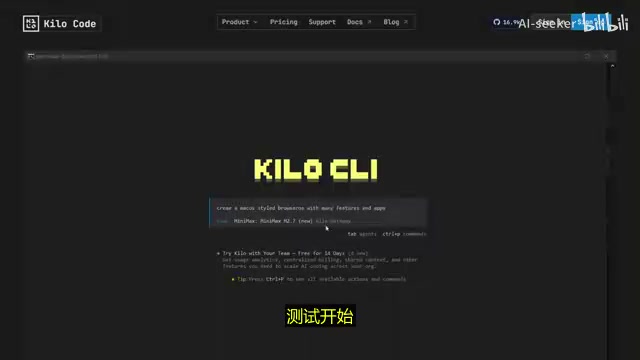
The MacOS-style operating system generated by M2.7 was stunning: settings allow freely changing desktop backgrounds, all applications support dynamic interactive effects, and every app opens and functions properly. This MacOS-style system received a 9/10 rating.
Notably, M2.7 excels particularly in structured workflows. In a presentation generation case, it impressively organized KPIs and global electric vehicle market analysis, covering market size, leading companies, and growth forecasts.
Test 2: Dynamic Landing Page & Minecraft Clone
The next test required generating a dynamic landing page with multiple properties, including various shader rendering and dynamic effects.
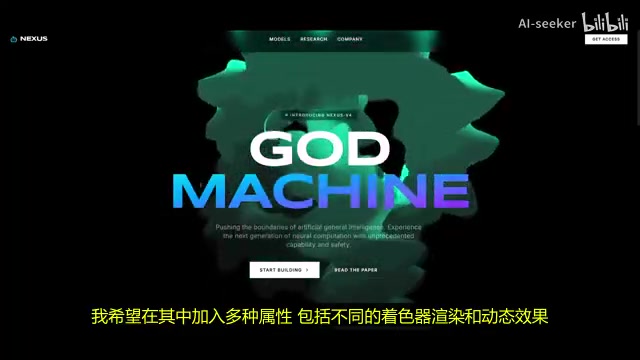
M2.7 performed excellently, producing a fully functional landing page with multiple features, and the final page result was quite impressive. Based on test results, M2.7's front-end development capability represents a quantum leap over previous model generations, comparable to top-tier models like Opus 4.0.
Even more surprisingly, M2.7 successfully generated a Minecraft clone, complete with all textures, water effects, terrain generation, and even an inventory system. While block mining isn't yet possible, the ability to generate infinite terrain is already remarkable. Additionally, in a simple butterfly generation test, M2.7 not only completed the modeling but automatically added animation effects, earning an 8/10 rating.
Test 3: Slot Machine Game—The Ultimate Interactive Logic Test
This test required generating a slot machine game with spinning reels, testing the model's ability to build interactive state-driven systems.
A "state-driven system" is a core architectural pattern in front-end and game development. State-driven means every visual aspect of the application is determined by underlying state data: for instance, a slot machine's "idle state," "spinning state," "winning state," and "payout state"—each state transition requires strict logical control. The challenge for AI models is that they must not only generate visually correct UI code but also construct complete state machine logic, handle asynchronous animation timing, random number generation algorithms (ensuring fair odds), and seamless transitions between multiple states. This capability far exceeds simple HTML/CSS page generation, requiring the model to simultaneously demonstrate comprehensive understanding of front-end rendering, algorithm design, and user experience design.

M2.7's generated slot machine includes complete functionality: lever-pull animations, symbol matching, winning line highlights, payout table references, coin payout animations, and jackpot celebration effects. This involves not just animation rendering but also writing logic for randomized winning mechanisms across various prizes, delivering complete visual feedback.
For comparison, Claude Opus 4.6 in deep thinking mode generated far inferior content—no animations, no randomized winning outcomes, just a basic slot machine layout. In this round, M2.7 definitively outperformed Opus 4.6.
Test 4: Gold Miner Game—The Ultimate Comprehensive Capability Showcase
The final test required generating a casual cartoon-style Gold Miner game, and the results exceeded all expectations.
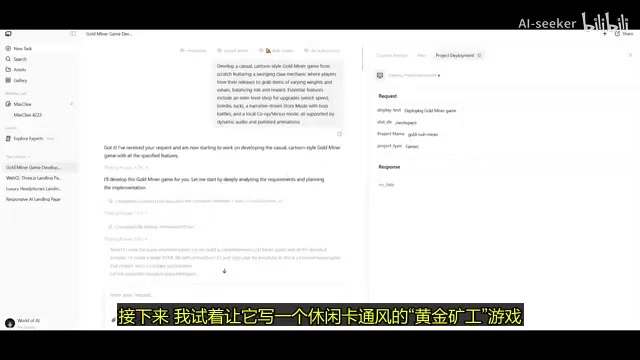
The generated game is feature-complete: adjustable background music and sound effect volumes, support for story mode, arcade mode, versus mode, and two-player co-op mode. In story mode, you click to start playing—the hook can grab gold from anywhere on the map for points, and you can enter a shop to upgrade various mining systems. This level of game generation capability fully demonstrates M2.7's comprehensive strengths in complex interactive logic, state management, and UI design.
Autonomous Evolution: 100 Rounds of Iteration Without Human Intervention
M2.7's most revolutionary feature is its autonomous self-evolution capability. The model underwent over 100 rounds of autonomous iteration without any human intervention, achieving a 30% performance improvement. This means it can not only execute tasks but also build, improve, and self-iterate on AI systems.
From a technical perspective, Autonomous Self-Evolution is one of the cutting-edge directions in current AI research. Traditional model training relies on human-annotated data and Reinforcement Learning from Human Feedback (RLHF), while autonomous evolution lets the model generate its own training data, evaluate output quality, and iteratively optimize itself. Specifically, this process typically involves: the model automatically generating tasks and their solutions, filtering high-quality samples through built-in verification mechanisms (such as code compilation pass rates and test case coverage), then using these samples for self-fine-tuning. Over 100 rounds of iteration means this "generate-verify-learn" cycle was repeated more than 100 times. The core challenge of this approach is avoiding "model collapse"—where the model gradually loses diversity during self-training and falls into repetitive outputs. The 30% performance improvement indicates that the MiniMax team achieved significant breakthroughs in preventing collapse and maintaining evolutionary direction, representing a key technical moat that distinguishes this model from competitors.
This capability makes M2.7 particularly well-suited for:
- Complex multi-agent system construction: Smoothly handling multi-agent collaboration scenarios. Multi-Agent Systems are one of the hottest technical paradigms in the AI application layer for 2024-2025. Unlike a single model handling all tasks, multi-agent architecture distributes complex tasks among multiple specialized AI Agents, each responsible for a specific domain (such as code writing, test verification, documentation generation), collaborating to complete end-to-end workflows. M2.7's capability in this area means it can serve not just as a single executor but also as the "brain" within a multi-agent system, coordinating and managing other agents' work—offering extremely high practical value in enterprise automation scenarios.
- Advanced productivity workflow automation: Handling real-world tasks like financial modeling, log analysis, and code refactoring
- Code security & ML pipelines: Outstanding performance in security auditing and machine learning engineering
- Android development: Supporting complete mobile development workflows
Conclusion: The Best Cost-Performance AI Coding Model Available Today
As a next-generation agentic model, MiniMax M2.7's coding and agent capabilities are sufficient to rival top-tier models like Claude Opus 4.6. While its parameter scale is clearly smaller, it shows no weakness in building, managing, and optimizing complex multi-agent systems. Considering its extremely low usage cost and excellent performance, M2.7 is undoubtedly one of the best cost-performance AI coding models currently available.
For developers, it's highly recommended to try it hands-on through tools like Kilo CLI—combined with free credits, you can experience M2.7's capabilities at zero cost. Whether it's front-end development, game generation, or complex business workflow processing, M2.7 demonstrates truly impressive capability levels.
Key Takeaways
- MiniMax M2.7 scores above 56% on multiple benchmarks including SWE-bench Pro, rivaling Claude Opus-level performance
- Input cost is 50x cheaper than Claude Opus at just $0.30 per million tokens, with 204K context window support
- Underwent 100+ rounds of autonomous self-evolution without human intervention, achieving 30% performance improvement
- Outperformed Opus 4.6 in hands-on tests across MacOS system generation, game development, and dynamic landing pages
- Supports multiple access methods including free official chatbot, OpenRouter API, and open-source tools like Kilo CLI
Related articles
 Product Reviews
The Programmer's Desk Setup Guide: Building a Workspace That Feels Like Home
Discover how programmers build productive, comfortable workspaces. From multi-monitor setups to ergonomic design, explore the desk philosophy that drives focus and flow.
 Product Reviews
Qoder vs Cursor Real-World Comparison: Which $20/Month AI IDE Is Better?
Hands-on comparison of Qoder vs Cursor AI IDEs: Agent autonomy, human interaction count, and architecture decisions. Qoder needed only 2 interactions vs Cursor's 8.
 Product Reviews
Cursor Cloud Agent Demo: Eliminating Bottlenecks Across the Entire Software Development Lifecycle
Deep analysis of Cursor's Cloud Agent demo showing how cloud VMs, automated test artifacts, and a full-chain control plane systematically eliminate human bottlenecks across the software development lifecycle.