MiniMax-M3.1-Flash Coming Soon: Official Teaser Draws Community Attention

MiniMax teases M3.1-Flash release, with the community speculating a faster, lighter optimized version.
MiniMax officially teased the upcoming release of its next-generation model MiniMax-M3.1-Flash via X, without disclosing parameters, performance data, or a timeline, sparking immediate Reddit discussion. The article summarizes the limited available information, noting that the "Flash" suffix typically implies faster inference or a lighter deployment form, and that M3.1-Flash may be positioned to retain core capabilities while optimizing speed and cost. Community focus centers on long-context, multimodal capabilities, and API optimization, though all performance claims remain speculative. The article also analyzes MiniMax's product logic and reminds developers to await official details on context window, latency, and pricing.
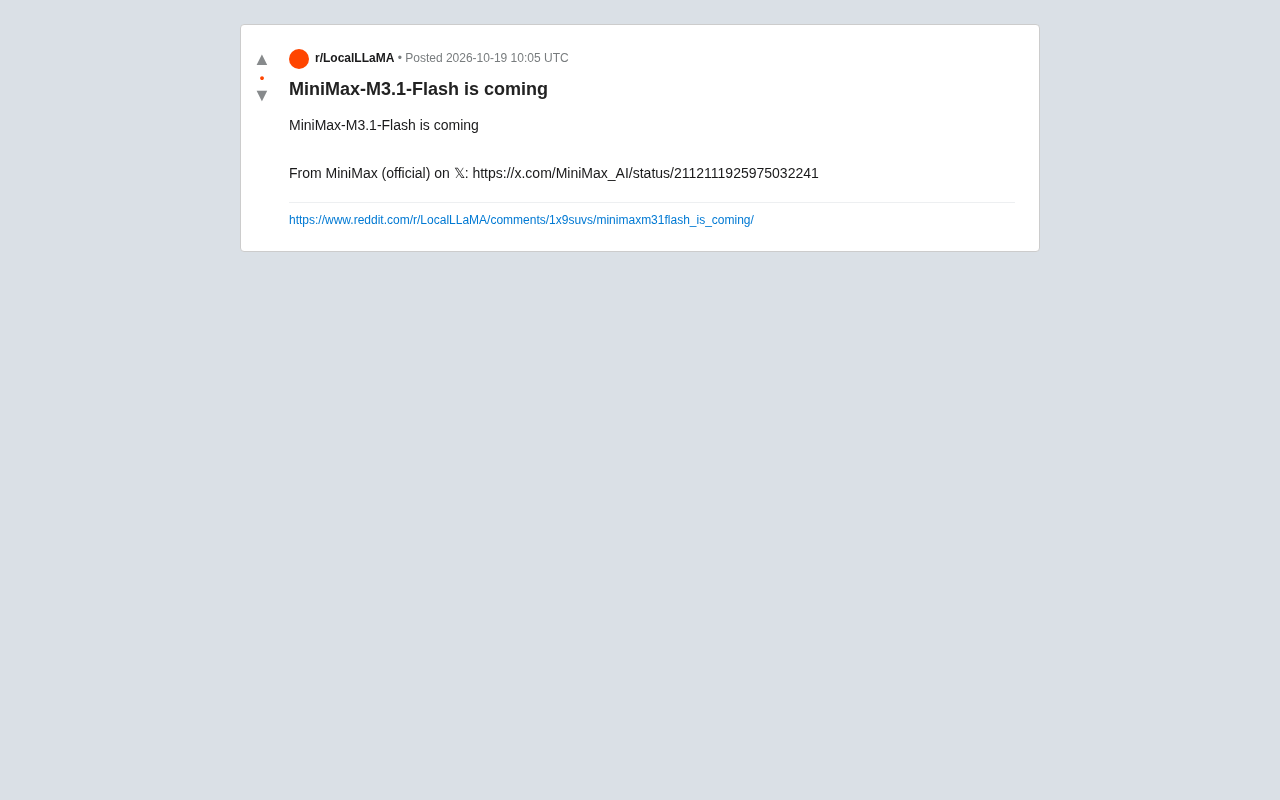
According to a teaser from the Reddit community and MiniMax's official post on X, MiniMax is about to launch its next-generation model, MiniMax-M3.1-Flash. The brief official tweet quickly sparked discussion in the relevant Reddit threads, with users beginning to speculate about the technical improvements and application potential this new model might bring.
What Does the Official Teaser Reveal?
Based on the information currently available, MiniMax's official account confirmed the existence of MiniMax-M3.1-Flash through a single X tweet, using the phrasing "is coming." The tweet itself did not include detailed parameter specifications, performance comparisons, or a release timeline, which means users and developers can currently only make reasonable inferences based on the naming convention.
The "Flash" suffix in the current model naming ecosystem typically implies faster inference speed or a more lightweight deployment form factor. Combined with MiniMax's previous product layout within its model family, M3.1-Flash is likely positioned as a version that retains core capabilities while optimizing response speed and cost efficiency.
In large model naming conventions, suffixes often carry clear engineering implications. Take "Flash" as an example—Google's Gemini series was the first to use it to emphasize low-latency, high-throughput lightweight versions, and since then multiple vendors have adopted similar semantics, pointing to product forms that trade model distillation, quantization, or inference architecture optimization for faster response times and lower per-call costs. These variants typically do not significantly alter the underlying architecture, but rather make trade-offs at the serving layer—for instance, sacrificing some complex reasoning capability in exchange for stability and concurrency capacity. Therefore, when MiniMax applies "Flash" to M3.1, a reasonable interpretation is that it has been engineered for high-frequency API calls and real-time interaction scenarios, rather than representing a generational leap in capability.
Community Reactions and Speculation
Discussion on Reddit exhibits the typical characteristics of early leaks: limited information but clear expectations. Community users are mainly focused on several aspects—whether the new model will continue MiniMax's strengths in long-context processing, whether it will make breakthroughs in multimodal capabilities, and whether the Flash version signals further optimization for API call scenarios.
Since the official benchmark data has not yet been released, all current claims about the magnitude of performance improvements remain speculative. Some users in the community have also cautioned that various rumors should be treated with skepticism until the official release of complete technical details.
The Product Logic Behind the Naming
If M3.1-Flash is placed within MiniMax's recent model iteration rhythm, a relatively clear pattern emerges: the main version is responsible for pushing the upper limit of capabilities, while suffixed variant versions are tailored for specific use cases. If the Flash series follows this logic, its target users are likely developers who are sensitive to latency and product teams that need to call model capabilities at scale.
This strategy is not uncommon in the current large model competitive landscape. Multiple vendors are deriving models of different specifications from the same base to cover the full spectrum from research experiments to production deployment. MiniMax's choice to introduce a Flash variant at the M3.1 version number may suggest that the base model architecture has stabilized, with the focus now shifting toward engineering and scenario adaptation.
The practice of "deriving multiple specifications from the same base" is often referred to in the industry as a model family strategy. Its core is to train a base model with a larger parameter count, then derive versions of different sizes and positioning through continued pre-training, instruction fine-tuning, distillation, or quantization, thereby covering the full spectrum of needs from offline research and complex reasoning to high-concurrency production deployment. The advantage of this approach is shared underlying capabilities and evaluation systems, reduced maintenance costs, and the ability for developers to flexibly select models based on the triangle of latency, cost, and capability. Observing MiniMax's introduction of a Flash variant on M3.1 can be understood as a signal that, with the base architecture having stabilized, the product focus is shifting from "capability ceiling" to "engineering usability and scenario adaptation."
Information Worth Watching For
For developers and technical decision-makers, the truly important information will be revealed at official launch: including specific context window sizes, inference latency metrics, API pricing strategy, and comparative performance against other models at the same tier. Until then, this teaser is better understood as a signal release—MiniMax is expanding its model product line, and the Flash version is about to become available.
It is recommended to follow MiniMax's official channels and the relevant Reddit communities for the latest updates to obtain first-hand release information. We will also provide in-depth analysis as soon as the official detailed specifications are announced.
One-line Summary
MiniMax teases the upcoming release of M3.1-Flash, with the community speculating it is positioned as a faster, more lightweight optimized version.
Paragraph Summary
MiniMax officially teased the upcoming launch of its next-generation model MiniMax-M3.1-Flash via X, but did not disclose parameters, performance data, or a release timeline, prompting immediate discussion in the Reddit community. This article summarizes the currently limited information, noting that the "Flash" suffix typically implies faster inference speed or a more lightweight deployment form factor, and that M3.1-Flash may be positioned as a version that retains core capabilities while optimizing response speed and cost efficiency. Community focus centers on long-context, multimodal capabilities, and API scenario optimization, but all performance claims remain speculative. The article also analyzes MiniMax's product logic of "main versions breaking through capability ceilings, suffixed variants optimizing for specific scenarios," and reminds developers to wait for official information on context window, latency metrics, and pricing.
Related articles

Workbuddy for Absolute Beginners: How a Desktop AI Agent Fits Into Real Workflows
A beginner's guide to the Workbuddy desktop AI agent: installation, claiming credits, file management, and building automated workflows—compared with CodeX for fit and cost, helping professionals shift from AI question-askers to AI managers.

OpenAI's New Agent Stack: Computer Use, Decisions API, and Ultra-Fast Workflows
OpenAI Dev Day unveiled a new agent stack: Computer Use outperforms humans, Decisions API delivers ultra-low-latency classification via Luna, Agents API opens the same Computer Use capabilities, and GPT-6.1 Sol costs only one-seventh of Astra. Core updates, benchmark data, and developer insights.

Liang Wenfeng Open-Sources DeepInfo Inference Framework, Takes On U.S. Ban
DeepSeek open-sources its DeepInfo inference framework after its models, featuring GPU/CPU cross-pipelining, small-model prediction with large-model verification, and full Huawei Ascend and NVIDIA chip support—facing the U.S. federal ban head-on. This article analyzes its significance for AI deployment and open-source strategy.