LLM Interview Focus Shifts to Agents: Harness Engineering and Langfuse Tracing Become Must-Know Topics

2026 LLM application interviews shift to agent engineering; multi-agent, Harness, and evaluation are must-ask topics.
Based on an instructor's aggregated student interview reports, this article notes that 2026 LLM application interviews have shifted from rote memorization and Python syntax details toward AI agent engineering. Multi-agent architecture, Harness engineering, and agent tracing/evaluation are the three high-frequency must-ask areas. Enterprises find single agents insufficient for complex business, making multi-agent collaboration and orchestration real engineering challenges. Tracing and evaluation questions drill into tool call failures, token management, and quality regression after prompt upgrades, with tools like Langfuse appearing frequently. If a resume includes enterprise agent experience, security mechanisms (skill security, data and file permissions) are threshold requirements. The article also reminds new graduates to prepare for algorithm tests and advises learning only what JDs require—grab a spot first, deepen later.
The LLM Interview Landscape Has Changed
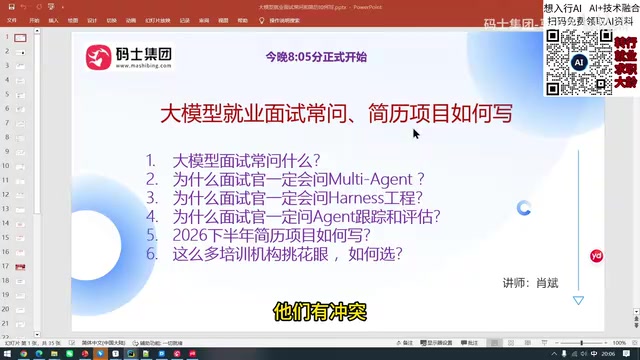
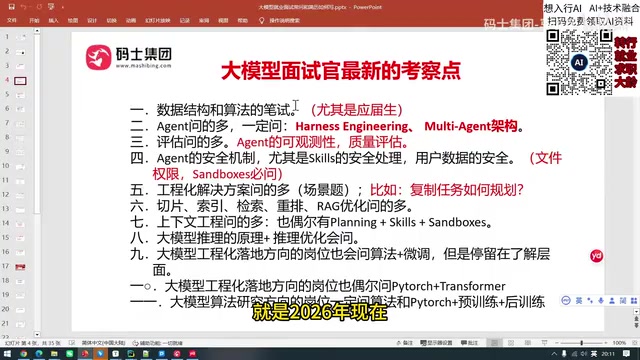
If you're still grinding through rote memorization and Python syntax minutiae, you may already be off track from what today's LLM job interviews actually test. According to a Bilibili instructor who has long tracked student interview feedback, the focus of 2026 LLM application interviews has clearly shifted toward AI agent engineering capabilities—particularly three areas: multi-agent architecture, Harness engineering, and agent tracing and evaluation.
During a livestream, the instructor candidly shared that he has collected a large volume of firsthand interview reports from students, and is especially familiar with the situation for new graduates and those with under three years of experience. His judgment was blunt: learn whatever the interviewer asks. Syntax details and garbage collection mechanisms—topics that came up in interviews just two years ago—have essentially faded from the interview scope since 2025.
Why These Three Areas Have Become Mandatory Topics
Multi-Agent and Harness Engineering
Interviewers will definitely ask about multi-agent systems, and they will definitely ask about Harness engineering—the instructor emphasized both repeatedly. The reasoning isn't complicated: when enterprises deploy agents, a single agent often can't handle complex business scenarios. The real engineering challenges lie in multi-agent collaboration, orchestration, and conflict handling. Harness engineering, meanwhile, involves how to reliably integrate model capabilities into actual systems—a core part of engineering implementation.
The instructor's advice: don't fill your resume with too much single-agent content. Save space for multi-agent architecture and Harness-related engineering practice.
Harness engineering in the agent context refers to the entire "carrier and driver" framework built around a model, including prompt organization, tool/function registration and invocation, context and memory management, parsing and validation of model outputs, failure retry and fallback, and logging instrumentation of the execution process. The model itself is only responsible for reasoning and generation; what really determines whether an agent can run stably in production is this peripheral engineering layer. Harness can be understood as the agent's "runtime skeleton": it glues model capabilities to external tools, data, and business systems, and is responsible for fallback when model outputs are unstable. When enterprises emphasize Harness engineering in interviews, they are essentially testing whether candidates can wrap an unreliable model into a reliable system—not just whether they can write prompts.
Agent Tracing and Evaluation
This area is asked about very intensively, and it goes beyond conceptual-level "how to evaluate an agent." Interviewers will drill into specific scenarios: What do you do when a tool call fails? How do you manage tokens? After an agent goes live, as prompts are continuously upgraded and skills keep being added, how do you ensure quality evaluation of new versions? These are all real engineering scenario questions.
The instructor specifically mentioned that tracing and evaluation tools like Langfuse appear very frequently in interviews, and recommended steering your resume in that direction.
Langfuse is an open-source observability platform for LLM applications, commonly used for agent tracing and evaluation. Its core capabilities include: recording the inputs, outputs, and latency of each step in a request (model calls, tool calls, retrieval, etc.) in a tree structure to form a traceable trace; version management and online comparison of prompts; support for human annotation or automated scoring (such as LLM-as-judge) to perform regression evaluation of new versions; and statistics on token consumption and cost. Mentioning such tools in interviews is often about testing whether candidates understand "how to continuously observe quality after an agent goes live, locate failure chains, and evaluate performance fluctuations caused by version iterations"—not just whether they know what features the tool has.
Agent Security Mechanisms
If your resume mentions experience developing agents in an enterprise, security questions are mandatory. Assessment points include skill security issues, user data security, and how file permissions are designed. The instructor used the word "mandatory" to describe this, indicating it's not a bonus item but a threshold requirement.
Skill in the agent context usually refers to a packaged capability unit that an agent can invoke on demand, possibly corresponding to a tool function, a domain workflow, or a prompt template. Skill security risks mainly come from several aspects: first, skills may carry permissions such as file read/write, network requests, and command execution—once induced by malicious prompts or untrusted input, they may cause unauthorized operations; second, if a skill's source is untrusted, malicious logic may be implanted; third, as the number of skills grows, permission boundaries can easily spiral out of control. Common protection approaches include the principle of least privilege, manual confirmation or sandbox isolation for high-risk skills, validation and audit logging of inputs and outputs, and restricting the set of callable skills by role.
New Graduates Still Face Algorithm Written Tests
It's important to distinguish: agent-focused assessment mainly targets application and engineering implementation roles. For new graduates or candidates with under three years of experience, data structures and algorithms written tests or interviews still appear with relatively high probability. The instructor's exact words were "I'll only say this once," reminding new graduates not to completely abandon algorithm fundamentals just because agents are hot.
Grab a Spot First, Deepen Later
There was a rather pragmatic piece of advice in the livestream worth highlighting separately. Facing people job-hunting during graduation season, the instructor's strategy was: quickly compare against LLM job JDs on the market, learn only what the job requirements specify, get an offer first to secure an LLM position—even if the salary is temporarily lower—and then fill in the gaps while working after joining.
His reasoning is realistic: the top priority for engineering professionals is to solve engineering problems, not to grind through everything from first principles. The technology you'll actually use at work doesn't necessarily have to be fully learned before the interview—catching up within one or two weeks after joining is fine. This sounds utilitarian, but for job seekers with tight time windows, having a sense of direction matters more than perfectionism.
How to Adjust Your Resume
Based on the interview trends the instructor revealed, resume adjustments can follow a few main threads: downplay standalone single-agent project descriptions and highlight multi-agent collaboration and Harness engineering experience; make agent observability concrete, including tracing, evaluation, prompt version management, and handling quality fluctuations caused by skill iteration; if enterprise-level deployment is involved, clearly describe the security mechanism design. Scenario questions like complex task planning should also be prepared in advance—interviewers may present a business scenario on the spot and ask you to break it down live.
Note that the above content comes from a single instructor's livestream sharing and aggregated student feedback. It is empirical judgment rather than official statistics, and readers can cross-verify with their own interview experiences.
Background Supplement
LLM-as-judge is a commonly used automated scoring method in agent evaluation: a more capable model acts as the judge, scoring or comparing the outputs of the model under evaluation according to predefined criteria. It is suitable for open-ended tasks that are difficult to measure with exact matching (such as answer quality or whether tool calls are reasonable), and costs less than human annotation—but it suffers from the judge model's own biases, position preferences, and sensitivity to prompts. In engineering practice, it usually requires human-annotated samples for calibration, clearly designed rubrics, and combination with rule-based metrics (such as tool call success rate and task completion rate) to avoid misjudgments caused by relying on a single automated score.
Related articles

DiDi Open-Sources X-Helix: Making AI Coding Tools Truly Understand Enterprise Java Microservices
DiDi open-sources X-Helix, an AI coding engineering framework that adds a standards layer on top of Claude Code and Codex to solve compilation failures and missed internal method calls in enterprise Java microservice projects, with knowledge accumulation and team reuse.

From Vibe Coding to Enterprise-Grade: A Practical Guide to Engineering with Claude Code + Codex
A Bilibili hands-on tutorial: using Claude Code and Codex to go from Vibe Coding and Plan Mode to engineering enterprise e-commerce projects with Super Power, plus tool selection and model comparison.

Claude Code Advanced Guide: 10 Tips to Stop Approving Manually
Based on The Benmore Brief's Claude Code tutorial, 10 practical tips: from Auto mode, effort levels, and side chats to phone remote control and scheduled tasks—stop approving every step.