MiniMax Raises API Prices by 60%-65%: China's LLM Price War Reaches a Turning Point

MiniMax hikes API prices 60%-65%, signaling the end of China's LLM price war era.
MiniMax has announced a 60%-65% increase in its API service prices, part of a broader wave of price hikes across Chinese LLM providers. After nearly two years of aggressive price competition, rising compute costs, tighter funding, and investor pressure for profitability are driving providers toward rational pricing. Developers are advised to diversify across multiple models, optimize API usage, and consider open-source alternatives.
MiniMax Announces Major API Price Increase
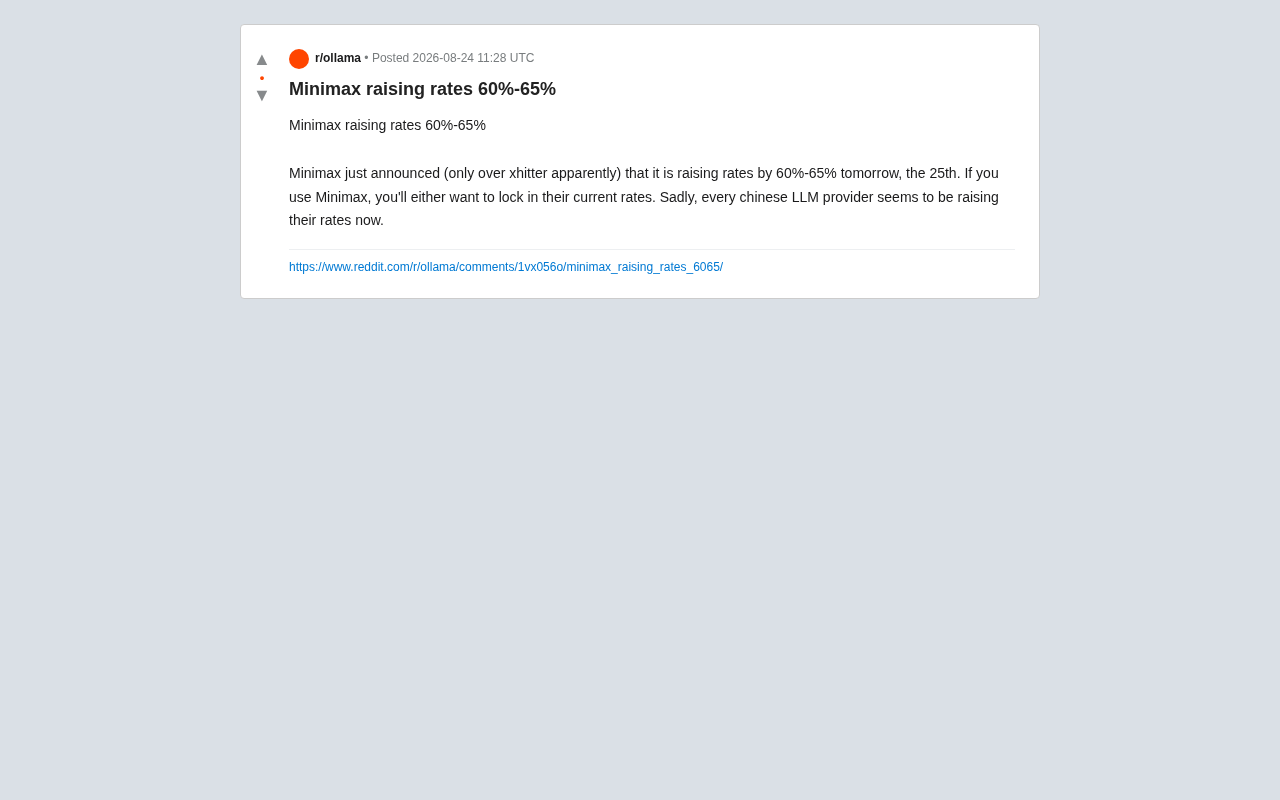
According to posts on Reddit, Chinese AI company MiniMax (MiniMax Technology) recently announced via X (formerly Twitter) that it will raise its API service prices by 60% to 65% starting from the 25th. The news, which has primarily spread through the company's overseas social media channels, has drawn widespread attention from the developer community.
For developers and businesses that rely on MiniMax models, this price adjustment is significant. Some community members have advised that if you're currently using MiniMax's services, you may want to consider locking in the current pricing before the increase takes effect to mitigate the impact of rising costs.
It's Not Just MiniMax: A Collective Price Hike Across Chinese LLM Providers
You may not have noticed, but this price increase isn't an isolated move by MiniMax. As the original Reddit post pointed out, "pretty much every Chinese LLM provider seems to be raising prices now." This signals that the nearly two-year-long "price war" among Chinese LLM providers may be reaching a turning point.
From Price War to Rational Pricing
Over the past two years, China's LLM market has experienced fierce price competition. Multiple providers raced to undercut each other, with some models' API call prices dropping to just a few cents per million tokens — a period widely described in the industry as a "subsidize losses to capture market share" battle.
While this strategy rapidly expanded user bases in the short term, it was never commercially sustainable in the long run. As capital markets grow more rational and compute cost pressures persist, providers are beginning to reassess their pricing strategies. Returning to price levels that cover costs and support R&D investment is a logical and inevitable business decision.
The Deeper Reasons Behind the Price Increases
The Reality of Compute and Operational Costs
The core cost of LLM inference services comes from GPU compute. Against a backdrop of constrained high-end AI chip supply and soaring energy and operations expenses, prolonged low-price strategies have been eroding providers' cash flow. As the funding environment tightens and investors demand clearer paths to profitability, raising prices becomes a direct lever for improving unit economics.
From "Grabbing Users" to "Retaining High-Value Users"
During the price war phase, the primary goal was to acquire as many users and API calls as possible. However, among the massive volume of low-cost or even free API calls, the proportion of customers with genuine willingness to pay and real commercial value was limited. By raising prices moderately, providers can filter for customers who have genuine demand for model capabilities and are willing to pay for value, thereby optimizing their revenue structure. This also explains why multiple providers are making similar decisions within the same time window — it's a cyclical, industry-wide adjustment.
Practical Impact on Developers and Businesses
Short-Term: Rising Operational Costs and Migration Pressure
A 60%-65% price hike translates to a significant increase in operating costs for high-volume applications. For AI application startups already operating on thin margins, this could directly challenge the viability of their business models. Strategies such as locking in existing prices, evaluating multi-provider setups, and optimizing call efficiency (e.g., caching, batching, prompt compression) become especially critical.
Long-Term: Reshaping the Market Landscape
The wave of price increases is actually a signal that the industry is transitioning from "wild growth" to "refined operations." For developers, this means:
- Building multi-model capabilities: Avoid over-reliance on a single provider and maintain flexibility in your tech stack;
- Focusing on cost-effectiveness rather than the absolute lowest price: Find the right balance among capability, latency, reliability, and price;
- Paying attention to open-source model solutions: As open-source models continue to improve, self-hosted deployments or open-source models may become an important option for controlling long-term costs.
Conclusion: The Beginning of the End for the Price War
MiniMax's price increase may be seen as a microcosm of China's LLM market entering a new phase. As subsidies recede, true competition will return to what really matters: model capability, engineering efficiency, and commercial value.
For developers and businesses navigating this shift, it's better to proactively build more resilient technical architectures and cost strategies than to passively absorb cost fluctuations. As AI infrastructure matures, rational pricing will inevitably replace destructive subsidies, becoming a necessary step toward healthy industry development.
(Note: This article is based on information from the Reddit community. For specific pricing details from MiniMax, please refer to their official announcements.)
Related articles

Workbuddy for Absolute Beginners: How a Desktop AI Agent Fits Into Real Workflows
A beginner's guide to the Workbuddy desktop AI agent: installation, claiming credits, file management, and building automated workflows—compared with CodeX for fit and cost, helping professionals shift from AI question-askers to AI managers.

OpenAI's New Agent Stack: Computer Use, Decisions API, and Ultra-Fast Workflows
OpenAI Dev Day unveiled a new agent stack: Computer Use outperforms humans, Decisions API delivers ultra-low-latency classification via Luna, Agents API opens the same Computer Use capabilities, and GPT-6.1 Sol costs only one-seventh of Astra. Core updates, benchmark data, and developer insights.

Liang Wenfeng Open-Sources DeepInfo Inference Framework, Takes On U.S. Ban
DeepSeek open-sources its DeepInfo inference framework after its models, featuring GPU/CPU cross-pipelining, small-model prediction with large-model verification, and full Huawei Ascend and NVIDIA chip support—facing the U.S. federal ban head-on. This article analyzes its significance for AI deployment and open-source strategy.